

224
6 Deep Learning and RFID System Physical Anti-Collision
We use the ADAM algorithm to optimize the cost function to minimize the cost
function.
We use four data sets to train MWCNN. The four datasets are Berkeley segmentation dataset (BSD) [11], DIV2K [15], Waterloo Exploration Database (WED) [16],
and the real degraded image set generated in the actual experimental scene. We
randomly extract 350 images from BSD, 1000 images from DIV2K, and 6000 images
from WED. For these randomly extracted images, we add motion blurs with different
blur lengths and angles to the images to generate simulated degraded images. In
addition, 500 degraded real images are selected from the data set of the actual scene.
The MWCNN model is learned for each degraded setting. The network parameters
are initialized based on the method described in [29]. We use the ADAM algorithm
[29] with α=0.01, β 1 =0.9, β 2 = 0.999, and ∈ =10
−8 for optimizing a minibatch size of 24. For other superparameters of ADAM, the default settings are taken.
During 40 epochs, the learning rate decays exponentially from 0.001 to 0.0001. We
train our MWCNN using the MatConvNet software package with cuDNN 9.0. All
experiments are performed in a MATLAB (R2016a) environment running on a PC
with an Intel(R) Core(TM) i7-7700HQ CPU 2.81 GHz and NVIDIA GTX 1050
GPU.
Since the images acquired by industrial cameras are generally grayscale images,
the network of this paper is only for grayscale images. After obtaining the denoiser
priors by MWCNN, the acquired denoiser priors are inserted into the model-based
Wiener filter to recover the image. The restored results are evaluated using PSNR
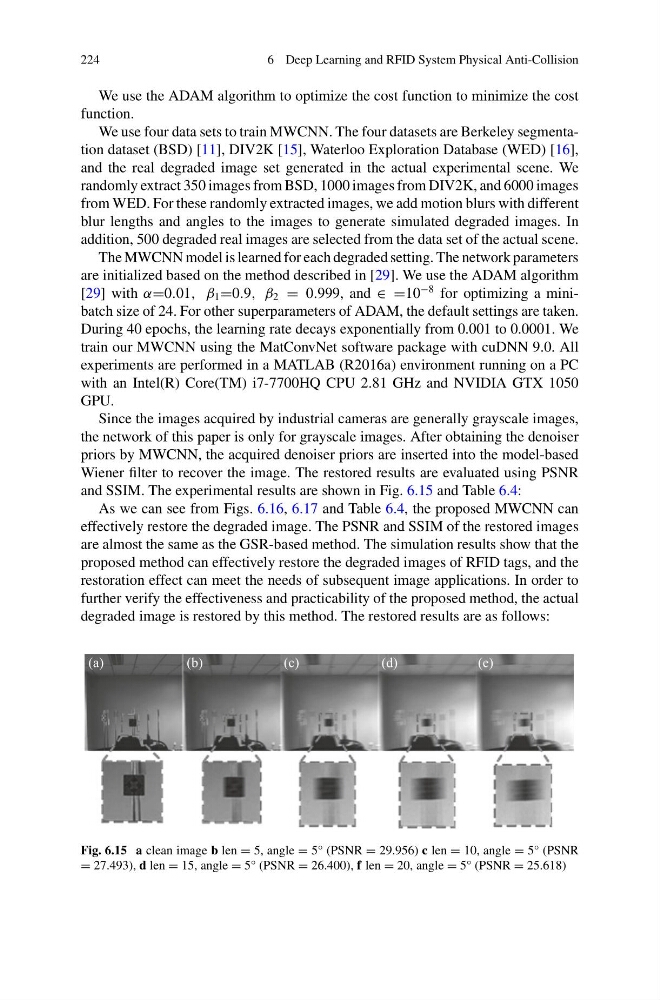
and SSIM. The experimental results are shown in Fig. 6.15 and Table 6.4:
As we can see from Figs. 6.16, 6.17 and Table 6.4, the proposed MWCNN can
effectively restore the degraded image. The PSNR and SSIM of the restored images
are almost the same as the GSR-based method. The simulation results show that the
proposed method can effectively restore the degraded images of RFID tags, and the
restoration effect can meet the needs of subsequent image applications. In order to
further verify the effectiveness and practicability of the proposed method, the actual
degraded image is restored by this method. The restored results are as follows:
Fig. 6.15 a clean image b len = 5, angle = 5° (PSNR = 29.956) c len = 10, angle = 5° (PSNR
= 27.493), d len = 15, angle = 5° (PSNR = 26.400), f len = 20, angle = 5° (PSNR = 25.618)
6 Deep Learning and RFID System Physical Anti-Collision
We use the ADAM algorithm to optimize the cost function to minimize the cost
function.
We use four data sets to train MWCNN. The four datasets are Berkeley segmentation dataset (BSD) [11], DIV2K [15], Waterloo Exploration Database (WED) [16],
and the real degraded image set generated in the actual experimental scene. We
randomly extract 350 images from BSD, 1000 images from DIV2K, and 6000 images
from WED. For these randomly extracted images, we add motion blurs with different
blur lengths and angles to the images to generate simulated degraded images. In
addition, 500 degraded real images are selected from the data set of the actual scene.
The MWCNN model is learned for each degraded setting. The network parameters
are initialized based on the method described in [29]. We use the ADAM algorithm
[29] with α=0.01, β 1 =0.9, β 2 = 0.999, and ∈ =10
−8 for optimizing a minibatch size of 24. For other superparameters of ADAM, the default settings are taken.
During 40 epochs, the learning rate decays exponentially from 0.001 to 0.0001. We
train our MWCNN using the MatConvNet software package with cuDNN 9.0. All
experiments are performed in a MATLAB (R2016a) environment running on a PC
with an Intel(R) Core(TM) i7-7700HQ CPU 2.81 GHz and NVIDIA GTX 1050
GPU.
Since the images acquired by industrial cameras are generally grayscale images,
the network of this paper is only for grayscale images. After obtaining the denoiser
priors by MWCNN, the acquired denoiser priors are inserted into the model-based
Wiener filter to recover the image. The restored results are evaluated using PSNR
and SSIM. The experimental results are shown in Fig. 6.15 and Table 6.4:
As we can see from Figs. 6.16, 6.17 and Table 6.4, the proposed MWCNN can
effectively restore the degraded image. The PSNR and SSIM of the restored images
are almost the same as the GSR-based method. The simulation results show that the
proposed method can effectively restore the degraded images of RFID tags, and the
restoration effect can meet the needs of subsequent image applications. In order to
further verify the effectiveness and practicability of the proposed method, the actual
degraded image is restored by this method. The restored results are as follows:
Fig. 6.15 a clean image b len = 5, angle = 5° (PSNR = 29.956) c len = 10, angle = 5° (PSNR
= 27.493), d len = 15, angle = 5° (PSNR = 26.400), f len = 20, angle = 5° (PSNR = 25.618)