

194
5 Optimization Algorithm and RFID System Physical Anti-Collision
y(k) =
l
i=1
ω ik h(i) k = 1, 2, . . . .., m
(5.49)
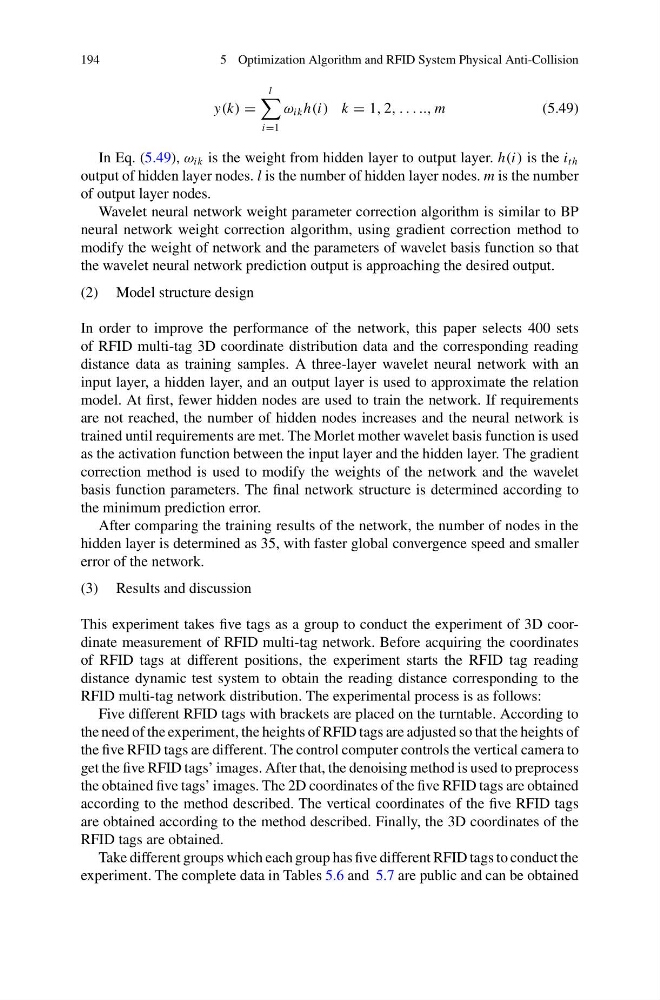
In Eq. (5.49), ω ik is the weight from hidden layer to output layer. h(i) is the i th
output of hidden layer nodes. l is the number of hidden layer nodes. m is the number
of output layer nodes.
Wavelet neural network weight parameter correction algorithm is similar to BP
neural network weight correction algorithm, using gradient correction method to
modify the weight of network and the parameters of wavelet basis function so that
the wavelet neural network prediction output is approaching the desired output.
(2) Model structure design
In order to improve the performance of the network, this paper selects 400 sets
of RFID multi-tag 3D coordinate distribution data and the corresponding reading
distance data as training samples. A three-layer wavelet neural network with an
input layer, a hidden layer, and an output layer is used to approximate the relation
model. At first, fewer hidden nodes are used to train the network. If requirements
are not reached, the number of hidden nodes increases and the neural network is
trained until requirements are met. The Morlet mother wavelet basis function is used
as the activation function between the input layer and the hidden layer. The gradient
correction method is used to modify the weights of the network and the wavelet
basis function parameters. The final network structure is determined according to
the minimum prediction error.
After comparing the training results of the network, the number of nodes in the
hidden layer is determined as 35, with faster global convergence speed and smaller
error of the network.
(3) Results and discussion
This experiment takes five tags as a group to conduct the experiment of 3D coordinate measurement of RFID multi-tag network. Before acquiring the coordinates
of RFID tags at different positions, the experiment starts the RFID tag reading
distance dynamic test system to obtain the reading distance corresponding to the
RFID multi-tag network distribution. The experimental process is as follows:
Five different RFID tags with brackets are placed on the turntable. According to
the need of the experiment, the heights of RFID tags are adjusted so that the heights of
the five RFID tags are different. The control computer controls the vertical camera to
get the five RFID tags’ images. After that, the denoising method is used to preprocess
the obtained five tags’ images. The 2D coordinates of the five RFID tags are obtained
according to the method described. The vertical coordinates of the five RFID tags
are obtained according to the method described. Finally, the 3D coordinates of the
RFID tags are obtained.
Take different groups which each group has five different RFID tags to conduct the
experiment. The complete data in Tables 5.6 and 5.7 are public and can be obtained
5 Optimization Algorithm and RFID System Physical Anti-Collision
y(k) =
l
i=1
ω ik h(i) k = 1, 2, . . . .., m
(5.49)
In Eq. (5.49), ω ik is the weight from hidden layer to output layer. h(i) is the i th
output of hidden layer nodes. l is the number of hidden layer nodes. m is the number
of output layer nodes.
Wavelet neural network weight parameter correction algorithm is similar to BP
neural network weight correction algorithm, using gradient correction method to
modify the weight of network and the parameters of wavelet basis function so that
the wavelet neural network prediction output is approaching the desired output.
(2) Model structure design
In order to improve the performance of the network, this paper selects 400 sets
of RFID multi-tag 3D coordinate distribution data and the corresponding reading
distance data as training samples. A three-layer wavelet neural network with an
input layer, a hidden layer, and an output layer is used to approximate the relation
model. At first, fewer hidden nodes are used to train the network. If requirements
are not reached, the number of hidden nodes increases and the neural network is
trained until requirements are met. The Morlet mother wavelet basis function is used
as the activation function between the input layer and the hidden layer. The gradient
correction method is used to modify the weights of the network and the wavelet
basis function parameters. The final network structure is determined according to
the minimum prediction error.
After comparing the training results of the network, the number of nodes in the
hidden layer is determined as 35, with faster global convergence speed and smaller
error of the network.
(3) Results and discussion
This experiment takes five tags as a group to conduct the experiment of 3D coordinate measurement of RFID multi-tag network. Before acquiring the coordinates
of RFID tags at different positions, the experiment starts the RFID tag reading
distance dynamic test system to obtain the reading distance corresponding to the
RFID multi-tag network distribution. The experimental process is as follows:
Five different RFID tags with brackets are placed on the turntable. According to
the need of the experiment, the heights of RFID tags are adjusted so that the heights of
the five RFID tags are different. The control computer controls the vertical camera to
get the five RFID tags’ images. After that, the denoising method is used to preprocess
the obtained five tags’ images. The 2D coordinates of the five RFID tags are obtained
according to the method described. The vertical coordinates of the five RFID tags
are obtained according to the method described. Finally, the 3D coordinates of the
RFID tags are obtained.
Take different groups which each group has five different RFID tags to conduct the
experiment. The complete data in Tables 5.6 and 5.7 are public and can be obtained