

5.1 Physical anti-Collision based on Particle Swarm Optimization (PSO)
171
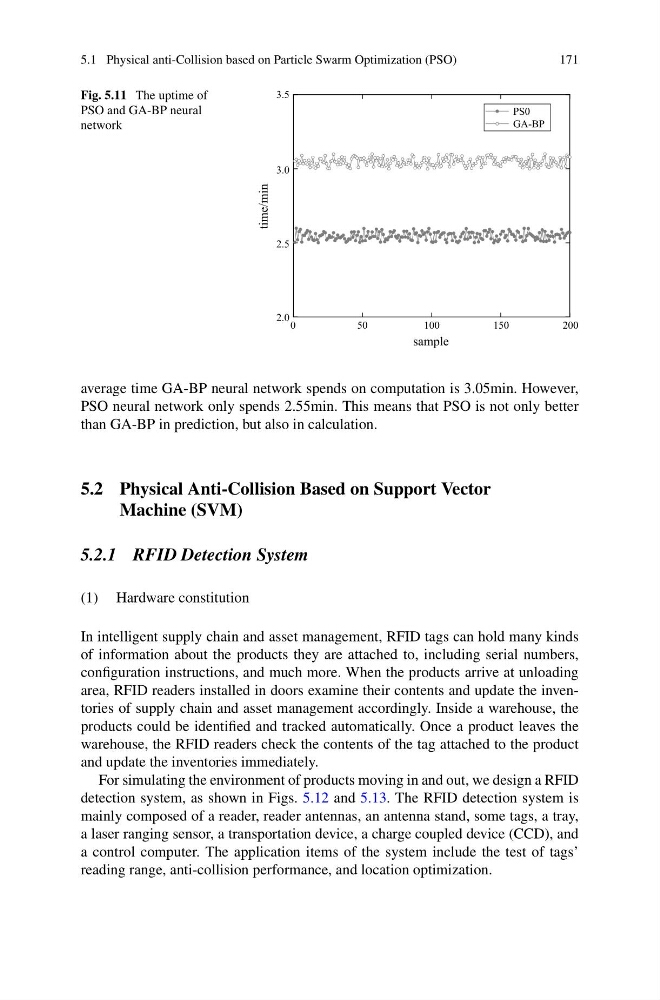
Fig. 5.11 The uptime of
PSO and GA-BP neural
network
average time GA-BP neural network spends on computation is 3.05min. However,
PSO neural network only spends 2.55min. This means that PSO is not only better
than GA-BP in prediction, but also in calculation.
5.2 Physical Anti-Collision Based on Support Vector
Machine (SVM)
5.2.1 RFID Detection System
(1) Hardware constitution
In intelligent supply chain and asset management, RFID tags can hold many kinds
of information about the products they are attached to, including serial numbers,
configuration instructions, and much more. When the products arrive at unloading
area, RFID readers installed in doors examine their contents and update the inventories of supply chain and asset management accordingly. Inside a warehouse, the
products could be identified and tracked automatically. Once a product leaves the
warehouse, the RFID readers check the contents of the tag attached to the product
and update the inventories immediately.
For simulating the environment of products moving in and out, we design a RFID
detection system, as shown in Figs. 5.12 and 5.13. The RFID detection system is
mainly composed of a reader, reader antennas, an antenna stand, some tags, a tray,
a laser ranging sensor, a transportation device, a charge coupled device (CCD), and
a control computer. The application items of the system include the test of tags’
reading range, anti-collision performance, and location optimization.
171
Fig. 5.11 The uptime of
PSO and GA-BP neural
network
average time GA-BP neural network spends on computation is 3.05min. However,
PSO neural network only spends 2.55min. This means that PSO is not only better
than GA-BP in prediction, but also in calculation.
5.2 Physical Anti-Collision Based on Support Vector
Machine (SVM)
5.2.1 RFID Detection System
(1) Hardware constitution
In intelligent supply chain and asset management, RFID tags can hold many kinds
of information about the products they are attached to, including serial numbers,
configuration instructions, and much more. When the products arrive at unloading
area, RFID readers installed in doors examine their contents and update the inventories of supply chain and asset management accordingly. Inside a warehouse, the
products could be identified and tracked automatically. Once a product leaves the
warehouse, the RFID readers check the contents of the tag attached to the product
and update the inventories immediately.
For simulating the environment of products moving in and out, we design a RFID
detection system, as shown in Figs. 5.12 and 5.13. The RFID detection system is
mainly composed of a reader, reader antennas, an antenna stand, some tags, a tray,
a laser ranging sensor, a transportation device, a charge coupled device (CCD), and
a control computer. The application items of the system include the test of tags’
reading range, anti-collision performance, and location optimization.