

5.1 Physical anti-Collision based on Particle Swarm Optimization (PSO)
167
follows:
I (X (t)) =
1
M N
M
j=1
N
i=1
[X i j (t) − X
(t)]
2
(5.13)
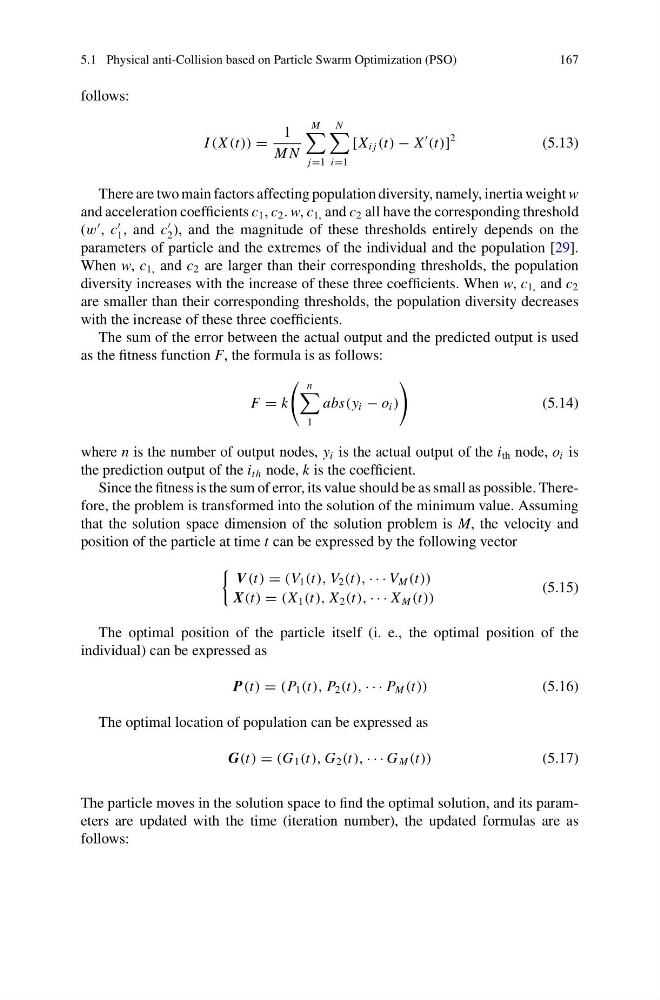
There are two main factors affecting population diversity, namely, inertia weight w
and acceleration coefficients c 1 , c 2 . w, c 1, and c 2 all have the corresponding threshold
(w
, c
1 , and c
2 ), and the magnitude of these thresholds entirely depends on the
parameters of particle and the extremes of the individual and the population [29].
When w, c 1, and c 2 are larger than their corresponding thresholds, the population
diversity increases with the increase of these three coefficients. When w, c 1, and c 2
are smaller than their corresponding thresholds, the population diversity decreases
with the increase of these three coefficients.
The sum of the error between the actual output and the predicted output is used
as the fitness function F, the formula is as follows:
F = k
n
1
abs(y i − o i )
(5.14)
where n is the number of output nodes, y i is the actual output of the i th node, o i is
the prediction output of the i th node, k is the coefficient.
Since the fitness is the sum of error, its value should be as small as possible. Therefore, the problem is transformed into the solution of the minimum value. Assuming
that the solution space dimension of the solution problem is M, the velocity and
position of the particle at time t can be expressed by the following vector
V (t) = (V 1 (t), V 2 (t), · · · V M (t))
X(t) = (X 1 (t), X 2 (t), · · · X M (t))
(5.15)
The optimal position of the particle itself (i. e., the optimal position of the
individual) can be expressed as
P(t) = (P 1 (t), P 2 (t), · · · P M (t))
(5.16)
The optimal location of population can be expressed as
G(t) = (G 1 (t), G 2 (t), · · · G M (t))
(5.17)
The particle moves in the solution space to find the optimal solution, and its parameters are updated with the time (iteration number), the updated formulas are as
follows:
167
follows:
I (X (t)) =
1
M N
M
j=1
N
i=1
[X i j (t) − X
(t)]
2
(5.13)
There are two main factors affecting population diversity, namely, inertia weight w
and acceleration coefficients c 1 , c 2 . w, c 1, and c 2 all have the corresponding threshold
(w
, c
1 , and c
2 ), and the magnitude of these thresholds entirely depends on the
parameters of particle and the extremes of the individual and the population [29].
When w, c 1, and c 2 are larger than their corresponding thresholds, the population
diversity increases with the increase of these three coefficients. When w, c 1, and c 2
are smaller than their corresponding thresholds, the population diversity decreases
with the increase of these three coefficients.
The sum of the error between the actual output and the predicted output is used
as the fitness function F, the formula is as follows:
F = k
n
1
abs(y i − o i )
(5.14)
where n is the number of output nodes, y i is the actual output of the i th node, o i is
the prediction output of the i th node, k is the coefficient.
Since the fitness is the sum of error, its value should be as small as possible. Therefore, the problem is transformed into the solution of the minimum value. Assuming
that the solution space dimension of the solution problem is M, the velocity and
position of the particle at time t can be expressed by the following vector
V (t) = (V 1 (t), V 2 (t), · · · V M (t))
X(t) = (X 1 (t), X 2 (t), · · · X M (t))
(5.15)
The optimal position of the particle itself (i. e., the optimal position of the
individual) can be expressed as
P(t) = (P 1 (t), P 2 (t), · · · P M (t))
(5.16)
The optimal location of population can be expressed as
G(t) = (G 1 (t), G 2 (t), · · · G M (t))
(5.17)
The particle moves in the solution space to find the optimal solution, and its parameters are updated with the time (iteration number), the updated formulas are as
follows: