

5.1 Physical anti-Collision based on Particle Swarm Optimization (PSO)
161
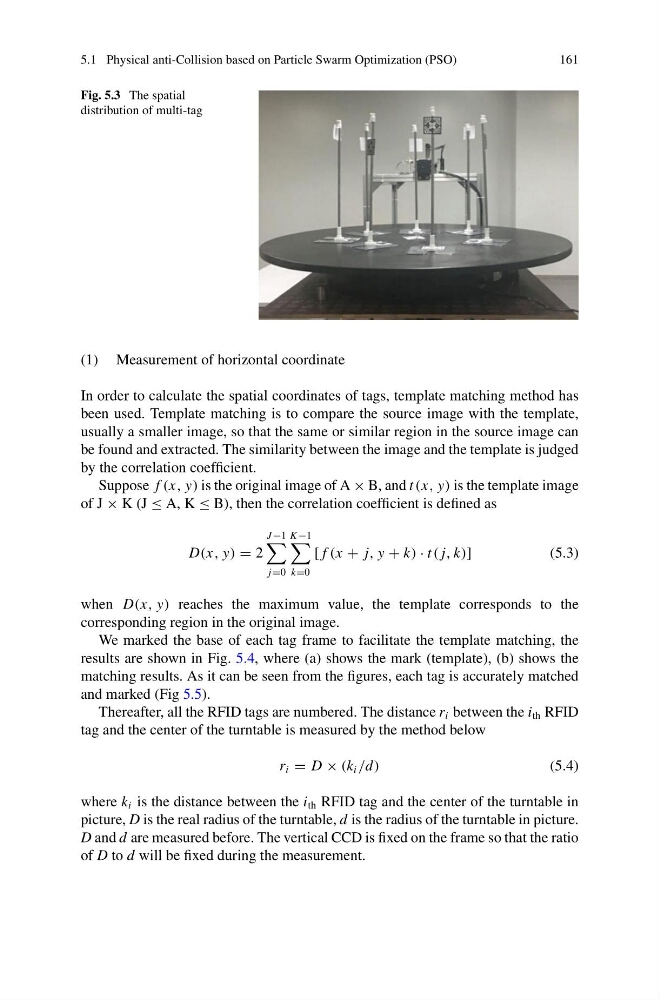
Fig. 5.3 The spatial
distribution of multi-tag
(1) Measurement of horizontal coordinate
In order to calculate the spatial coordinates of tags, template matching method has
been used. Template matching is to compare the source image with the template,
usually a smaller image, so that the same or similar region in the source image can
be found and extracted. The similarity between the image and the template is judged
by the correlation coefficient.
Suppose f (x, y) is the original image of A × B, and t (x, y) is the template image
of J × K (J ≤ A, K ≤ B), then the correlation coefficient is defined as
D(x, y) = 2
J −1
j=0
K −1
k=0
[ f (x + j, y + k) · t ( j, k)]
(5.3)
when D(x, y) reaches the maximum value, the template corresponds to the
corresponding region in the original image.
We marked the base of each tag frame to facilitate the template matching, the
results are shown in Fig. 5.4, where (a) shows the mark (template), (b) shows the
matching results. As it can be seen from the figures, each tag is accurately matched
and marked (Fig 5.5).
Thereafter, all the RFID tags are numbered. The distance r i between the i th RFID
tag and the center of the turntable is measured by the method below
r i = D × (k i /d)
(5.4)
where k i is the distance between the i th RFID tag and the center of the turntable in
picture, D is the real radius of the turntable, d is the radius of the turntable in picture.
D and d are measured before. The vertical CCD is fixed on the frame so that the ratio
of D to d will be fixed during the measurement.
161
Fig. 5.3 The spatial
distribution of multi-tag
(1) Measurement of horizontal coordinate
In order to calculate the spatial coordinates of tags, template matching method has
been used. Template matching is to compare the source image with the template,
usually a smaller image, so that the same or similar region in the source image can
be found and extracted. The similarity between the image and the template is judged
by the correlation coefficient.
Suppose f (x, y) is the original image of A × B, and t (x, y) is the template image
of J × K (J ≤ A, K ≤ B), then the correlation coefficient is defined as
D(x, y) = 2
J −1
j=0
K −1
k=0
[ f (x + j, y + k) · t ( j, k)]
(5.3)
when D(x, y) reaches the maximum value, the template corresponds to the
corresponding region in the original image.
We marked the base of each tag frame to facilitate the template matching, the
results are shown in Fig. 5.4, where (a) shows the mark (template), (b) shows the
matching results. As it can be seen from the figures, each tag is accurately matched
and marked (Fig 5.5).
Thereafter, all the RFID tags are numbered. The distance r i between the i th RFID
tag and the center of the turntable is measured by the method below
r i = D × (k i /d)
(5.4)
where k i is the distance between the i th RFID tag and the center of the turntable in
picture, D is the real radius of the turntable, d is the radius of the turntable in picture.
D and d are measured before. The vertical CCD is fixed on the frame so that the ratio
of D to d will be fixed during the measurement.