

4.5 Novel Reverse Design Method of Tag Antenna Based on Image Analysis
141
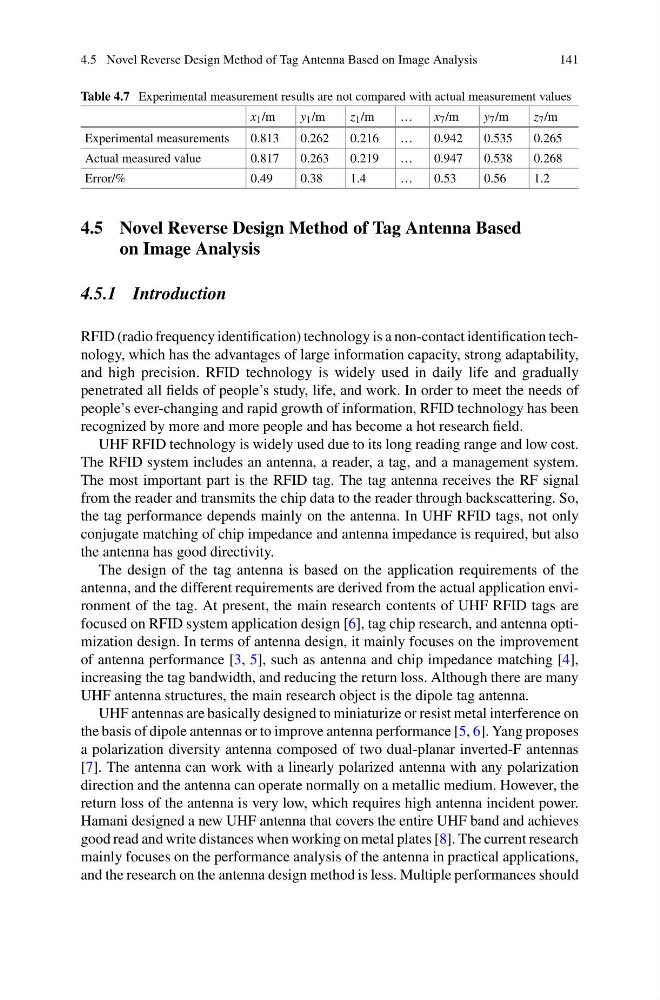
Table 4.7 Experimental measurement results are not compared with actual measurement values
x 1 /m
y 1 /m
z 1 /m
…
x 7 /m
y 7 /m
z 7 /m
Experimental measurements
0.813
0.262
0.216
…
0.942
0.535
0.265
Actual measured value
0.817
0.263
0.219
…
0.947
0.538
0.268
Error/%
0.49
0.38
1.4
…
0.53
0.56
1.2
4.5 Novel Reverse Design Method of Tag Antenna Based
on Image Analysis
4.5.1 Introduction
RFID (radio frequency identification) technology is a non-contact identification technology, which has the advantages of large information capacity, strong adaptability,
and high precision. RFID technology is widely used in daily life and gradually
penetrated all fields of people’s study, life, and work. In order to meet the needs of
people’s ever-changing and rapid growth of information, RFID technology has been
recognized by more and more people and has become a hot research field.
UHF RFID technology is widely used due to its long reading range and low cost.
The RFID system includes an antenna, a reader, a tag, and a management system.
The most important part is the RFID tag. The tag antenna receives the RF signal
from the reader and transmits the chip data to the reader through backscattering. So,
the tag performance depends mainly on the antenna. In UHF RFID tags, not only
conjugate matching of chip impedance and antenna impedance is required, but also
the antenna has good directivity.
The design of the tag antenna is based on the application requirements of the
antenna, and the different requirements are derived from the actual application environment of the tag. At present, the main research contents of UHF RFID tags are
focused on RFID system application design [6], tag chip research, and antenna optimization design. In terms of antenna design, it mainly focuses on the improvement
of antenna performance [3, 5], such as antenna and chip impedance matching [4],
increasing the tag bandwidth, and reducing the return loss. Although there are many
UHF antenna structures, the main research object is the dipole tag antenna.
UHF antennas are basically designed to miniaturize or resist metal interference on
the basis of dipole antennas or to improve antenna performance [5, 6]. Yang proposes
a polarization diversity antenna composed of two dual-planar inverted-F antennas
[7]. The antenna can work with a linearly polarized antenna with any polarization
direction and the antenna can operate normally on a metallic medium. However, the
return loss of the antenna is very low, which requires high antenna incident power.
Hamani designed a new UHF antenna that covers the entire UHF band and achieves
good read and write distances when working on metal plates [8]. The current research
mainly focuses on the performance analysis of the antenna in practical applications,
and the research on the antenna design method is less. Multiple performances should
141
Table 4.7 Experimental measurement results are not compared with actual measurement values
x 1 /m
y 1 /m
z 1 /m
…
x 7 /m
y 7 /m
z 7 /m
Experimental measurements
0.813
0.262
0.216
…
0.942
0.535
0.265
Actual measured value
0.817
0.263
0.219
…
0.947
0.538
0.268
Error/%
0.49
0.38
1.4
…
0.53
0.56
1.2
4.5 Novel Reverse Design Method of Tag Antenna Based
on Image Analysis
4.5.1 Introduction
RFID (radio frequency identification) technology is a non-contact identification technology, which has the advantages of large information capacity, strong adaptability,
and high precision. RFID technology is widely used in daily life and gradually
penetrated all fields of people’s study, life, and work. In order to meet the needs of
people’s ever-changing and rapid growth of information, RFID technology has been
recognized by more and more people and has become a hot research field.
UHF RFID technology is widely used due to its long reading range and low cost.
The RFID system includes an antenna, a reader, a tag, and a management system.
The most important part is the RFID tag. The tag antenna receives the RF signal
from the reader and transmits the chip data to the reader through backscattering. So,
the tag performance depends mainly on the antenna. In UHF RFID tags, not only
conjugate matching of chip impedance and antenna impedance is required, but also
the antenna has good directivity.
The design of the tag antenna is based on the application requirements of the
antenna, and the different requirements are derived from the actual application environment of the tag. At present, the main research contents of UHF RFID tags are
focused on RFID system application design [6], tag chip research, and antenna optimization design. In terms of antenna design, it mainly focuses on the improvement
of antenna performance [3, 5], such as antenna and chip impedance matching [4],
increasing the tag bandwidth, and reducing the return loss. Although there are many
UHF antenna structures, the main research object is the dipole tag antenna.
UHF antennas are basically designed to miniaturize or resist metal interference on
the basis of dipole antennas or to improve antenna performance [5, 6]. Yang proposes
a polarization diversity antenna composed of two dual-planar inverted-F antennas
[7]. The antenna can work with a linearly polarized antenna with any polarization
direction and the antenna can operate normally on a metallic medium. However, the
return loss of the antenna is very low, which requires high antenna incident power.
Hamani designed a new UHF antenna that covers the entire UHF band and achieves
good read and write distances when working on metal plates [8]. The current research
mainly focuses on the performance analysis of the antenna in practical applications,
and the research on the antenna design method is less. Multiple performances should