

130
4 Image Theory of RFID System Physical Anti-Collision
image matching technology, there is also the problem of optimization of perceptual
excitation.
Image matching techniques can be divided into two categories. The first aspect
is the image representation method, and the second aspect is to define an appropriate similarity metric to compare the images in the selected representation space.
Different representations and similarity measures are introduced in image matching
technology, and in particular, image representations are also selected for each application. However, finding the appropriate similarity measure will make the problem
more complicated.
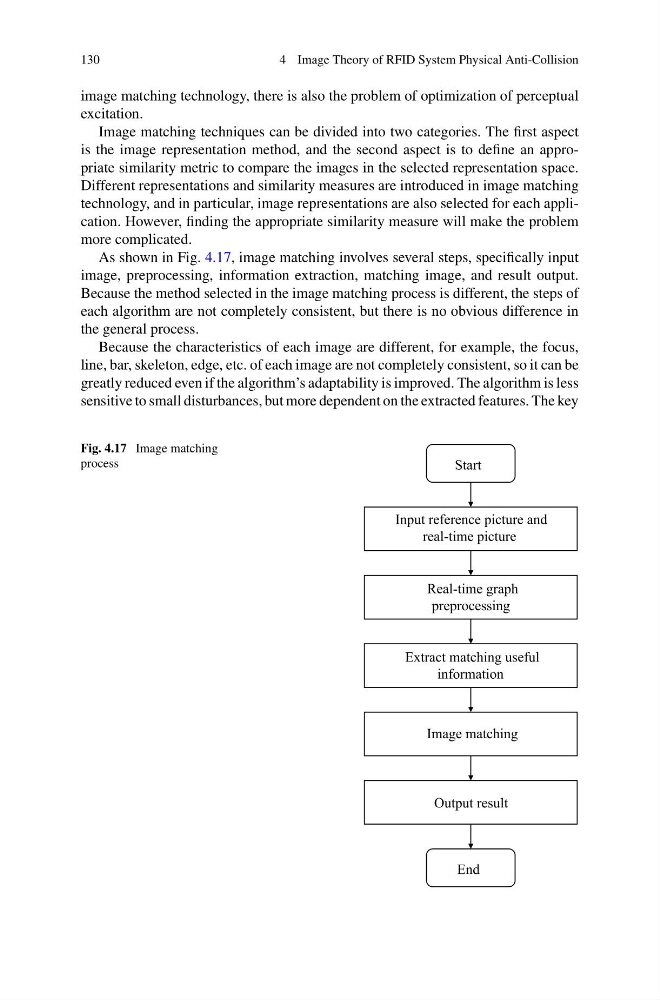
As shown in Fig. 4.17, image matching involves several steps, specifically input
image, preprocessing, information extraction, matching image, and result output.
Because the method selected in the image matching process is different, the steps of
each algorithm are not completely consistent, but there is no obvious difference in
the general process.
Because the characteristics of each image are different, for example, the focus,
line, bar, skeleton, edge, etc. of each image are not completely consistent, so it can be
greatly reduced even if the algorithm’s adaptability is improved. The algorithm is less
sensitive to small disturbances, but more dependent on the extracted features. The key
Fig. 4.17 Image matching
process
4 Image Theory of RFID System Physical Anti-Collision
image matching technology, there is also the problem of optimization of perceptual
excitation.
Image matching techniques can be divided into two categories. The first aspect
is the image representation method, and the second aspect is to define an appropriate similarity metric to compare the images in the selected representation space.
Different representations and similarity measures are introduced in image matching
technology, and in particular, image representations are also selected for each application. However, finding the appropriate similarity measure will make the problem
more complicated.
As shown in Fig. 4.17, image matching involves several steps, specifically input
image, preprocessing, information extraction, matching image, and result output.
Because the method selected in the image matching process is different, the steps of
each algorithm are not completely consistent, but there is no obvious difference in
the general process.
Because the characteristics of each image are different, for example, the focus,
line, bar, skeleton, edge, etc. of each image are not completely consistent, so it can be
greatly reduced even if the algorithm’s adaptability is improved. The algorithm is less
sensitive to small disturbances, but more dependent on the extracted features. The key
Fig. 4.17 Image matching
process