

4.2 Image Processing in Multi-tag Movement
129
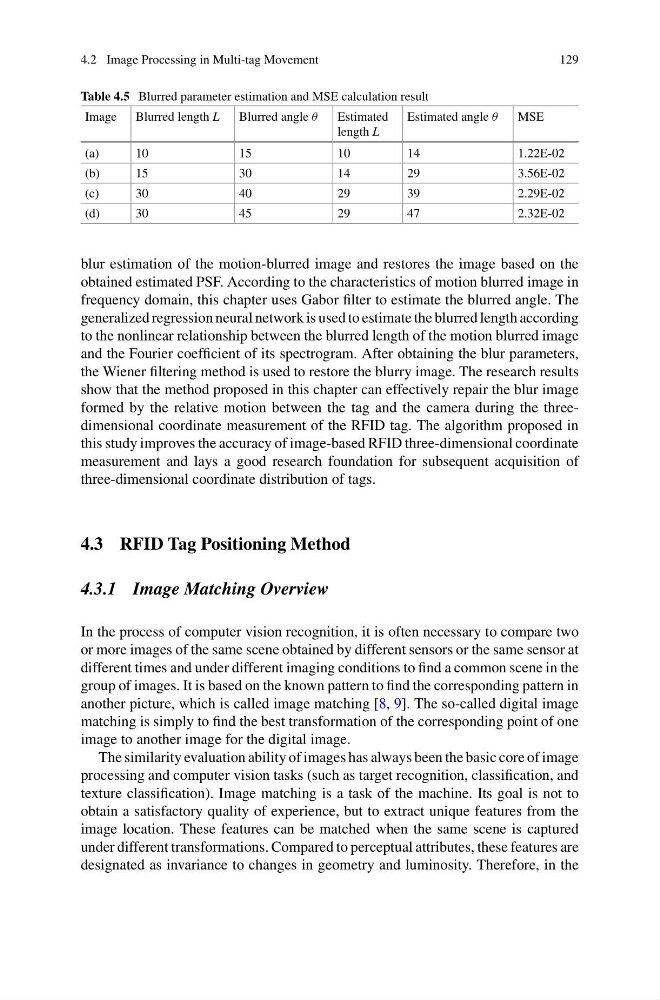
Table 4.5 Blurred parameter estimation and MSE calculation result
Image Blurred length L
Blurred angle θ
Estimated
length L
Estimated angle θ
MSE
(a)
10
15
10
14
1.22E-02
(b)
15
30
14
29
3.56E-02
(c)
30
40
29
39
2.29E-02
(d)
30
45
29
47
2.32E-02
blur estimation of the motion-blurred image and restores the image based on the
obtained estimated PSF. According to the characteristics of motion blurred image in
frequency domain, this chapter uses Gabor filter to estimate the blurred angle. The
generalized regression neural network is used to estimate the blurred length according
to the nonlinear relationship between the blurred length of the motion blurred image
and the Fourier coefficient of its spectrogram. After obtaining the blur parameters,
the Wiener filtering method is used to restore the blurry image. The research results
show that the method proposed in this chapter can effectively repair the blur image
formed by the relative motion between the tag and the camera during the threedimensional coordinate measurement of the RFID tag. The algorithm proposed in
this study improves the accuracy of image-based RFID three-dimensional coordinate
measurement and lays a good research foundation for subsequent acquisition of
three-dimensional coordinate distribution of tags.
4.3 RFID Tag Positioning Method
4.3.1 Image Matching Overview
In the process of computer vision recognition, it is often necessary to compare two
or more images of the same scene obtained by different sensors or the same sensor at
different times and under different imaging conditions to find a common scene in the
group of images. It is based on the known pattern to find the corresponding pattern in
another picture, which is called image matching [8, 9]. The so-called digital image
matching is simply to find the best transformation of the corresponding point of one
image to another image for the digital image.
The similarity evaluation ability of images has always been the basic core of image
processing and computer vision tasks (such as target recognition, classification, and
texture classification). Image matching is a task of the machine. Its goal is not to
obtain a satisfactory quality of experience, but to extract unique features from the
image location. These features can be matched when the same scene is captured
under different transformations. Compared to perceptual attributes, these features are
designated as invariance to changes in geometry and luminosity. Therefore, in the
129
Table 4.5 Blurred parameter estimation and MSE calculation result
Image Blurred length L
Blurred angle θ
Estimated
length L
Estimated angle θ
MSE
(a)
10
15
10
14
1.22E-02
(b)
15
30
14
29
3.56E-02
(c)
30
40
29
39
2.29E-02
(d)
30
45
29
47
2.32E-02
blur estimation of the motion-blurred image and restores the image based on the
obtained estimated PSF. According to the characteristics of motion blurred image in
frequency domain, this chapter uses Gabor filter to estimate the blurred angle. The
generalized regression neural network is used to estimate the blurred length according
to the nonlinear relationship between the blurred length of the motion blurred image
and the Fourier coefficient of its spectrogram. After obtaining the blur parameters,
the Wiener filtering method is used to restore the blurry image. The research results
show that the method proposed in this chapter can effectively repair the blur image
formed by the relative motion between the tag and the camera during the threedimensional coordinate measurement of the RFID tag. The algorithm proposed in
this study improves the accuracy of image-based RFID three-dimensional coordinate
measurement and lays a good research foundation for subsequent acquisition of
three-dimensional coordinate distribution of tags.
4.3 RFID Tag Positioning Method
4.3.1 Image Matching Overview
In the process of computer vision recognition, it is often necessary to compare two
or more images of the same scene obtained by different sensors or the same sensor at
different times and under different imaging conditions to find a common scene in the
group of images. It is based on the known pattern to find the corresponding pattern in
another picture, which is called image matching [8, 9]. The so-called digital image
matching is simply to find the best transformation of the corresponding point of one
image to another image for the digital image.
The similarity evaluation ability of images has always been the basic core of image
processing and computer vision tasks (such as target recognition, classification, and
texture classification). Image matching is a task of the machine. Its goal is not to
obtain a satisfactory quality of experience, but to extract unique features from the
image location. These features can be matched when the same scene is captured
under different transformations. Compared to perceptual attributes, these features are
designated as invariance to changes in geometry and luminosity. Therefore, in the