

100
3 Physical Theory of RFID System Physical Anti-Collision
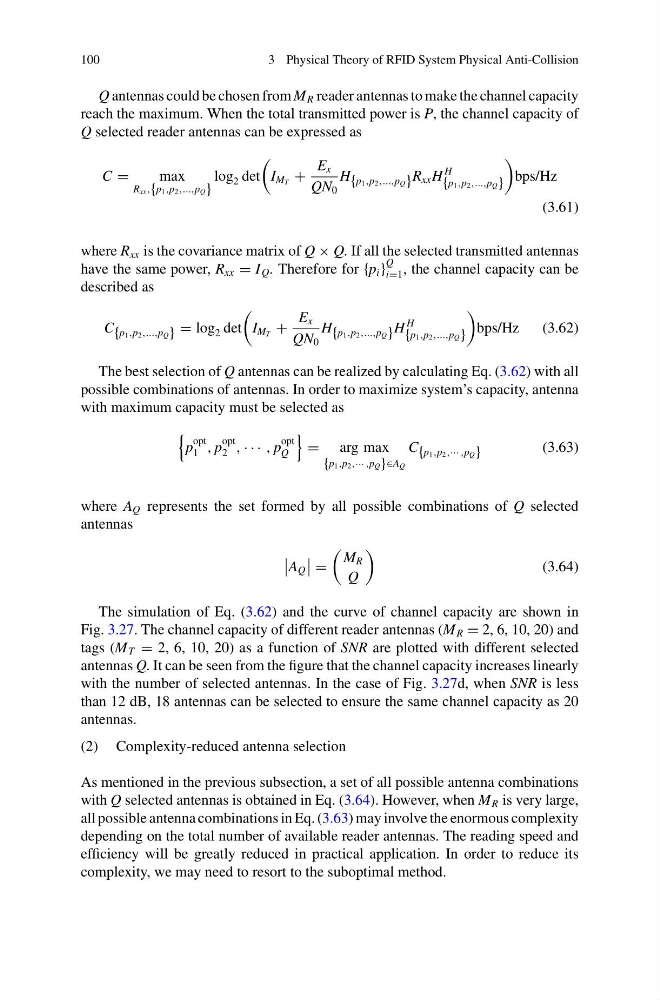
Q antennas could be chosen from M R reader antennas to make the channel capacity
reach the maximum. When the total transmitted power is P, the channel capacity of
Q selected reader antennas can be expressed as
C =
max
R xx ,{p 1 ,p 2 ,...,p Q }
log 2 det
I M T +
E x
QN 0
H {p1,p2,...,pQ} R xx H
H
{p1,p2,...,pQ}
bps/Hz
(3.61)
where R xx is the covariance matrix of Q × Q. If all the selected transmitted antennas
have the same power, R xx = I Q . Therefore for {p i }
Q
i=1 , the channel capacity can be
described as
C {p1,p2,...,pQ} = log 2 det
I M T +
E x
QN 0
H {p1,p2,...,pQ} H
H
{p1,p2,...,pQ}
bps/Hz
(3.62)
The best selection of Q antennas can be realized by calculating Eq. (3.62) with all
possible combinations of antennas. In order to maximize system’s capacity, antenna
with maximum capacity must be selected as
p
opt
1 , p
opt
2 , · · · , p
opt
Q
= arg max
{p1,p2,··· ,p Q }∈AQ
C {p1,p2,··· ,p Q }
(3.63)
where A Q represents the set formed by all possible combinations of Q selected
antennas
A Q
=
M R
Q
(3.64)
The simulation of Eq. (3.62) and the curve of channel capacity are shown in
Fig. 3.27. The channel capacity of different reader antennas (M R = 2, 6, 10, 20) and
tags (M T = 2, 6, 10, 20) as a function of SNR are plotted with different selected
antennas Q. It can be seen from the figure that the channel capacity increases linearly
with the number of selected antennas. In the case of Fig. 3.27d, when SNR is less
than 12 dB, 18 antennas can be selected to ensure the same channel capacity as 20
antennas.
(2) Complexity-reduced antenna selection
As mentioned in the previous subsection, a set of all possible antenna combinations
with Q selected antennas is obtained in Eq. (3.64). However, when M R is very large,
all possible antenna combinations in Eq. (3.63) may involve the enormous complexity
depending on the total number of available reader antennas. The reading speed and
efficiency will be greatly reduced in practical application. In order to reduce its
complexity, we may need to resort to the suboptimal method.
3 Physical Theory of RFID System Physical Anti-Collision
Q antennas could be chosen from M R reader antennas to make the channel capacity
reach the maximum. When the total transmitted power is P, the channel capacity of
Q selected reader antennas can be expressed as
C =
max
R xx ,{p 1 ,p 2 ,...,p Q }
log 2 det
I M T +
E x
QN 0
H {p1,p2,...,pQ} R xx H
H
{p1,p2,...,pQ}
bps/Hz
(3.61)
where R xx is the covariance matrix of Q × Q. If all the selected transmitted antennas
have the same power, R xx = I Q . Therefore for {p i }
Q
i=1 , the channel capacity can be
described as
C {p1,p2,...,pQ} = log 2 det
I M T +
E x
QN 0
H {p1,p2,...,pQ} H
H
{p1,p2,...,pQ}
bps/Hz
(3.62)
The best selection of Q antennas can be realized by calculating Eq. (3.62) with all
possible combinations of antennas. In order to maximize system’s capacity, antenna
with maximum capacity must be selected as
p
opt
1 , p
opt
2 , · · · , p
opt
Q
= arg max
{p1,p2,··· ,p Q }∈AQ
C {p1,p2,··· ,p Q }
(3.63)
where A Q represents the set formed by all possible combinations of Q selected
antennas
A Q
=
M R
Q
(3.64)
The simulation of Eq. (3.62) and the curve of channel capacity are shown in
Fig. 3.27. The channel capacity of different reader antennas (M R = 2, 6, 10, 20) and
tags (M T = 2, 6, 10, 20) as a function of SNR are plotted with different selected
antennas Q. It can be seen from the figure that the channel capacity increases linearly
with the number of selected antennas. In the case of Fig. 3.27d, when SNR is less
than 12 dB, 18 antennas can be selected to ensure the same channel capacity as 20
antennas.
(2) Complexity-reduced antenna selection
As mentioned in the previous subsection, a set of all possible antenna combinations
with Q selected antennas is obtained in Eq. (3.64). However, when M R is very large,
all possible antenna combinations in Eq. (3.63) may involve the enormous complexity
depending on the total number of available reader antennas. The reading speed and
efficiency will be greatly reduced in practical application. In order to reduce its
complexity, we may need to resort to the suboptimal method.