

502
13 Preparation of Nanoporous Oxides from Metals by Electrochemical …
was obtained as being invariant with the anodization time [240], the stress caused by
the oxygen bubbles and their release may lead to a periodically thinned wall structure
[237]. To overcome this difficulty, anodization voltage as low as 2 V was suggested.
13.9 Anodization of Alloys
13.9.1 Binary Alloys with Components that Form Regular
Anodized Nanostructures
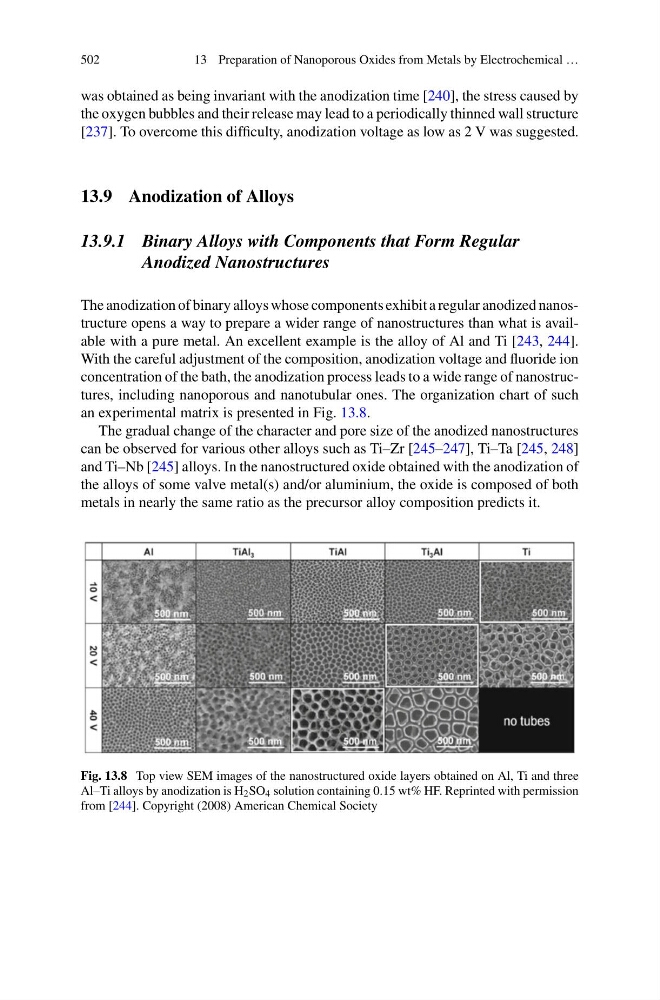
The anodization of binary alloys whose components exhibit a regular anodized nanostructure opens a way to prepare a wider range of nanostructures than what is available with a pure metal. An excellent example is the alloy of Al and Ti [243, 244].
With the careful adjustment of the composition, anodization voltage and fluoride ion
concentration of the bath, the anodization process leads to a wide range of nanostructures, including nanoporous and nanotubular ones. The organization chart of such
an experimental matrix is presented in Fig. 13.8.
The gradual change of the character and pore size of the anodized nanostructures
can be observed for various other alloys such as Ti–Zr [245–247], Ti–Ta [245, 248]
and Ti–Nb [245] alloys. In the nanostructured oxide obtained with the anodization of
the alloys of some valve metal(s) and/or aluminium, the oxide is composed of both
metals in nearly the same ratio as the precursor alloy composition predicts it.
Fig. 13.8 Top view SEM images of the nanostructured oxide layers obtained on Al, Ti and three
Al–Ti alloys by anodization is H 2 SO 4 solution containing 0.15 wt% HF. Reprinted with permission
from [244]. Copyright (2008) American Chemical Society
13 Preparation of Nanoporous Oxides from Metals by Electrochemical …
was obtained as being invariant with the anodization time [240], the stress caused by
the oxygen bubbles and their release may lead to a periodically thinned wall structure
[237]. To overcome this difficulty, anodization voltage as low as 2 V was suggested.
13.9 Anodization of Alloys
13.9.1 Binary Alloys with Components that Form Regular
Anodized Nanostructures
The anodization of binary alloys whose components exhibit a regular anodized nanostructure opens a way to prepare a wider range of nanostructures than what is available with a pure metal. An excellent example is the alloy of Al and Ti [243, 244].
With the careful adjustment of the composition, anodization voltage and fluoride ion
concentration of the bath, the anodization process leads to a wide range of nanostructures, including nanoporous and nanotubular ones. The organization chart of such
an experimental matrix is presented in Fig. 13.8.
The gradual change of the character and pore size of the anodized nanostructures
can be observed for various other alloys such as Ti–Zr [245–247], Ti–Ta [245, 248]
and Ti–Nb [245] alloys. In the nanostructured oxide obtained with the anodization of
the alloys of some valve metal(s) and/or aluminium, the oxide is composed of both
metals in nearly the same ratio as the precursor alloy composition predicts it.
Fig. 13.8 Top view SEM images of the nanostructured oxide layers obtained on Al, Ti and three
Al–Ti alloys by anodization is H 2 SO 4 solution containing 0.15 wt% HF. Reprinted with permission
from [244]. Copyright (2008) American Chemical Society