

13.8 Nanostructures Prepared with Anodization of Miscellaneous Other …
501
13.8.2 Tin
The importance of the anodization of tin stems from the fact that it forms an optically
transparent but electrically conductive oxide that can be used as electrode for various
photoelectrochemical processes. Moreover, the anodic polarization limit without
significant water decomposition is higher for SnO 2 than for conventional transparent
electrode materials like indium tin oxide (ITO) (indium tin oxide) [236].
The anodization of tin is different from that of other metals by various means.
Although the anodization of Sn in oxalic acid solution also leads to a porous oxide
structure [237–239], the anodization in alkaline solutions became rather widespread
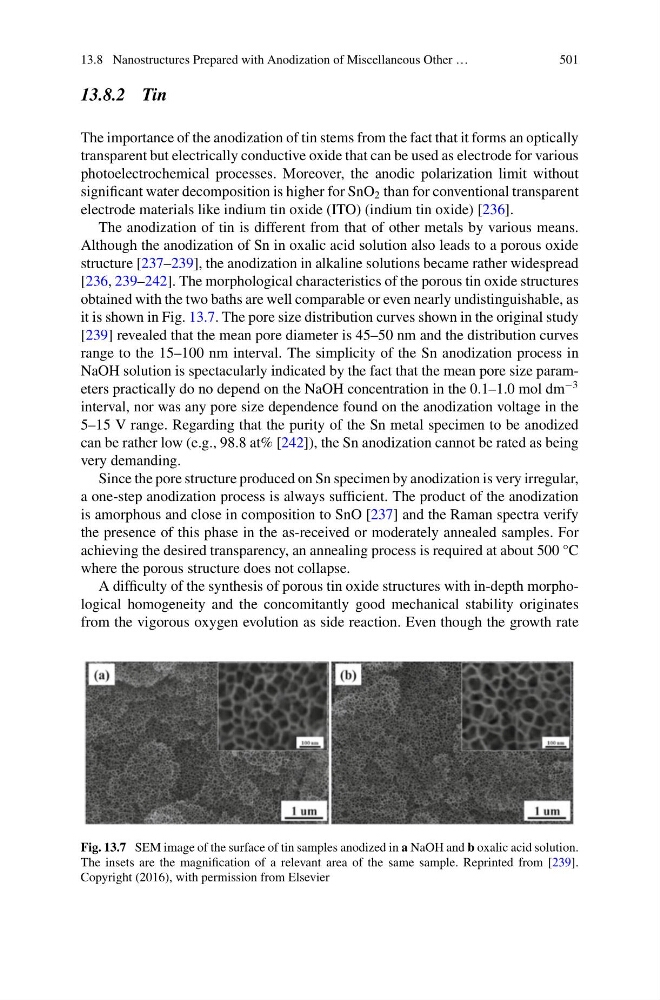
[236, 239–242]. The morphological characteristics of the porous tin oxide structures
obtained with the two baths are well comparable or even nearly undistinguishable, as
it is shown in Fig. 13.7. The pore size distribution curves shown in the original study
[239] revealed that the mean pore diameter is 45–50 nm and the distribution curves
range to the 15–100 nm interval. The simplicity of the Sn anodization process in
NaOH solution is spectacularly indicated by the fact that the mean pore size parameters practically do no depend on the NaOH concentration in the 0.1–1.0 mol dm
−3
interval, nor was any pore size dependence found on the anodization voltage in the
5–15 V range. Regarding that the purity of the Sn metal specimen to be anodized
can be rather low (e.g., 98.8 at% [242]), the Sn anodization cannot be rated as being
very demanding.
Since the pore structure produced on Sn specimen by anodization is very irregular,
a one-step anodization process is always sufficient. The product of the anodization
is amorphous and close in composition to SnO [237] and the Raman spectra verify
the presence of this phase in the as-received or moderately annealed samples. For
achieving the desired transparency, an annealing process is required at about 500 °C
where the porous structure does not collapse.
A difficulty of the synthesis of porous tin oxide structures with in-depth morphological homogeneity and the concomitantly good mechanical stability originates
from the vigorous oxygen evolution as side reaction. Even though the growth rate
Fig. 13.7 SEM image of the surface of tin samples anodized in a NaOH and b oxalic acid solution.
The insets are the magnification of a relevant area of the same sample. Reprinted from [239].
Copyright (2016), with permission from Elsevier
501
13.8.2 Tin
The importance of the anodization of tin stems from the fact that it forms an optically
transparent but electrically conductive oxide that can be used as electrode for various
photoelectrochemical processes. Moreover, the anodic polarization limit without
significant water decomposition is higher for SnO 2 than for conventional transparent
electrode materials like indium tin oxide (ITO) (indium tin oxide) [236].
The anodization of tin is different from that of other metals by various means.
Although the anodization of Sn in oxalic acid solution also leads to a porous oxide
structure [237–239], the anodization in alkaline solutions became rather widespread
[236, 239–242]. The morphological characteristics of the porous tin oxide structures
obtained with the two baths are well comparable or even nearly undistinguishable, as
it is shown in Fig. 13.7. The pore size distribution curves shown in the original study
[239] revealed that the mean pore diameter is 45–50 nm and the distribution curves
range to the 15–100 nm interval. The simplicity of the Sn anodization process in
NaOH solution is spectacularly indicated by the fact that the mean pore size parameters practically do no depend on the NaOH concentration in the 0.1–1.0 mol dm
−3
interval, nor was any pore size dependence found on the anodization voltage in the
5–15 V range. Regarding that the purity of the Sn metal specimen to be anodized
can be rather low (e.g., 98.8 at% [242]), the Sn anodization cannot be rated as being
very demanding.
Since the pore structure produced on Sn specimen by anodization is very irregular,
a one-step anodization process is always sufficient. The product of the anodization
is amorphous and close in composition to SnO [237] and the Raman spectra verify
the presence of this phase in the as-received or moderately annealed samples. For
achieving the desired transparency, an annealing process is required at about 500 °C
where the porous structure does not collapse.
A difficulty of the synthesis of porous tin oxide structures with in-depth morphological homogeneity and the concomitantly good mechanical stability originates
from the vigorous oxygen evolution as side reaction. Even though the growth rate
Fig. 13.7 SEM image of the surface of tin samples anodized in a NaOH and b oxalic acid solution.
The insets are the magnification of a relevant area of the same sample. Reprinted from [239].
Copyright (2016), with permission from Elsevier