

466
12 Localized or Spatially Selective Electrodeposition Methods
a tungsten wire that is immersed into the alkaline solution partly by holding the
top of the wire. The meniscus getting shaped near the contact of the wire with the
solution plays a crucial role in the tip formation. When a bulk solution is used in the
manufacturing process, the tip position is often monitored and adjusted during the
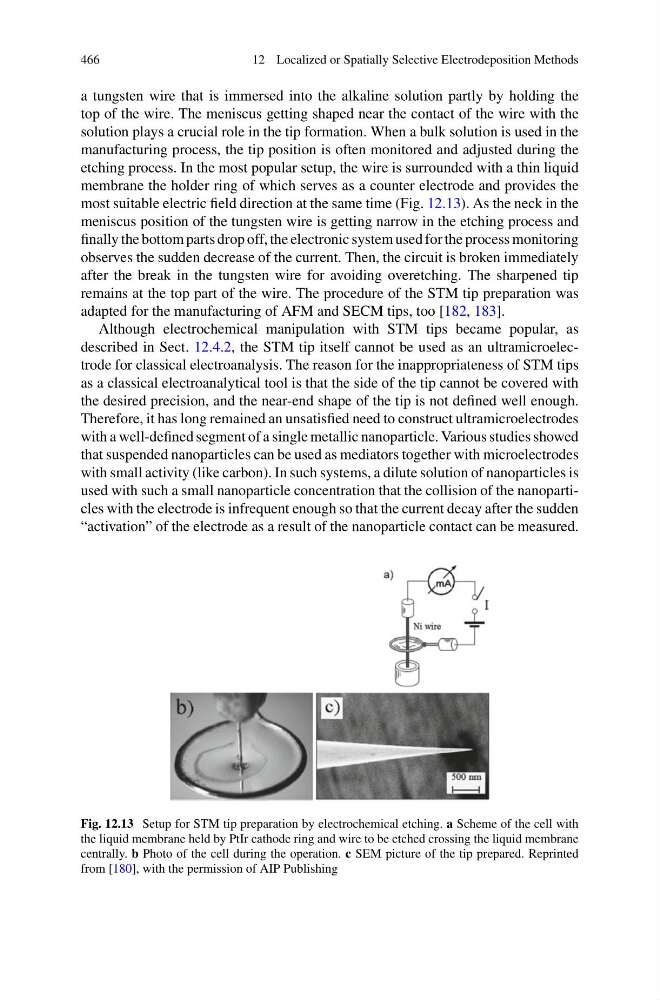
etching process. In the most popular setup, the wire is surrounded with a thin liquid
membrane the holder ring of which serves as a counter electrode and provides the
most suitable electric field direction at the same time (Fig. 12.13). As the neck in the
meniscus position of the tungsten wire is getting narrow in the etching process and
finally the bottom parts drop off, the electronic system used for the process monitoring
observes the sudden decrease of the current. Then, the circuit is broken immediately
after the break in the tungsten wire for avoiding overetching. The sharpened tip
remains at the top part of the wire. The procedure of the STM tip preparation was
adapted for the manufacturing of AFM and SECM tips, too [182, 183].
Although electrochemical manipulation with STM tips became popular, as
described in Sect. 12.4.2, the STM tip itself cannot be used as an ultramicroelectrode for classical electroanalysis. The reason for the inappropriateness of STM tips
as a classical electroanalytical tool is that the side of the tip cannot be covered with
the desired precision, and the near-end shape of the tip is not defined well enough.
Therefore, it has long remained an unsatisfied need to construct ultramicroelectrodes
with a well-defined segment of a single metallic nanoparticle. Various studies showed
that suspended nanoparticles can be used as mediators together with microelectrodes
with small activity (like carbon). In such systems, a dilute solution of nanoparticles is
used with such a small nanoparticle concentration that the collision of the nanoparticles with the electrode is infrequent enough so that the current decay after the sudden
“activation” of the electrode as a result of the nanoparticle contact can be measured.
Fig. 12.13 Setup for STM tip preparation by electrochemical etching. a Scheme of the cell with
the liquid membrane held by PtIr cathode ring and wire to be etched crossing the liquid membrane
centrally. b Photo of the cell during the operation. c SEM picture of the tip prepared. Reprinted
from [180], with the permission of AIP Publishing
12 Localized or Spatially Selective Electrodeposition Methods
a tungsten wire that is immersed into the alkaline solution partly by holding the
top of the wire. The meniscus getting shaped near the contact of the wire with the
solution plays a crucial role in the tip formation. When a bulk solution is used in the
manufacturing process, the tip position is often monitored and adjusted during the
etching process. In the most popular setup, the wire is surrounded with a thin liquid
membrane the holder ring of which serves as a counter electrode and provides the
most suitable electric field direction at the same time (Fig. 12.13). As the neck in the
meniscus position of the tungsten wire is getting narrow in the etching process and
finally the bottom parts drop off, the electronic system used for the process monitoring
observes the sudden decrease of the current. Then, the circuit is broken immediately
after the break in the tungsten wire for avoiding overetching. The sharpened tip
remains at the top part of the wire. The procedure of the STM tip preparation was
adapted for the manufacturing of AFM and SECM tips, too [182, 183].
Although electrochemical manipulation with STM tips became popular, as
described in Sect. 12.4.2, the STM tip itself cannot be used as an ultramicroelectrode for classical electroanalysis. The reason for the inappropriateness of STM tips
as a classical electroanalytical tool is that the side of the tip cannot be covered with
the desired precision, and the near-end shape of the tip is not defined well enough.
Therefore, it has long remained an unsatisfied need to construct ultramicroelectrodes
with a well-defined segment of a single metallic nanoparticle. Various studies showed
that suspended nanoparticles can be used as mediators together with microelectrodes
with small activity (like carbon). In such systems, a dilute solution of nanoparticles is
used with such a small nanoparticle concentration that the collision of the nanoparticles with the electrode is infrequent enough so that the current decay after the sudden
“activation” of the electrode as a result of the nanoparticle contact can be measured.
Fig. 12.13 Setup for STM tip preparation by electrochemical etching. a Scheme of the cell with
the liquid membrane held by PtIr cathode ring and wire to be etched crossing the liquid membrane
centrally. b Photo of the cell during the operation. c SEM picture of the tip prepared. Reprinted
from [180], with the permission of AIP Publishing