

444
12 Localized or Spatially Selective Electrodeposition Methods
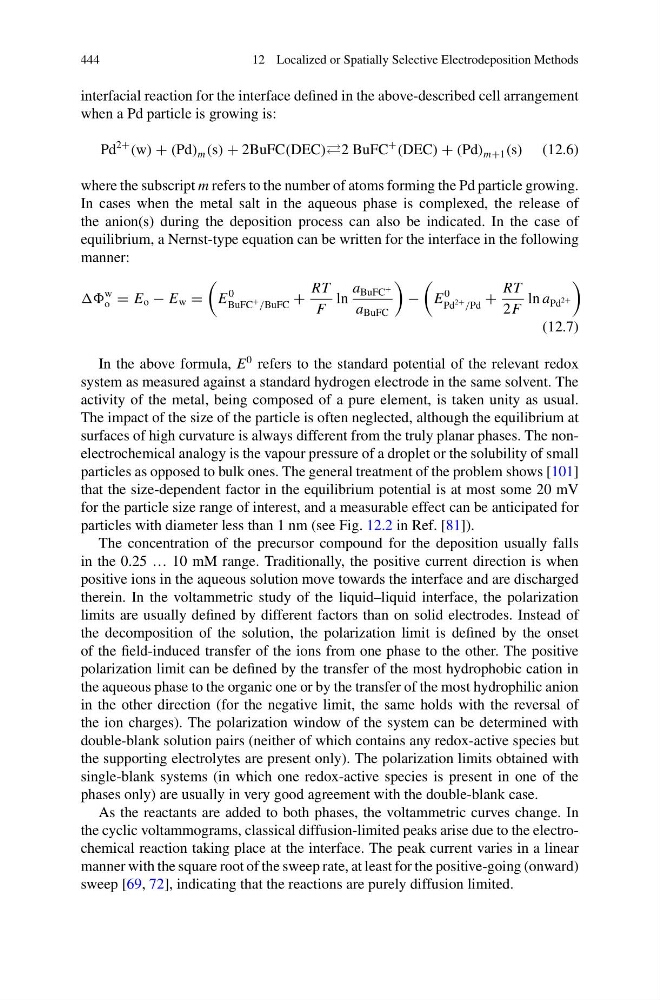
interfacial reaction for the interface defined in the above-described cell arrangement
when a Pd particle is growing is:
Pd
2+
(w) + (Pd) m (s) + 2BuFC(DEC)2 BuFC
+
(DEC) + (Pd) m+1 (s) (12.6)
where the subscript m refers to the number of atoms forming the Pd particle growing.
In cases when the metal salt in the aqueous phase is complexed, the release of
the anion(s) during the deposition process can also be indicated. In the case of
equilibrium, a Nernst-type equation can be written for the interface in the following
manner:
w
o = E o − E w =
E
0
BuFC
+ /BuFC +
RT
F
ln
a BuFC
+
a BuFC
−
E
0
Pd
2+ /Pd
+
RT
2F
ln a Pd
2+
(12.7)
In the above formula, E
0 refers to the standard potential of the relevant redox
system as measured against a standard hydrogen electrode in the same solvent. The
activity of the metal, being composed of a pure element, is taken unity as usual.
The impact of the size of the particle is often neglected, although the equilibrium at
surfaces of high curvature is always different from the truly planar phases. The nonelectrochemical analogy is the vapour pressure of a droplet or the solubility of small
particles as opposed to bulk ones. The general treatment of the problem shows [101]
that the size-dependent factor in the equilibrium potential is at most some 20 mV
for the particle size range of interest, and a measurable effect can be anticipated for
particles with diameter less than 1 nm (see Fig. 12.2 in Ref. [81]).
The concentration of the precursor compound for the deposition usually falls
in the 0.25 … 10 mM range. Traditionally, the positive current direction is when
positive ions in the aqueous solution move towards the interface and are discharged
therein. In the voltammetric study of the liquid–liquid interface, the polarization
limits are usually defined by different factors than on solid electrodes. Instead of
the decomposition of the solution, the polarization limit is defined by the onset
of the field-induced transfer of the ions from one phase to the other. The positive
polarization limit can be defined by the transfer of the most hydrophobic cation in
the aqueous phase to the organic one or by the transfer of the most hydrophilic anion
in the other direction (for the negative limit, the same holds with the reversal of
the ion charges). The polarization window of the system can be determined with
double-blank solution pairs (neither of which contains any redox-active species but
the supporting electrolytes are present only). The polarization limits obtained with
single-blank systems (in which one redox-active species is present in one of the
phases only) are usually in very good agreement with the double-blank case.
As the reactants are added to both phases, the voltammetric curves change. In
the cyclic voltammograms, classical diffusion-limited peaks arise due to the electrochemical reaction taking place at the interface. The peak current varies in a linear
manner with the square root of the sweep rate, at least for the positive-going (onward)
sweep [69, 72], indicating that the reactions are purely diffusion limited.
12 Localized or Spatially Selective Electrodeposition Methods
interfacial reaction for the interface defined in the above-described cell arrangement
when a Pd particle is growing is:
Pd
2+
(w) + (Pd) m (s) + 2BuFC(DEC)2 BuFC
+
(DEC) + (Pd) m+1 (s) (12.6)
where the subscript m refers to the number of atoms forming the Pd particle growing.
In cases when the metal salt in the aqueous phase is complexed, the release of
the anion(s) during the deposition process can also be indicated. In the case of
equilibrium, a Nernst-type equation can be written for the interface in the following
manner:
w
o = E o − E w =
E
0
BuFC
+ /BuFC +
RT
F
ln
a BuFC
+
a BuFC
−
E
0
Pd
2+ /Pd
+
RT
2F
ln a Pd
2+
(12.7)
In the above formula, E
0 refers to the standard potential of the relevant redox
system as measured against a standard hydrogen electrode in the same solvent. The
activity of the metal, being composed of a pure element, is taken unity as usual.
The impact of the size of the particle is often neglected, although the equilibrium at
surfaces of high curvature is always different from the truly planar phases. The nonelectrochemical analogy is the vapour pressure of a droplet or the solubility of small
particles as opposed to bulk ones. The general treatment of the problem shows [101]
that the size-dependent factor in the equilibrium potential is at most some 20 mV
for the particle size range of interest, and a measurable effect can be anticipated for
particles with diameter less than 1 nm (see Fig. 12.2 in Ref. [81]).
The concentration of the precursor compound for the deposition usually falls
in the 0.25 … 10 mM range. Traditionally, the positive current direction is when
positive ions in the aqueous solution move towards the interface and are discharged
therein. In the voltammetric study of the liquid–liquid interface, the polarization
limits are usually defined by different factors than on solid electrodes. Instead of
the decomposition of the solution, the polarization limit is defined by the onset
of the field-induced transfer of the ions from one phase to the other. The positive
polarization limit can be defined by the transfer of the most hydrophobic cation in
the aqueous phase to the organic one or by the transfer of the most hydrophilic anion
in the other direction (for the negative limit, the same holds with the reversal of
the ion charges). The polarization window of the system can be determined with
double-blank solution pairs (neither of which contains any redox-active species but
the supporting electrolytes are present only). The polarization limits obtained with
single-blank systems (in which one redox-active species is present in one of the
phases only) are usually in very good agreement with the double-blank case.
As the reactants are added to both phases, the voltammetric curves change. In
the cyclic voltammograms, classical diffusion-limited peaks arise due to the electrochemical reaction taking place at the interface. The peak current varies in a linear
manner with the square root of the sweep rate, at least for the positive-going (onward)
sweep [69, 72], indicating that the reactions are purely diffusion limited.