

2.8 Basic Electrode Kinetics
25
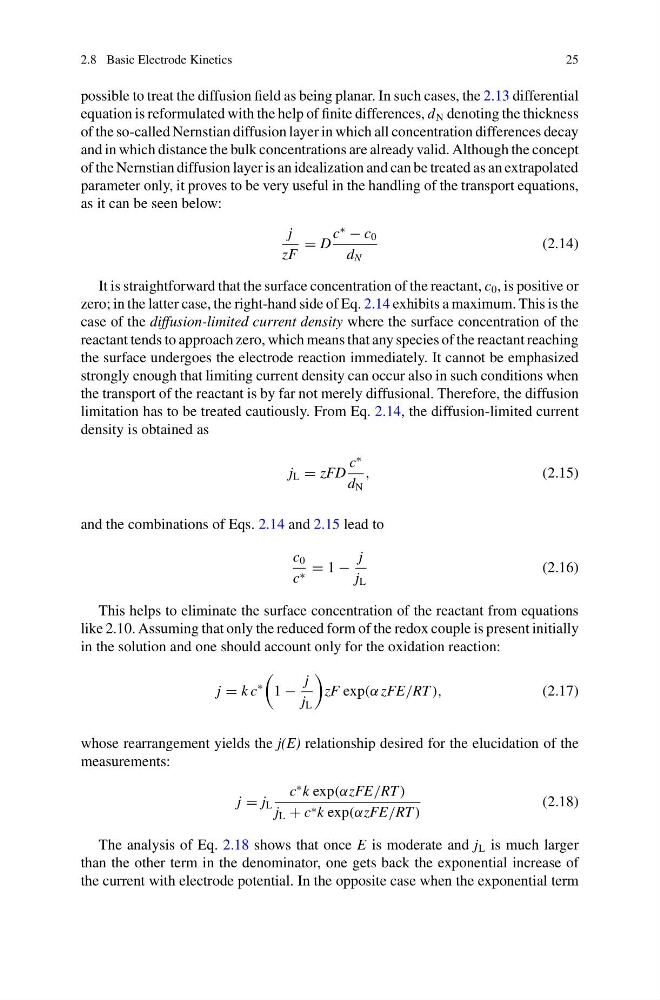
possible to treat the diffusion field as being planar. In such cases, the 2.13 differential
equation is reformulated with the help of finite differences, d N denoting the thickness
of the so-called Nernstian diffusion layer in which all concentration differences decay
and in which distance the bulk concentrations are already valid. Although the concept
of the Nernstian diffusion layer is an idealization and can be treated as an extrapolated
parameter only, it proves to be very useful in the handling of the transport equations,
as it can be seen below:
j
zF
= D
c
∗
− c 0
d N
(2.14)
It is straightforward that the surface concentration of the reactant, c 0 , is positive or
zero; in the latter case, the right-hand side of Eq. 2.14 exhibits a maximum. This is the
case of the diffusion-limited current density where the surface concentration of the
reactant tends to approach zero, which means that any species of the reactant reaching
the surface undergoes the electrode reaction immediately. It cannot be emphasized
strongly enough that limiting current density can occur also in such conditions when
the transport of the reactant is by far not merely diffusional. Therefore, the diffusion
limitation has to be treated cautiously. From Eq. 2.14, the diffusion-limited current
density is obtained as
j L = zFD
c
∗
d N
,
(2.15)
and the combinations of Eqs. 2.14 and 2.15 lead to
c 0
c ∗ = 1 −
j
j L
(2.16)
This helps to eliminate the surface concentration of the reactant from equations
like 2.10. Assuming that only the reduced form of the redox couple is present initially
in the solution and one should account only for the oxidation reaction:
j = k c
∗
1 −
j
j L
zF exp(α zFE/RT ),
(2.17)
whose rearrangement yields the j(E) relationship desired for the elucidation of the
measurements:
j = j L
c
∗ k exp(αzFE/RT )
j L + c ∗ k exp(αzFE/RT )
(2.18)
The analysis of Eq. 2.18 shows that once E is moderate and j L is much larger
than the other term in the denominator, one gets back the exponential increase of
the current with electrode potential. In the opposite case when the exponential term
25
possible to treat the diffusion field as being planar. In such cases, the 2.13 differential
equation is reformulated with the help of finite differences, d N denoting the thickness
of the so-called Nernstian diffusion layer in which all concentration differences decay
and in which distance the bulk concentrations are already valid. Although the concept
of the Nernstian diffusion layer is an idealization and can be treated as an extrapolated
parameter only, it proves to be very useful in the handling of the transport equations,
as it can be seen below:
j
zF
= D
c
∗
− c 0
d N
(2.14)
It is straightforward that the surface concentration of the reactant, c 0 , is positive or
zero; in the latter case, the right-hand side of Eq. 2.14 exhibits a maximum. This is the
case of the diffusion-limited current density where the surface concentration of the
reactant tends to approach zero, which means that any species of the reactant reaching
the surface undergoes the electrode reaction immediately. It cannot be emphasized
strongly enough that limiting current density can occur also in such conditions when
the transport of the reactant is by far not merely diffusional. Therefore, the diffusion
limitation has to be treated cautiously. From Eq. 2.14, the diffusion-limited current
density is obtained as
j L = zFD
c
∗
d N
,
(2.15)
and the combinations of Eqs. 2.14 and 2.15 lead to
c 0
c ∗ = 1 −
j
j L
(2.16)
This helps to eliminate the surface concentration of the reactant from equations
like 2.10. Assuming that only the reduced form of the redox couple is present initially
in the solution and one should account only for the oxidation reaction:
j = k c
∗
1 −
j
j L
zF exp(α zFE/RT ),
(2.17)
whose rearrangement yields the j(E) relationship desired for the elucidation of the
measurements:
j = j L
c
∗ k exp(αzFE/RT )
j L + c ∗ k exp(αzFE/RT )
(2.18)
The analysis of Eq. 2.18 shows that once E is moderate and j L is much larger
than the other term in the denominator, one gets back the exponential increase of
the current with electrode potential. In the opposite case when the exponential term