

436
12 Localized or Spatially Selective Electrodeposition Methods
is applied and hence c S can be taken independent of time, the time dependence of
the radius directly follows. At higher times, the following considerations are valid.
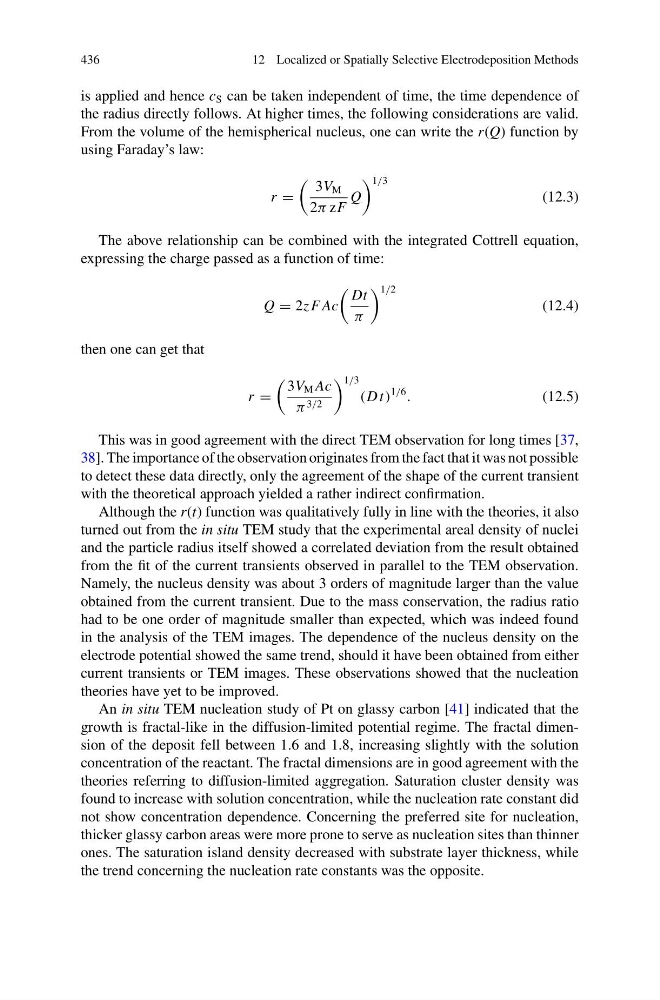
From the volume of the hemispherical nucleus, one can write the r(Q) function by
using Faraday’s law:
r =
3V M
2π zF
Q
1/3
(12.3)
The above relationship can be combined with the integrated Cottrell equation,
expressing the charge passed as a function of time:
Q = 2z F Ac
Dt
π
1/2
(12.4)
then one can get that
r =
3V M Ac
π 3/2
1/3
(D t)
1/6
.
(12.5)
This was in good agreement with the direct TEM observation for long times [37,
38]. The importance of the observation originates from the fact that it was not possible
to detect these data directly, only the agreement of the shape of the current transient
with the theoretical approach yielded a rather indirect confirmation.
Although the r(t) function was qualitatively fully in line with the theories, it also
turned out from the in situ TEM study that the experimental areal density of nuclei
and the particle radius itself showed a correlated deviation from the result obtained
from the fit of the current transients observed in parallel to the TEM observation.
Namely, the nucleus density was about 3 orders of magnitude larger than the value
obtained from the current transient. Due to the mass conservation, the radius ratio
had to be one order of magnitude smaller than expected, which was indeed found
in the analysis of the TEM images. The dependence of the nucleus density on the
electrode potential showed the same trend, should it have been obtained from either
current transients or TEM images. These observations showed that the nucleation
theories have yet to be improved.
An in situ TEM nucleation study of Pt on glassy carbon [41] indicated that the
growth is fractal-like in the diffusion-limited potential regime. The fractal dimension of the deposit fell between 1.6 and 1.8, increasing slightly with the solution
concentration of the reactant. The fractal dimensions are in good agreement with the
theories referring to diffusion-limited aggregation. Saturation cluster density was
found to increase with solution concentration, while the nucleation rate constant did
not show concentration dependence. Concerning the preferred site for nucleation,
thicker glassy carbon areas were more prone to serve as nucleation sites than thinner
ones. The saturation island density decreased with substrate layer thickness, while
the trend concerning the nucleation rate constants was the opposite.
12 Localized or Spatially Selective Electrodeposition Methods
is applied and hence c S can be taken independent of time, the time dependence of
the radius directly follows. At higher times, the following considerations are valid.
From the volume of the hemispherical nucleus, one can write the r(Q) function by
using Faraday’s law:
r =
3V M
2π zF
Q
1/3
(12.3)
The above relationship can be combined with the integrated Cottrell equation,
expressing the charge passed as a function of time:
Q = 2z F Ac
Dt
π
1/2
(12.4)
then one can get that
r =
3V M Ac
π 3/2
1/3
(D t)
1/6
.
(12.5)
This was in good agreement with the direct TEM observation for long times [37,
38]. The importance of the observation originates from the fact that it was not possible
to detect these data directly, only the agreement of the shape of the current transient
with the theoretical approach yielded a rather indirect confirmation.
Although the r(t) function was qualitatively fully in line with the theories, it also
turned out from the in situ TEM study that the experimental areal density of nuclei
and the particle radius itself showed a correlated deviation from the result obtained
from the fit of the current transients observed in parallel to the TEM observation.
Namely, the nucleus density was about 3 orders of magnitude larger than the value
obtained from the current transient. Due to the mass conservation, the radius ratio
had to be one order of magnitude smaller than expected, which was indeed found
in the analysis of the TEM images. The dependence of the nucleus density on the
electrode potential showed the same trend, should it have been obtained from either
current transients or TEM images. These observations showed that the nucleation
theories have yet to be improved.
An in situ TEM nucleation study of Pt on glassy carbon [41] indicated that the
growth is fractal-like in the diffusion-limited potential regime. The fractal dimension of the deposit fell between 1.6 and 1.8, increasing slightly with the solution
concentration of the reactant. The fractal dimensions are in good agreement with the
theories referring to diffusion-limited aggregation. Saturation cluster density was
found to increase with solution concentration, while the nucleation rate constant did
not show concentration dependence. Concerning the preferred site for nucleation,
thicker glassy carbon areas were more prone to serve as nucleation sites than thinner
ones. The saturation island density decreased with substrate layer thickness, while
the trend concerning the nucleation rate constants was the opposite.