

11.2 Nanochannel Templates Obtained with Top-Down Synthesis Methods
379
The preparation of the membrane with one single-ion track is based on the limitation of the cross section of the irradiating ion beam and the detection of the first ion
passing through the polymer membrane [47, 109]. Then, the pore opening/widening
process is carried out in a permeation cell. The electrodes in the two chambers of
the permeation cell are used as conductivity sensors (see the left panel in Fig. 11.7).
Then, the back side contact formation and the electrodeposition of the nanowire
can be performed with the usual process. The major difference is the current level
observed during the nanowire formation (0.05 nA < I < 2 nA). An alternative method
includes the preparation of a nanowire array but with stopping the deposition process
once the first wire penetrates through the whole membrane and contacts the front
side electrode (see the right panel in Fig. 11.7 [78]).
Superconductivity in Pb nanowires was detected nearly at the same transition
temperature as for bulk Pb when the nanowires were single crystalline, while a
decrease in the critical temperature was shown for polycrystalline samples [76, 77]. If
nanowires are made from materials of lower critical temperature than the end contacts
(like Sn with Pb contacts, Zn with either Sn or Pb contacts), the contacting metal can
cause an induced superconductivity nearly with the same critical temperature as the
contact metal [78]. It was demonstrated that the interdiffusion in the superconductor–
contact metal region impacts the resistivity change of the nanowires [142]. The
study of superconductivity in nanowires is important due to the possible quantum
confinement. For instance, it was found that 70 nm is the critical diameter for Zn
nanowires below which the bulk-like behaviour changes to one-dimensional one
[83].
Magnetoresistance can also be fundamentally different for multilayered nanowires
than for thin films of similar composition modulation. This is because in multilayered nanowires, the measurements can be naturally carried out with the
current-perpendicular-to-plane geometry, while the current-in-plane configuration
is customary for thin films. The key parameters determining the magnetoresistance
ratio are also different for the two geometries. These studies are important for the
verification of the theories of magnetoresistance as well as for the possible construction of magnetoresistive memory elements. Measurements for both homogeneous
[48, 59, 75, 107] and compositionally modulated nanowires [150, 151, 153–155]
have been published for a variety of nanowire compositions.
Thermoelectricity. The thermoelectric properties of semiconductor nanowires
have been optimized in a large number of works. The reason for the interest in the
thermoelectricity of nanowires stems from the fact that nanowires are well organized
within the template, and hence, they can be potentially integrated into thermoelectric
devices. The conversion efficiency of such devices is characterized with the figure
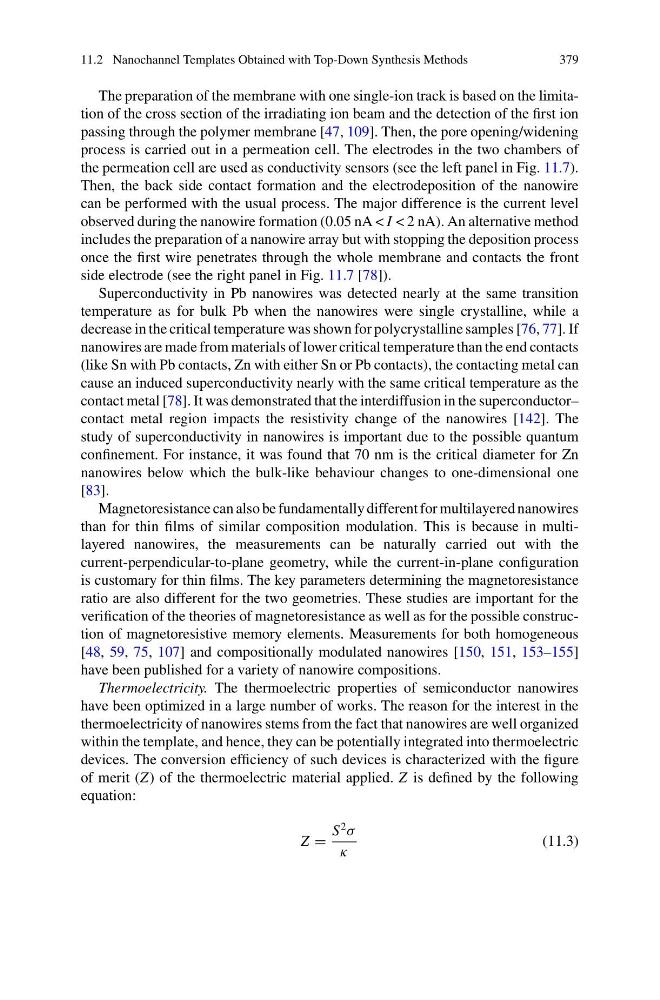
of merit (Z) of the thermoelectric material applied. Z is defined by the following
equation:
Z =
S
2
σ
κ
(11.3)
379
The preparation of the membrane with one single-ion track is based on the limitation of the cross section of the irradiating ion beam and the detection of the first ion
passing through the polymer membrane [47, 109]. Then, the pore opening/widening
process is carried out in a permeation cell. The electrodes in the two chambers of
the permeation cell are used as conductivity sensors (see the left panel in Fig. 11.7).
Then, the back side contact formation and the electrodeposition of the nanowire
can be performed with the usual process. The major difference is the current level
observed during the nanowire formation (0.05 nA < I < 2 nA). An alternative method
includes the preparation of a nanowire array but with stopping the deposition process
once the first wire penetrates through the whole membrane and contacts the front
side electrode (see the right panel in Fig. 11.7 [78]).
Superconductivity in Pb nanowires was detected nearly at the same transition
temperature as for bulk Pb when the nanowires were single crystalline, while a
decrease in the critical temperature was shown for polycrystalline samples [76, 77]. If
nanowires are made from materials of lower critical temperature than the end contacts
(like Sn with Pb contacts, Zn with either Sn or Pb contacts), the contacting metal can
cause an induced superconductivity nearly with the same critical temperature as the
contact metal [78]. It was demonstrated that the interdiffusion in the superconductor–
contact metal region impacts the resistivity change of the nanowires [142]. The
study of superconductivity in nanowires is important due to the possible quantum
confinement. For instance, it was found that 70 nm is the critical diameter for Zn
nanowires below which the bulk-like behaviour changes to one-dimensional one
[83].
Magnetoresistance can also be fundamentally different for multilayered nanowires
than for thin films of similar composition modulation. This is because in multilayered nanowires, the measurements can be naturally carried out with the
current-perpendicular-to-plane geometry, while the current-in-plane configuration
is customary for thin films. The key parameters determining the magnetoresistance
ratio are also different for the two geometries. These studies are important for the
verification of the theories of magnetoresistance as well as for the possible construction of magnetoresistive memory elements. Measurements for both homogeneous
[48, 59, 75, 107] and compositionally modulated nanowires [150, 151, 153–155]
have been published for a variety of nanowire compositions.
Thermoelectricity. The thermoelectric properties of semiconductor nanowires
have been optimized in a large number of works. The reason for the interest in the
thermoelectricity of nanowires stems from the fact that nanowires are well organized
within the template, and hence, they can be potentially integrated into thermoelectric
devices. The conversion efficiency of such devices is characterized with the figure
of merit (Z) of the thermoelectric material applied. Z is defined by the following
equation:
Z =
S
2
σ
κ
(11.3)