

11.2 Nanochannel Templates Obtained with Top-Down Synthesis Methods
363
e
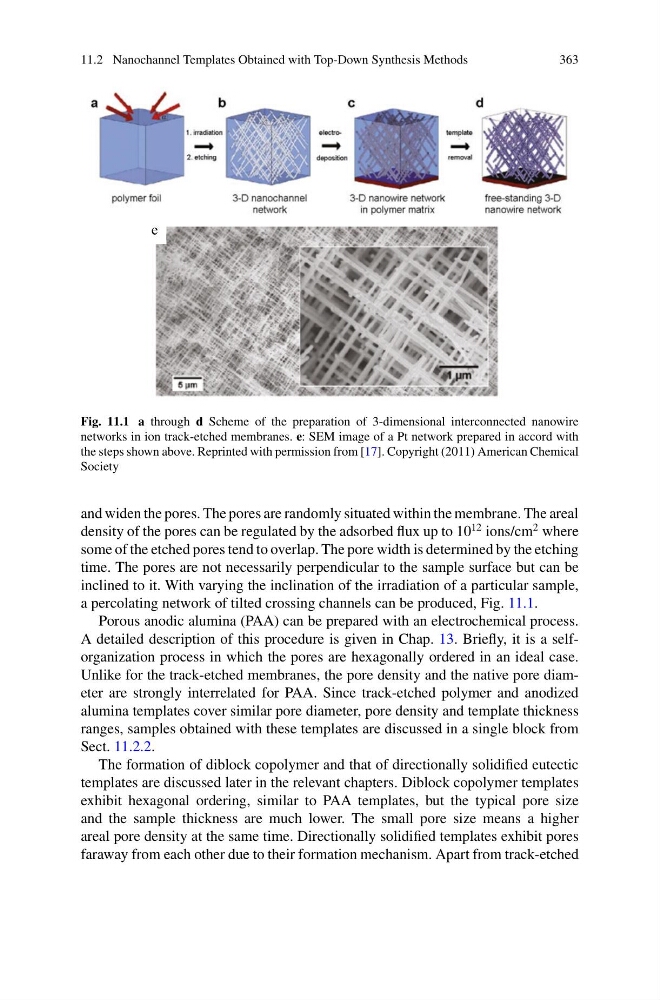
Fig. 11.1 a through d Scheme of the preparation of 3-dimensional interconnected nanowire
networks in ion track-etched membranes. e: SEM image of a Pt network prepared in accord with
the steps shown above. Reprinted with permission from [17]. Copyright (2011) American Chemical
Society
and widen the pores. The pores are randomly situated within the membrane. The areal
density of the pores can be regulated by the adsorbed flux up to 10
12 ions/cm
2 where
some of the etched pores tend to overlap. The pore width is determined by the etching
time. The pores are not necessarily perpendicular to the sample surface but can be
inclined to it. With varying the inclination of the irradiation of a particular sample,
a percolating network of tilted crossing channels can be produced, Fig. 11.1.
Porous anodic alumina (PAA) can be prepared with an electrochemical process.
A detailed description of this procedure is given in Chap. 13. Briefly, it is a selforganization process in which the pores are hexagonally ordered in an ideal case.
Unlike for the track-etched membranes, the pore density and the native pore diameter are strongly interrelated for PAA. Since track-etched polymer and anodized
alumina templates cover similar pore diameter, pore density and template thickness
ranges, samples obtained with these templates are discussed in a single block from
Sect. 11.2.2.
The formation of diblock copolymer and that of directionally solidified eutectic
templates are discussed later in the relevant chapters. Diblock copolymer templates
exhibit hexagonal ordering, similar to PAA templates, but the typical pore size
and the sample thickness are much lower. The small pore size means a higher
areal pore density at the same time. Directionally solidified templates exhibit pores
faraway from each other due to their formation mechanism. Apart from track-etched
363
e
Fig. 11.1 a through d Scheme of the preparation of 3-dimensional interconnected nanowire
networks in ion track-etched membranes. e: SEM image of a Pt network prepared in accord with
the steps shown above. Reprinted with permission from [17]. Copyright (2011) American Chemical
Society
and widen the pores. The pores are randomly situated within the membrane. The areal
density of the pores can be regulated by the adsorbed flux up to 10
12 ions/cm
2 where
some of the etched pores tend to overlap. The pore width is determined by the etching
time. The pores are not necessarily perpendicular to the sample surface but can be
inclined to it. With varying the inclination of the irradiation of a particular sample,
a percolating network of tilted crossing channels can be produced, Fig. 11.1.
Porous anodic alumina (PAA) can be prepared with an electrochemical process.
A detailed description of this procedure is given in Chap. 13. Briefly, it is a selforganization process in which the pores are hexagonally ordered in an ideal case.
Unlike for the track-etched membranes, the pore density and the native pore diameter are strongly interrelated for PAA. Since track-etched polymer and anodized
alumina templates cover similar pore diameter, pore density and template thickness
ranges, samples obtained with these templates are discussed in a single block from
Sect. 11.2.2.
The formation of diblock copolymer and that of directionally solidified eutectic
templates are discussed later in the relevant chapters. Diblock copolymer templates
exhibit hexagonal ordering, similar to PAA templates, but the typical pore size
and the sample thickness are much lower. The small pore size means a higher
areal pore density at the same time. Directionally solidified templates exhibit pores
faraway from each other due to their formation mechanism. Apart from track-etched