

9.1 Synthesis of Nanoparticles on Electrodes
307
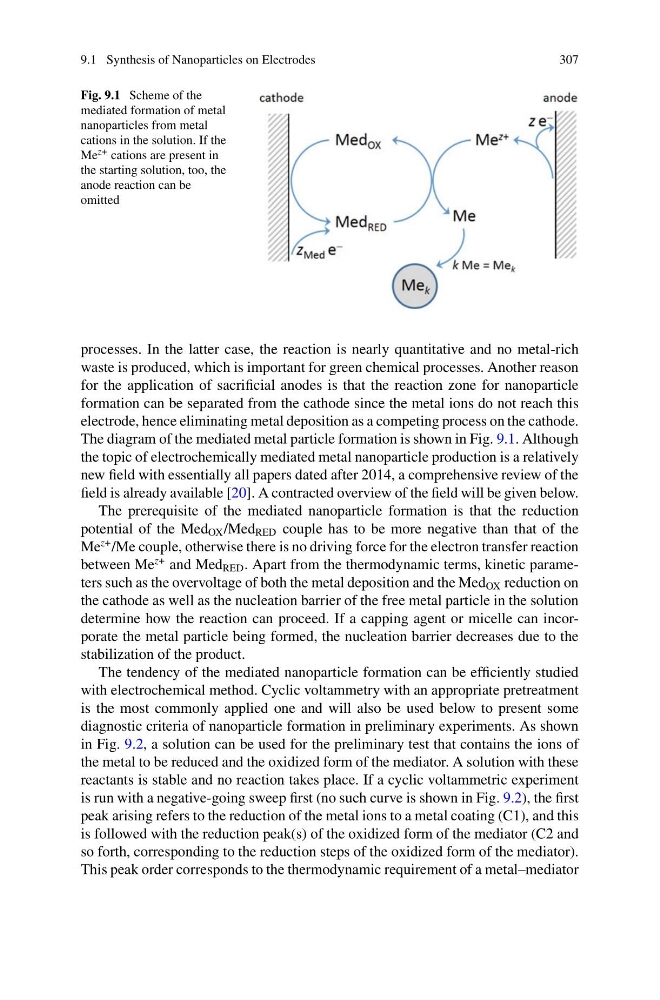
Fig. 9.1 Scheme of the
mediated formation of metal
nanoparticles from metal
cations in the solution. If the
Me z+ cations are present in
the starting solution, too, the
anode reaction can be
omitted
processes. In the latter case, the reaction is nearly quantitative and no metal-rich
waste is produced, which is important for green chemical processes. Another reason
for the application of sacrificial anodes is that the reaction zone for nanoparticle
formation can be separated from the cathode since the metal ions do not reach this
electrode, hence eliminating metal deposition as a competing process on the cathode.
The diagram of the mediated metal particle formation is shown in Fig. 9.1. Although
the topic of electrochemically mediated metal nanoparticle production is a relatively
new field with essentially all papers dated after 2014, a comprehensive review of the
field is already available [20]. A contracted overview of the field will be given below.
The prerequisite of the mediated nanoparticle formation is that the reduction
potential of the Med OX /Med RED couple has to be more negative than that of the
Me
z+ /Me couple, otherwise there is no driving force for the electron transfer reaction
between Me
z+ and Med RED . Apart from the thermodynamic terms, kinetic parameters such as the overvoltage of both the metal deposition and the Med OX reduction on
the cathode as well as the nucleation barrier of the free metal particle in the solution
determine how the reaction can proceed. If a capping agent or micelle can incorporate the metal particle being formed, the nucleation barrier decreases due to the
stabilization of the product.
The tendency of the mediated nanoparticle formation can be efficiently studied
with electrochemical method. Cyclic voltammetry with an appropriate pretreatment
is the most commonly applied one and will also be used below to present some
diagnostic criteria of nanoparticle formation in preliminary experiments. As shown
in Fig. 9.2, a solution can be used for the preliminary test that contains the ions of
the metal to be reduced and the oxidized form of the mediator. A solution with these
reactants is stable and no reaction takes place. If a cyclic voltammetric experiment
is run with a negative-going sweep first (no such curve is shown in Fig. 9.2), the first
peak arising refers to the reduction of the metal ions to a metal coating (C1), and this
is followed with the reduction peak(s) of the oxidized form of the mediator (C2 and
so forth, corresponding to the reduction steps of the oxidized form of the mediator).
This peak order corresponds to the thermodynamic requirement of a metal–mediator
307
Fig. 9.1 Scheme of the
mediated formation of metal
nanoparticles from metal
cations in the solution. If the
Me z+ cations are present in
the starting solution, too, the
anode reaction can be
omitted
processes. In the latter case, the reaction is nearly quantitative and no metal-rich
waste is produced, which is important for green chemical processes. Another reason
for the application of sacrificial anodes is that the reaction zone for nanoparticle
formation can be separated from the cathode since the metal ions do not reach this
electrode, hence eliminating metal deposition as a competing process on the cathode.
The diagram of the mediated metal particle formation is shown in Fig. 9.1. Although
the topic of electrochemically mediated metal nanoparticle production is a relatively
new field with essentially all papers dated after 2014, a comprehensive review of the
field is already available [20]. A contracted overview of the field will be given below.
The prerequisite of the mediated nanoparticle formation is that the reduction
potential of the Med OX /Med RED couple has to be more negative than that of the
Me
z+ /Me couple, otherwise there is no driving force for the electron transfer reaction
between Me
z+ and Med RED . Apart from the thermodynamic terms, kinetic parameters such as the overvoltage of both the metal deposition and the Med OX reduction on
the cathode as well as the nucleation barrier of the free metal particle in the solution
determine how the reaction can proceed. If a capping agent or micelle can incorporate the metal particle being formed, the nucleation barrier decreases due to the
stabilization of the product.
The tendency of the mediated nanoparticle formation can be efficiently studied
with electrochemical method. Cyclic voltammetry with an appropriate pretreatment
is the most commonly applied one and will also be used below to present some
diagnostic criteria of nanoparticle formation in preliminary experiments. As shown
in Fig. 9.2, a solution can be used for the preliminary test that contains the ions of
the metal to be reduced and the oxidized form of the mediator. A solution with these
reactants is stable and no reaction takes place. If a cyclic voltammetric experiment
is run with a negative-going sweep first (no such curve is shown in Fig. 9.2), the first
peak arising refers to the reduction of the metal ions to a metal coating (C1), and this
is followed with the reduction peak(s) of the oxidized form of the mediator (C2 and
so forth, corresponding to the reduction steps of the oxidized form of the mediator).
This peak order corresponds to the thermodynamic requirement of a metal–mediator