

8.4 Electrochemical Dealloying
287
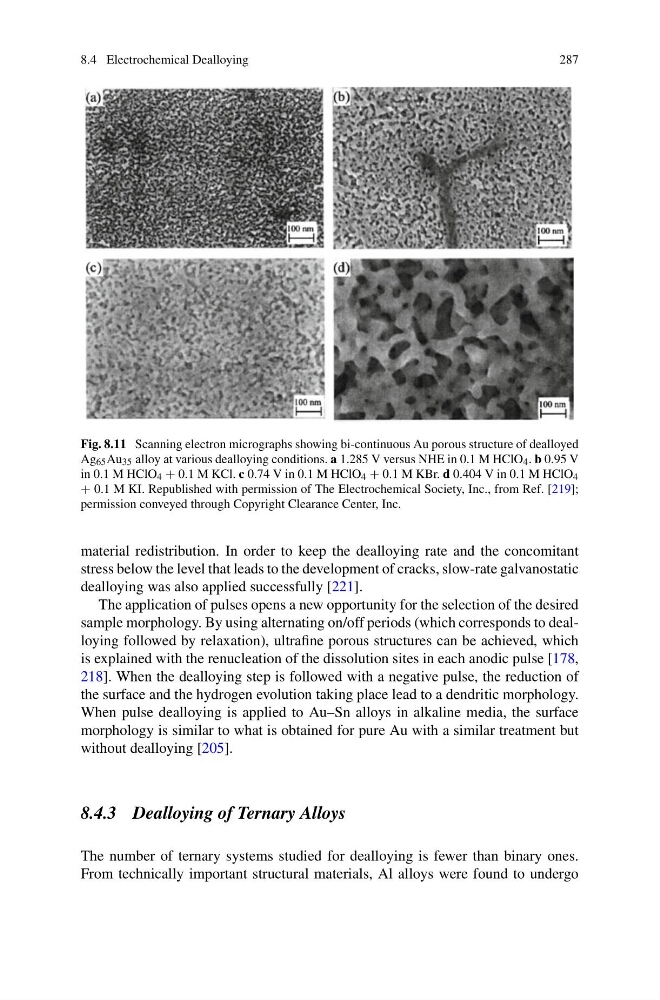
Fig. 8.11 Scanning electron micrographs showing bi-continuous Au porous structure of dealloyed
Ag 65 Au 35 alloy at various dealloying conditions. a 1.285 V versus NHE in 0.1 M HClO 4 . b 0.95 V
in 0.1 M HClO 4 + 0.1 M KCl. c 0.74 V in 0.1 M HClO 4 + 0.1 M KBr. d 0.404 V in 0.1 M HClO 4
+ 0.1 M KI. Republished with permission of The Electrochemical Society, Inc., from Ref. [219];
permission conveyed through Copyright Clearance Center, Inc.
material redistribution. In order to keep the dealloying rate and the concomitant
stress below the level that leads to the development of cracks, slow-rate galvanostatic
dealloying was also applied successfully [221].
The application of pulses opens a new opportunity for the selection of the desired
sample morphology. By using alternating on/off periods (which corresponds to dealloying followed by relaxation), ultrafine porous structures can be achieved, which
is explained with the renucleation of the dissolution sites in each anodic pulse [178,
218]. When the dealloying step is followed with a negative pulse, the reduction of
the surface and the hydrogen evolution taking place lead to a dendritic morphology.
When pulse dealloying is applied to Au–Sn alloys in alkaline media, the surface
morphology is similar to what is obtained for pure Au with a similar treatment but
without dealloying [205].
8.4.3 Dealloying of Ternary Alloys
The number of ternary systems studied for dealloying is fewer than binary ones.
From technically important structural materials, Al alloys were found to undergo
287
Fig. 8.11 Scanning electron micrographs showing bi-continuous Au porous structure of dealloyed
Ag 65 Au 35 alloy at various dealloying conditions. a 1.285 V versus NHE in 0.1 M HClO 4 . b 0.95 V
in 0.1 M HClO 4 + 0.1 M KCl. c 0.74 V in 0.1 M HClO 4 + 0.1 M KBr. d 0.404 V in 0.1 M HClO 4
+ 0.1 M KI. Republished with permission of The Electrochemical Society, Inc., from Ref. [219];
permission conveyed through Copyright Clearance Center, Inc.
material redistribution. In order to keep the dealloying rate and the concomitant
stress below the level that leads to the development of cracks, slow-rate galvanostatic
dealloying was also applied successfully [221].
The application of pulses opens a new opportunity for the selection of the desired
sample morphology. By using alternating on/off periods (which corresponds to dealloying followed by relaxation), ultrafine porous structures can be achieved, which
is explained with the renucleation of the dissolution sites in each anodic pulse [178,
218]. When the dealloying step is followed with a negative pulse, the reduction of
the surface and the hydrogen evolution taking place lead to a dendritic morphology.
When pulse dealloying is applied to Au–Sn alloys in alkaline media, the surface
morphology is similar to what is obtained for pure Au with a similar treatment but
without dealloying [205].
8.4.3 Dealloying of Ternary Alloys
The number of ternary systems studied for dealloying is fewer than binary ones.
From technically important structural materials, Al alloys were found to undergo