

8.2 Superhydrophobic Porous Surfaces by Electrodeposition
269
by choosing a slightly inhibited bath only and operating it close to or beyond the mass
transport-controlled current density range. A commonly applied technique is that a
smooth base layer is plated, and then the current density is increased in order to obtain
a dendritic (porous) adlayer. On the other hand, it is straightforward that additives
used to inhibit the dendrite-like growth of metal crystals are rendered to be useless if
the goal is the production of a surface layer with high roughness. This does not mean
that the metallic coatings can be plated in additive-free solutions only, but at least
the choice of the appropriate additives is different from other bath types. Concerning
the inhibition of the deposition process, additives should block the growth of the
side of the growing metal crystal but be inactive concerning the top of the crystals,
allowing the side branching at the same time. The suitable additives can be chosen in
a very heuristic manner since the elemental physico-chemical properties of the additives yield no easy-to-use guidelines concerning the deposit morphology regulation.
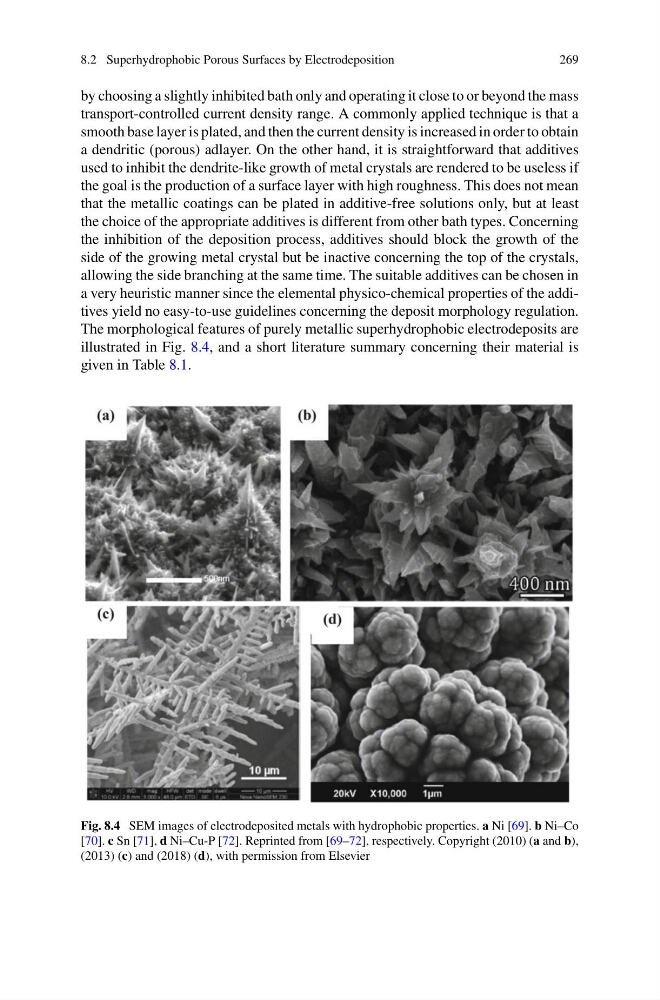
The morphological features of purely metallic superhydrophobic electrodeposits are
illustrated in Fig. 8.4, and a short literature summary concerning their material is
given in Table 8.1.
Fig. 8.4 SEM images of electrodeposited metals with hydrophobic properties. a Ni [69]. b Ni–Co
[70]. c Sn [71], d Ni–Cu-P [72]. Reprinted from [69–72], respectively. Copyright (2010) (a and b),
(2013) (c) and (2018) (d), with permission from Elsevier
269
by choosing a slightly inhibited bath only and operating it close to or beyond the mass
transport-controlled current density range. A commonly applied technique is that a
smooth base layer is plated, and then the current density is increased in order to obtain
a dendritic (porous) adlayer. On the other hand, it is straightforward that additives
used to inhibit the dendrite-like growth of metal crystals are rendered to be useless if
the goal is the production of a surface layer with high roughness. This does not mean
that the metallic coatings can be plated in additive-free solutions only, but at least
the choice of the appropriate additives is different from other bath types. Concerning
the inhibition of the deposition process, additives should block the growth of the
side of the growing metal crystal but be inactive concerning the top of the crystals,
allowing the side branching at the same time. The suitable additives can be chosen in
a very heuristic manner since the elemental physico-chemical properties of the additives yield no easy-to-use guidelines concerning the deposit morphology regulation.
The morphological features of purely metallic superhydrophobic electrodeposits are
illustrated in Fig. 8.4, and a short literature summary concerning their material is
given in Table 8.1.
Fig. 8.4 SEM images of electrodeposited metals with hydrophobic properties. a Ni [69]. b Ni–Co
[70]. c Sn [71], d Ni–Cu-P [72]. Reprinted from [69–72], respectively. Copyright (2010) (a and b),
(2013) (c) and (2018) (d), with permission from Elsevier