

252
7 Composites
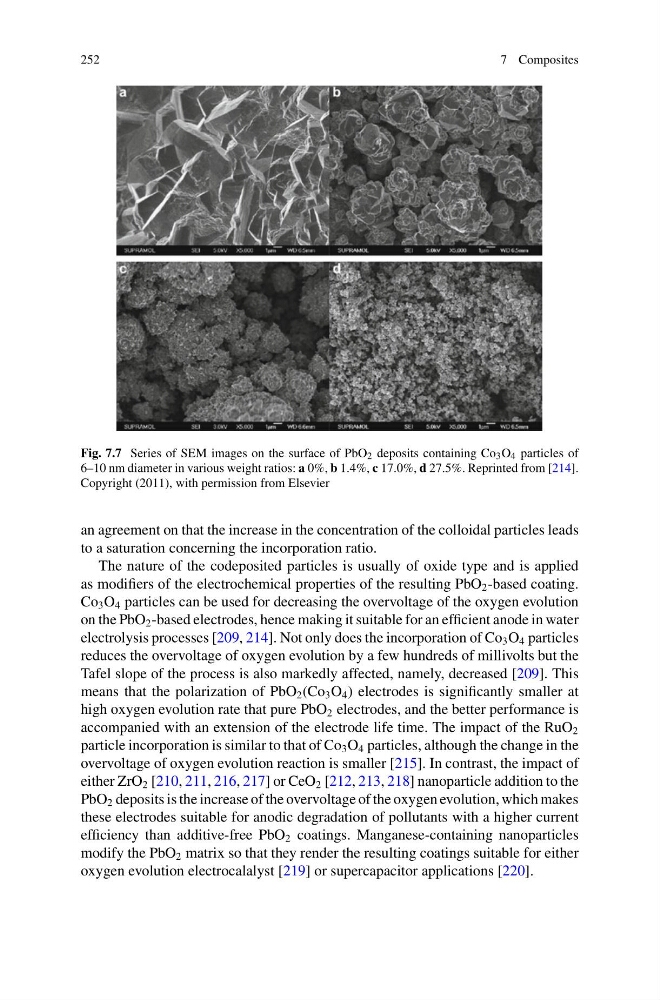
Fig. 7.7 Series of SEM images on the surface of PbO 2 deposits containing Co 3 O 4 particles of
6–10 nm diameter in various weight ratios: a 0%, b 1.4%, c 17.0%, d 27.5%. Reprinted from [214].
Copyright (2011), with permission from Elsevier
an agreement on that the increase in the concentration of the colloidal particles leads
to a saturation concerning the incorporation ratio.
The nature of the codeposited particles is usually of oxide type and is applied
as modifiers of the electrochemical properties of the resulting PbO 2 -based coating.
Co 3 O 4 particles can be used for decreasing the overvoltage of the oxygen evolution
on the PbO 2 -based electrodes, hence making it suitable for an efficient anode in water
electrolysis processes [209, 214]. Not only does the incorporation of Co 3 O 4 particles
reduces the overvoltage of oxygen evolution by a few hundreds of millivolts but the
Tafel slope of the process is also markedly affected, namely, decreased [209]. This
means that the polarization of PbO 2 (Co 3 O 4 ) electrodes is significantly smaller at
high oxygen evolution rate that pure PbO 2 electrodes, and the better performance is
accompanied with an extension of the electrode life time. The impact of the RuO 2
particle incorporation is similar to that of Co 3 O 4 particles, although the change in the
overvoltage of oxygen evolution reaction is smaller [215]. In contrast, the impact of
either ZrO 2 [210, 211, 216, 217] or CeO 2 [212, 213, 218] nanoparticle addition to the
PbO 2 deposits is the increase of the overvoltage of the oxygen evolution, which makes
these electrodes suitable for anodic degradation of pollutants with a higher current
efficiency than additive-free PbO 2 coatings. Manganese-containing nanoparticles
modify the PbO 2 matrix so that they render the resulting coatings suitable for either
oxygen evolution electrocalalyst [219] or supercapacitor applications [220].
7 Composites
Fig. 7.7 Series of SEM images on the surface of PbO 2 deposits containing Co 3 O 4 particles of
6–10 nm diameter in various weight ratios: a 0%, b 1.4%, c 17.0%, d 27.5%. Reprinted from [214].
Copyright (2011), with permission from Elsevier
an agreement on that the increase in the concentration of the colloidal particles leads
to a saturation concerning the incorporation ratio.
The nature of the codeposited particles is usually of oxide type and is applied
as modifiers of the electrochemical properties of the resulting PbO 2 -based coating.
Co 3 O 4 particles can be used for decreasing the overvoltage of the oxygen evolution
on the PbO 2 -based electrodes, hence making it suitable for an efficient anode in water
electrolysis processes [209, 214]. Not only does the incorporation of Co 3 O 4 particles
reduces the overvoltage of oxygen evolution by a few hundreds of millivolts but the
Tafel slope of the process is also markedly affected, namely, decreased [209]. This
means that the polarization of PbO 2 (Co 3 O 4 ) electrodes is significantly smaller at
high oxygen evolution rate that pure PbO 2 electrodes, and the better performance is
accompanied with an extension of the electrode life time. The impact of the RuO 2
particle incorporation is similar to that of Co 3 O 4 particles, although the change in the
overvoltage of oxygen evolution reaction is smaller [215]. In contrast, the impact of
either ZrO 2 [210, 211, 216, 217] or CeO 2 [212, 213, 218] nanoparticle addition to the
PbO 2 deposits is the increase of the overvoltage of the oxygen evolution, which makes
these electrodes suitable for anodic degradation of pollutants with a higher current
efficiency than additive-free PbO 2 coatings. Manganese-containing nanoparticles
modify the PbO 2 matrix so that they render the resulting coatings suitable for either
oxygen evolution electrocalalyst [219] or supercapacitor applications [220].