

194
6 Nanocrystalline Deposits
small, there is an electrode potential deviation from that of microcrystalline reference in the same solution. The order of magnitude of this deviation is between 6 and
10 mV, which is in accord with the theory for the grain size given. The analysis of
the time evolution of the electrode potential indicated that a parabolic rate law can
be applied for the self-annealing process of nanocrystalline silver.
When the self-annealing process is studied with X-ray diffractometry, not only the
change in grain size can be inferred but the texture evolution is also obtained [36, 37].
It was revealed that the original texture substantially changes with time. While the
as-received deposits were of <100> texture, a strong <111> texture develops within a
week. The grain growth characteristics of the crystals of different orientation are also
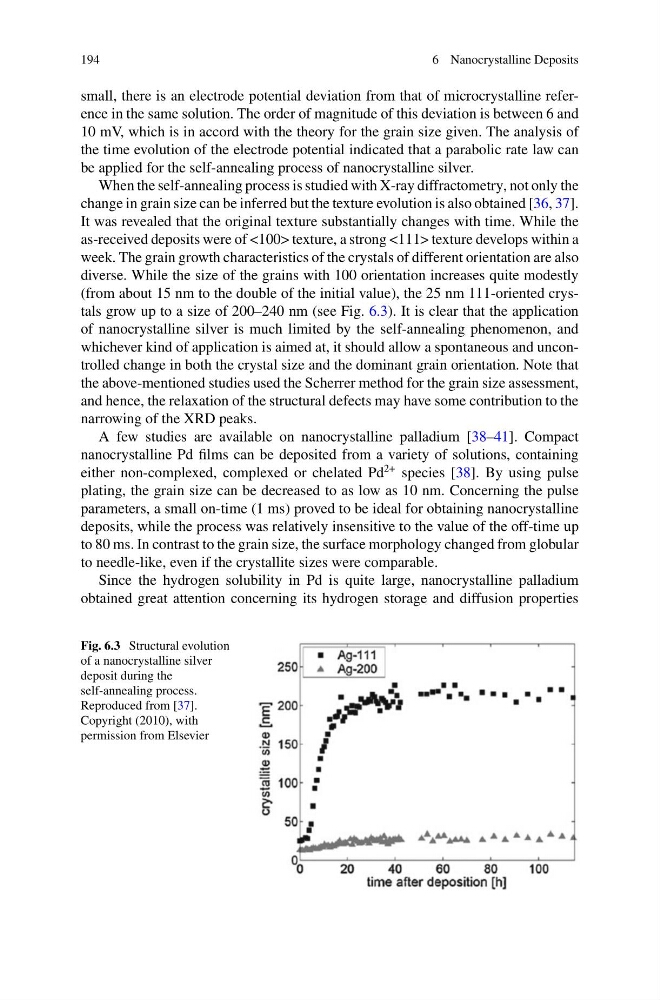
diverse. While the size of the grains with 100 orientation increases quite modestly
(from about 15 nm to the double of the initial value), the 25 nm 111-oriented crystals grow up to a size of 200–240 nm (see Fig. 6.3). It is clear that the application
of nanocrystalline silver is much limited by the self-annealing phenomenon, and
whichever kind of application is aimed at, it should allow a spontaneous and uncontrolled change in both the crystal size and the dominant grain orientation. Note that
the above-mentioned studies used the Scherrer method for the grain size assessment,
and hence, the relaxation of the structural defects may have some contribution to the
narrowing of the XRD peaks.
A few studies are available on nanocrystalline palladium [38–41]. Compact
nanocrystalline Pd films can be deposited from a variety of solutions, containing
either non-complexed, complexed or chelated Pd
2+ species [38]. By using pulse
plating, the grain size can be decreased to as low as 10 nm. Concerning the pulse
parameters, a small on-time (1 ms) proved to be ideal for obtaining nanocrystalline
deposits, while the process was relatively insensitive to the value of the off-time up
to 80 ms. In contrast to the grain size, the surface morphology changed from globular
to needle-like, even if the crystallite sizes were comparable.
Since the hydrogen solubility in Pd is quite large, nanocrystalline palladium
obtained great attention concerning its hydrogen storage and diffusion properties
Fig. 6.3 Structural evolution
of a nanocrystalline silver
deposit during the
self-annealing process.
Reproduced from [37].
Copyright (2010), with
permission from Elsevier
6 Nanocrystalline Deposits
small, there is an electrode potential deviation from that of microcrystalline reference in the same solution. The order of magnitude of this deviation is between 6 and
10 mV, which is in accord with the theory for the grain size given. The analysis of
the time evolution of the electrode potential indicated that a parabolic rate law can
be applied for the self-annealing process of nanocrystalline silver.
When the self-annealing process is studied with X-ray diffractometry, not only the
change in grain size can be inferred but the texture evolution is also obtained [36, 37].
It was revealed that the original texture substantially changes with time. While the
as-received deposits were of <100> texture, a strong <111> texture develops within a
week. The grain growth characteristics of the crystals of different orientation are also
diverse. While the size of the grains with 100 orientation increases quite modestly
(from about 15 nm to the double of the initial value), the 25 nm 111-oriented crystals grow up to a size of 200–240 nm (see Fig. 6.3). It is clear that the application
of nanocrystalline silver is much limited by the self-annealing phenomenon, and
whichever kind of application is aimed at, it should allow a spontaneous and uncontrolled change in both the crystal size and the dominant grain orientation. Note that
the above-mentioned studies used the Scherrer method for the grain size assessment,
and hence, the relaxation of the structural defects may have some contribution to the
narrowing of the XRD peaks.
A few studies are available on nanocrystalline palladium [38–41]. Compact
nanocrystalline Pd films can be deposited from a variety of solutions, containing
either non-complexed, complexed or chelated Pd
2+ species [38]. By using pulse
plating, the grain size can be decreased to as low as 10 nm. Concerning the pulse
parameters, a small on-time (1 ms) proved to be ideal for obtaining nanocrystalline
deposits, while the process was relatively insensitive to the value of the off-time up
to 80 ms. In contrast to the grain size, the surface morphology changed from globular
to needle-like, even if the crystallite sizes were comparable.
Since the hydrogen solubility in Pd is quite large, nanocrystalline palladium
obtained great attention concerning its hydrogen storage and diffusion properties
Fig. 6.3 Structural evolution
of a nanocrystalline silver
deposit during the
self-annealing process.
Reproduced from [37].
Copyright (2010), with
permission from Elsevier