

6.2 Nanocrystalline Deposits of Metallic Elements
193
by the reduction of HAuCl 4 with 3-merkapto-1-propanesulphonate, resulting in
[Au(–S–C 3 H 8 –SO 3 ) 2 ]
− species [33, 34]. All the three above-mentioned studies
demonstrate the synergetic effect of the simultaneous application of pulse plating
and additives in the reduction of the grain size by a factor of 2–3. The smallest grain
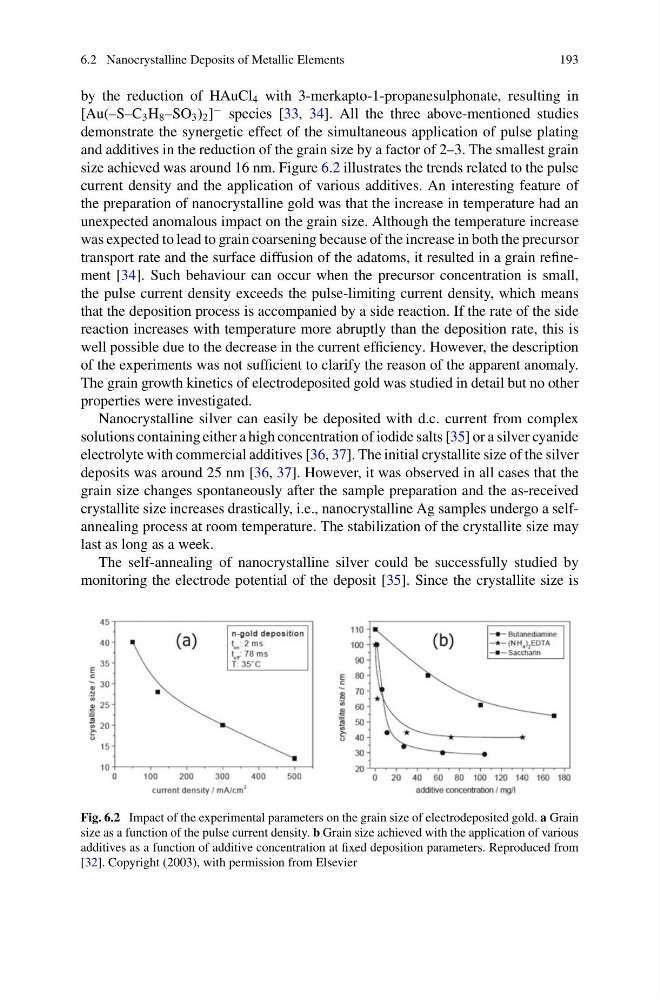
size achieved was around 16 nm. Figure 6.2 illustrates the trends related to the pulse
current density and the application of various additives. An interesting feature of
the preparation of nanocrystalline gold was that the increase in temperature had an
unexpected anomalous impact on the grain size. Although the temperature increase
was expected to lead to grain coarsening because of the increase in both the precursor
transport rate and the surface diffusion of the adatoms, it resulted in a grain refinement [34]. Such behaviour can occur when the precursor concentration is small,
the pulse current density exceeds the pulse-limiting current density, which means
that the deposition process is accompanied by a side reaction. If the rate of the side
reaction increases with temperature more abruptly than the deposition rate, this is
well possible due to the decrease in the current efficiency. However, the description
of the experiments was not sufficient to clarify the reason of the apparent anomaly.
The grain growth kinetics of electrodeposited gold was studied in detail but no other
properties were investigated.
Nanocrystalline silver can easily be deposited with d.c. current from complex
solutions containing either a high concentration of iodide salts [35] or a silver cyanide
electrolyte with commercial additives [36, 37]. The initial crystallite size of the silver
deposits was around 25 nm [36, 37]. However, it was observed in all cases that the
grain size changes spontaneously after the sample preparation and the as-received
crystallite size increases drastically, i.e., nanocrystalline Ag samples undergo a selfannealing process at room temperature. The stabilization of the crystallite size may
last as long as a week.
The self-annealing of nanocrystalline silver could be successfully studied by
monitoring the electrode potential of the deposit [35]. Since the crystallite size is
Fig. 6.2 Impact of the experimental parameters on the grain size of electrodeposited gold. a Grain
size as a function of the pulse current density. b Grain size achieved with the application of various
additives as a function of additive concentration at fixed deposition parameters. Reproduced from
[32]. Copyright (2003), with permission from Elsevier
193
by the reduction of HAuCl 4 with 3-merkapto-1-propanesulphonate, resulting in
[Au(–S–C 3 H 8 –SO 3 ) 2 ]
− species [33, 34]. All the three above-mentioned studies
demonstrate the synergetic effect of the simultaneous application of pulse plating
and additives in the reduction of the grain size by a factor of 2–3. The smallest grain
size achieved was around 16 nm. Figure 6.2 illustrates the trends related to the pulse
current density and the application of various additives. An interesting feature of
the preparation of nanocrystalline gold was that the increase in temperature had an
unexpected anomalous impact on the grain size. Although the temperature increase
was expected to lead to grain coarsening because of the increase in both the precursor
transport rate and the surface diffusion of the adatoms, it resulted in a grain refinement [34]. Such behaviour can occur when the precursor concentration is small,
the pulse current density exceeds the pulse-limiting current density, which means
that the deposition process is accompanied by a side reaction. If the rate of the side
reaction increases with temperature more abruptly than the deposition rate, this is
well possible due to the decrease in the current efficiency. However, the description
of the experiments was not sufficient to clarify the reason of the apparent anomaly.
The grain growth kinetics of electrodeposited gold was studied in detail but no other
properties were investigated.
Nanocrystalline silver can easily be deposited with d.c. current from complex
solutions containing either a high concentration of iodide salts [35] or a silver cyanide
electrolyte with commercial additives [36, 37]. The initial crystallite size of the silver
deposits was around 25 nm [36, 37]. However, it was observed in all cases that the
grain size changes spontaneously after the sample preparation and the as-received
crystallite size increases drastically, i.e., nanocrystalline Ag samples undergo a selfannealing process at room temperature. The stabilization of the crystallite size may
last as long as a week.
The self-annealing of nanocrystalline silver could be successfully studied by
monitoring the electrode potential of the deposit [35]. Since the crystallite size is
Fig. 6.2 Impact of the experimental parameters on the grain size of electrodeposited gold. a Grain
size as a function of the pulse current density. b Grain size achieved with the application of various
additives as a function of additive concentration at fixed deposition parameters. Reproduced from
[32]. Copyright (2003), with permission from Elsevier