

168
5 Compositionally Modulated and Multilayered Deposits
align the magnetization direction of the FM layers, the spin-dependent scattering is
strongly reduced, hence decreasing the resistance of the system. This phenomenon is
called the giant magnetoresistance (GMR) which originates from the order of magnitude of the resistivity change but it refers to the mechanism of the resistivity change
as well.
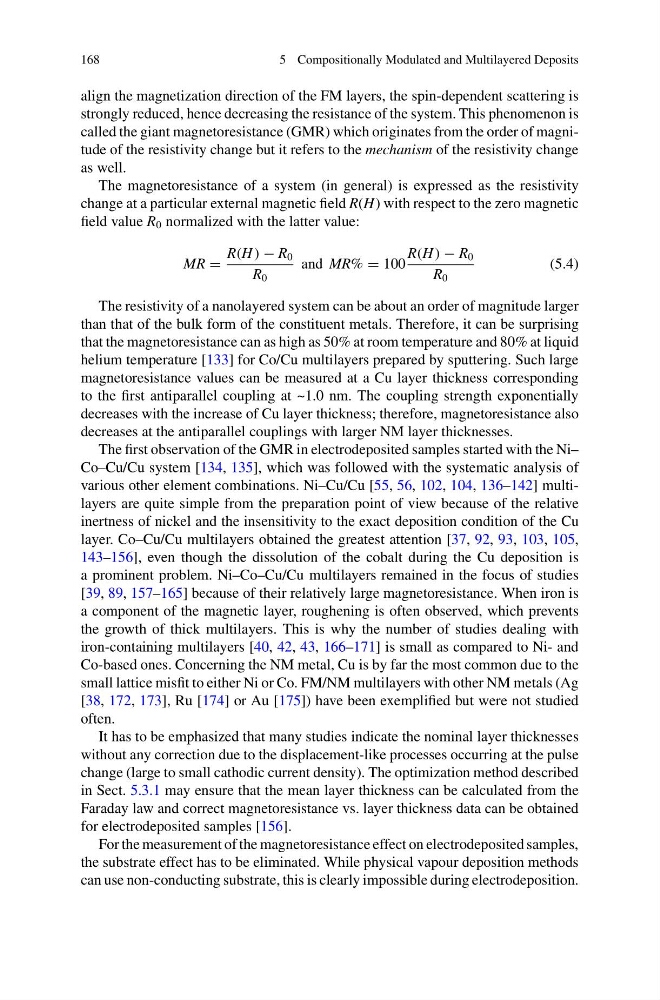
The magnetoresistance of a system (in general) is expressed as the resistivity
change at a particular external magnetic field R(H) with respect to the zero magnetic
field value R 0 normalized with the latter value:
MR =
R(H ) − R 0
R 0
and MR% = 100
R(H ) − R 0
R 0
(5.4)
The resistivity of a nanolayered system can be about an order of magnitude larger
than that of the bulk form of the constituent metals. Therefore, it can be surprising
that the magnetoresistance can as high as 50% at room temperature and 80% at liquid
helium temperature [133] for Co/Cu multilayers prepared by sputtering. Such large
magnetoresistance values can be measured at a Cu layer thickness corresponding
to the first antiparallel coupling at ~1.0 nm. The coupling strength exponentially
decreases with the increase of Cu layer thickness; therefore, magnetoresistance also
decreases at the antiparallel couplings with larger NM layer thicknesses.
The first observation of the GMR in electrodeposited samples started with the Ni–
Co–Cu/Cu system [134, 135], which was followed with the systematic analysis of
various other element combinations. Ni–Cu/Cu [55, 56, 102, 104, 136–142] multilayers are quite simple from the preparation point of view because of the relative
inertness of nickel and the insensitivity to the exact deposition condition of the Cu
layer. Co–Cu/Cu multilayers obtained the greatest attention [37, 92, 93, 103, 105,
143–156], even though the dissolution of the cobalt during the Cu deposition is
a prominent problem. Ni–Co–Cu/Cu multilayers remained in the focus of studies
[39, 89, 157–165] because of their relatively large magnetoresistance. When iron is
a component of the magnetic layer, roughening is often observed, which prevents
the growth of thick multilayers. This is why the number of studies dealing with
iron-containing multilayers [40, 42, 43, 166–171] is small as compared to Ni- and
Co-based ones. Concerning the NM metal, Cu is by far the most common due to the
small lattice misfit to either Ni or Co. FM/NM multilayers with other NM metals (Ag
[38, 172, 173], Ru [174] or Au [175]) have been exemplified but were not studied
often.
It has to be emphasized that many studies indicate the nominal layer thicknesses
without any correction due to the displacement-like processes occurring at the pulse
change (large to small cathodic current density). The optimization method described
in Sect. 5.3.1 may ensure that the mean layer thickness can be calculated from the
Faraday law and correct magnetoresistance vs. layer thickness data can be obtained
for electrodeposited samples [156].
For the measurement of the magnetoresistance effect on electrodeposited samples,
the substrate effect has to be eliminated. While physical vapour deposition methods
can use non-conducting substrate, this is clearly impossible during electrodeposition.
5 Compositionally Modulated and Multilayered Deposits
align the magnetization direction of the FM layers, the spin-dependent scattering is
strongly reduced, hence decreasing the resistance of the system. This phenomenon is
called the giant magnetoresistance (GMR) which originates from the order of magnitude of the resistivity change but it refers to the mechanism of the resistivity change
as well.
The magnetoresistance of a system (in general) is expressed as the resistivity
change at a particular external magnetic field R(H) with respect to the zero magnetic
field value R 0 normalized with the latter value:
MR =
R(H ) − R 0
R 0
and MR% = 100
R(H ) − R 0
R 0
(5.4)
The resistivity of a nanolayered system can be about an order of magnitude larger
than that of the bulk form of the constituent metals. Therefore, it can be surprising
that the magnetoresistance can as high as 50% at room temperature and 80% at liquid
helium temperature [133] for Co/Cu multilayers prepared by sputtering. Such large
magnetoresistance values can be measured at a Cu layer thickness corresponding
to the first antiparallel coupling at ~1.0 nm. The coupling strength exponentially
decreases with the increase of Cu layer thickness; therefore, magnetoresistance also
decreases at the antiparallel couplings with larger NM layer thicknesses.
The first observation of the GMR in electrodeposited samples started with the Ni–
Co–Cu/Cu system [134, 135], which was followed with the systematic analysis of
various other element combinations. Ni–Cu/Cu [55, 56, 102, 104, 136–142] multilayers are quite simple from the preparation point of view because of the relative
inertness of nickel and the insensitivity to the exact deposition condition of the Cu
layer. Co–Cu/Cu multilayers obtained the greatest attention [37, 92, 93, 103, 105,
143–156], even though the dissolution of the cobalt during the Cu deposition is
a prominent problem. Ni–Co–Cu/Cu multilayers remained in the focus of studies
[39, 89, 157–165] because of their relatively large magnetoresistance. When iron is
a component of the magnetic layer, roughening is often observed, which prevents
the growth of thick multilayers. This is why the number of studies dealing with
iron-containing multilayers [40, 42, 43, 166–171] is small as compared to Ni- and
Co-based ones. Concerning the NM metal, Cu is by far the most common due to the
small lattice misfit to either Ni or Co. FM/NM multilayers with other NM metals (Ag
[38, 172, 173], Ru [174] or Au [175]) have been exemplified but were not studied
often.
It has to be emphasized that many studies indicate the nominal layer thicknesses
without any correction due to the displacement-like processes occurring at the pulse
change (large to small cathodic current density). The optimization method described
in Sect. 5.3.1 may ensure that the mean layer thickness can be calculated from the
Faraday law and correct magnetoresistance vs. layer thickness data can be obtained
for electrodeposited samples [156].
For the measurement of the magnetoresistance effect on electrodeposited samples,
the substrate effect has to be eliminated. While physical vapour deposition methods
can use non-conducting substrate, this is clearly impossible during electrodeposition.