

5.4 Properties of Electrodeposited CMAs
167
Early works related to electrodeposited FM/NM multilayers focused on the
magnetic anisotropy of the layer system. The motivation was mainly the experience on thin cobalt layers; i.e., that a perpendicular magnetic anisotropy is observed
at a layer thickness of up to a few atomic planes. The multilayer configuration with
a suitable NM metal was hoped to give rise to a perpendicular anisotropy with high
magnetization at the same time. The perpendicular anisotropy was found for both
Co/Cu [129, 130] and Co/Pt [131, 132] multilayers obtained from a single bath.
Concerning the magnetoresistance in multilayered materials, the background
is explained here only shortly, referring to an extensive review listing the full
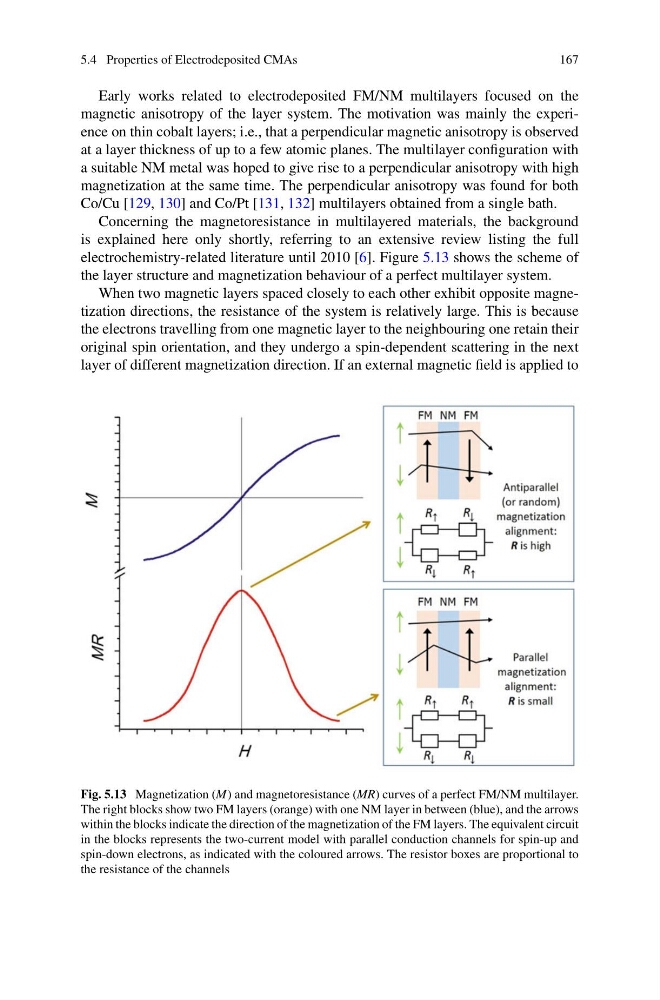
electrochemistry-related literature until 2010 [6]. Figure 5.13 shows the scheme of
the layer structure and magnetization behaviour of a perfect multilayer system.
When two magnetic layers spaced closely to each other exhibit opposite magnetization directions, the resistance of the system is relatively large. This is because
the electrons travelling from one magnetic layer to the neighbouring one retain their
original spin orientation, and they undergo a spin-dependent scattering in the next
layer of different magnetization direction. If an external magnetic field is applied to
Fig. 5.13 Magnetization (M) and magnetoresistance (MR) curves of a perfect FM/NM multilayer.
The right blocks show two FM layers (orange) with one NM layer in between (blue), and the arrows
within the blocks indicate the direction of the magnetization of the FM layers. The equivalent circuit
in the blocks represents the two-current model with parallel conduction channels for spin-up and
spin-down electrons, as indicated with the coloured arrows. The resistor boxes are proportional to
the resistance of the channels
167
Early works related to electrodeposited FM/NM multilayers focused on the
magnetic anisotropy of the layer system. The motivation was mainly the experience on thin cobalt layers; i.e., that a perpendicular magnetic anisotropy is observed
at a layer thickness of up to a few atomic planes. The multilayer configuration with
a suitable NM metal was hoped to give rise to a perpendicular anisotropy with high
magnetization at the same time. The perpendicular anisotropy was found for both
Co/Cu [129, 130] and Co/Pt [131, 132] multilayers obtained from a single bath.
Concerning the magnetoresistance in multilayered materials, the background
is explained here only shortly, referring to an extensive review listing the full
electrochemistry-related literature until 2010 [6]. Figure 5.13 shows the scheme of
the layer structure and magnetization behaviour of a perfect multilayer system.
When two magnetic layers spaced closely to each other exhibit opposite magnetization directions, the resistance of the system is relatively large. This is because
the electrons travelling from one magnetic layer to the neighbouring one retain their
original spin orientation, and they undergo a spin-dependent scattering in the next
layer of different magnetization direction. If an external magnetic field is applied to
Fig. 5.13 Magnetization (M) and magnetoresistance (MR) curves of a perfect FM/NM multilayer.
The right blocks show two FM layers (orange) with one NM layer in between (blue), and the arrows
within the blocks indicate the direction of the magnetization of the FM layers. The equivalent circuit
in the blocks represents the two-current model with parallel conduction channels for spin-up and
spin-down electrons, as indicated with the coloured arrows. The resistor boxes are proportional to
the resistance of the channels