

162
5 Compositionally Modulated and Multilayered Deposits
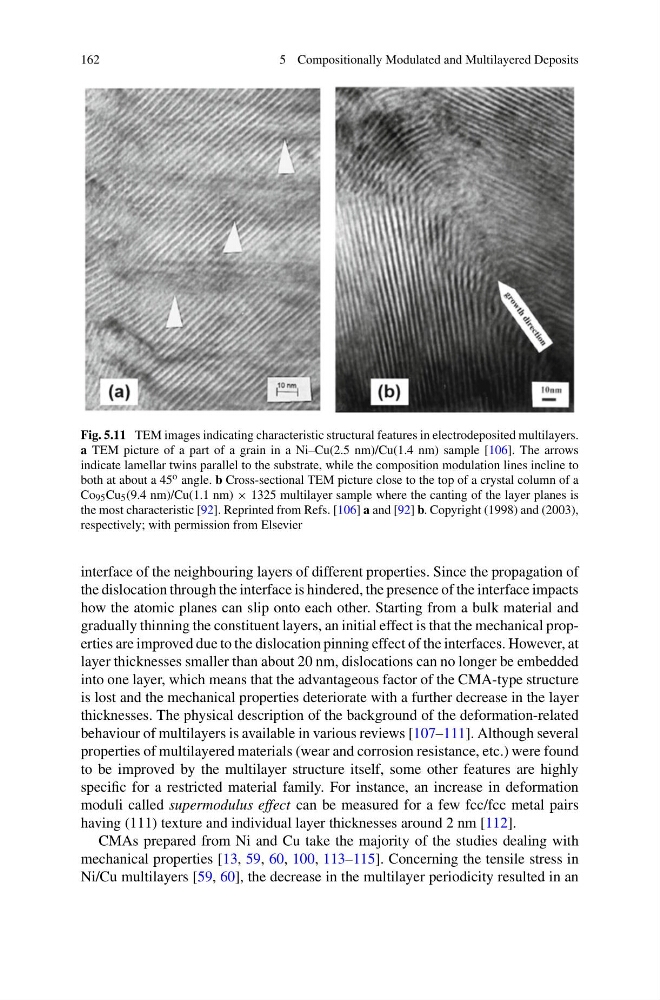
Fig. 5.11 TEM images indicating characteristic structural features in electrodeposited multilayers.
a TEM picture of a part of a grain in a Ni–Cu(2.5 nm)/Cu(1.4 nm) sample [106]. The arrows
indicate lamellar twins parallel to the substrate, while the composition modulation lines incline to
both at about a 45 o angle. b Cross-sectional TEM picture close to the top of a crystal column of a
Co 95 Cu 5 (9.4 nm)/Cu(1.1 nm) × 1325 multilayer sample where the canting of the layer planes is
the most characteristic [92]. Reprinted from Refs. [106] a and [92] b. Copyright (1998) and (2003),
respectively; with permission from Elsevier
interface of the neighbouring layers of different properties. Since the propagation of
the dislocation through the interface is hindered, the presence of the interface impacts
how the atomic planes can slip onto each other. Starting from a bulk material and
gradually thinning the constituent layers, an initial effect is that the mechanical properties are improved due to the dislocation pinning effect of the interfaces. However, at
layer thicknesses smaller than about 20 nm, dislocations can no longer be embedded
into one layer, which means that the advantageous factor of the CMA-type structure
is lost and the mechanical properties deteriorate with a further decrease in the layer
thicknesses. The physical description of the background of the deformation-related
behaviour of multilayers is available in various reviews [107–111]. Although several
properties of multilayered materials (wear and corrosion resistance, etc.) were found
to be improved by the multilayer structure itself, some other features are highly
specific for a restricted material family. For instance, an increase in deformation
moduli called supermodulus effect can be measured for a few fcc/fcc metal pairs
having (111) texture and individual layer thicknesses around 2 nm [112].
CMAs prepared from Ni and Cu take the majority of the studies dealing with
mechanical properties [13, 59, 60, 100, 113–115]. Concerning the tensile stress in
Ni/Cu multilayers [59, 60], the decrease in the multilayer periodicity resulted in an
5 Compositionally Modulated and Multilayered Deposits
Fig. 5.11 TEM images indicating characteristic structural features in electrodeposited multilayers.
a TEM picture of a part of a grain in a Ni–Cu(2.5 nm)/Cu(1.4 nm) sample [106]. The arrows
indicate lamellar twins parallel to the substrate, while the composition modulation lines incline to
both at about a 45 o angle. b Cross-sectional TEM picture close to the top of a crystal column of a
Co 95 Cu 5 (9.4 nm)/Cu(1.1 nm) × 1325 multilayer sample where the canting of the layer planes is
the most characteristic [92]. Reprinted from Refs. [106] a and [92] b. Copyright (1998) and (2003),
respectively; with permission from Elsevier
interface of the neighbouring layers of different properties. Since the propagation of
the dislocation through the interface is hindered, the presence of the interface impacts
how the atomic planes can slip onto each other. Starting from a bulk material and
gradually thinning the constituent layers, an initial effect is that the mechanical properties are improved due to the dislocation pinning effect of the interfaces. However, at
layer thicknesses smaller than about 20 nm, dislocations can no longer be embedded
into one layer, which means that the advantageous factor of the CMA-type structure
is lost and the mechanical properties deteriorate with a further decrease in the layer
thicknesses. The physical description of the background of the deformation-related
behaviour of multilayers is available in various reviews [107–111]. Although several
properties of multilayered materials (wear and corrosion resistance, etc.) were found
to be improved by the multilayer structure itself, some other features are highly
specific for a restricted material family. For instance, an increase in deformation
moduli called supermodulus effect can be measured for a few fcc/fcc metal pairs
having (111) texture and individual layer thicknesses around 2 nm [112].
CMAs prepared from Ni and Cu take the majority of the studies dealing with
mechanical properties [13, 59, 60, 100, 113–115]. Concerning the tensile stress in
Ni/Cu multilayers [59, 60], the decrease in the multilayer periodicity resulted in an