

46
N. Herisanu et al.
L(y) = y
+ y
(16)
N (y) =
ω
2
n
Ω 2 − 1
y +
1
Ω
(μ − αa
2 y
2
+ γ a
4 y
4
)y
−
β
Ω 2 a
4 y
5
(17)
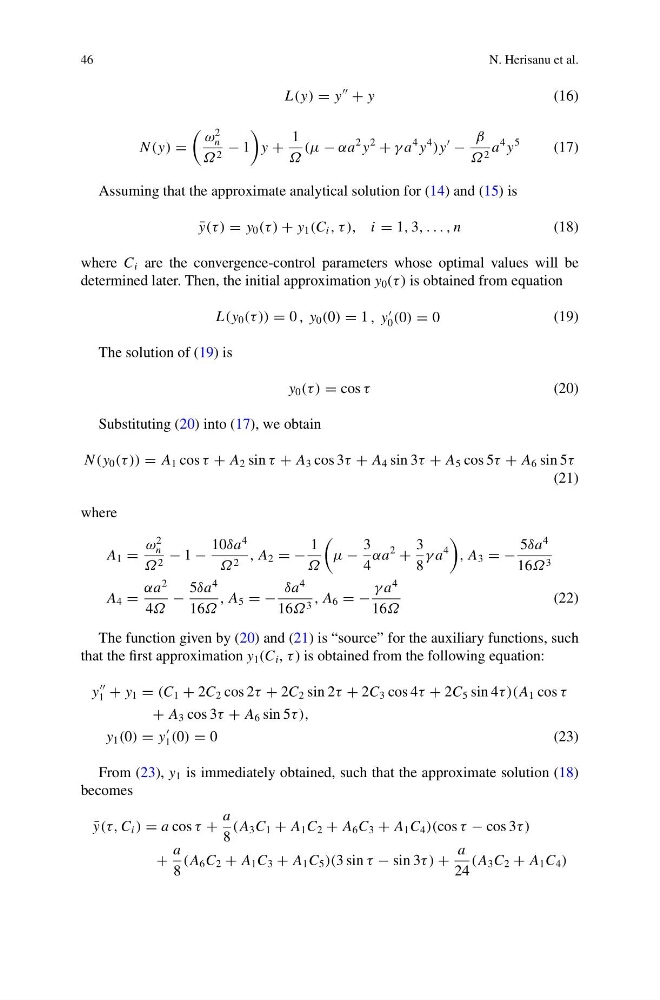
Assuming that the approximate analytical solution for (14) and (15) is
¯
y(τ ) = y 0 (τ ) + y 1 (C i , τ ), i = 1, 3, . . . , n
(18)
where C i are the convergence-control parameters whose optimal values will be
determined later. Then, the initial approximation y 0 (τ ) is obtained from equation
L(y 0 (τ )) = 0 , y 0 (0) = 1 , y
0 (0) = 0
(19)
The solution of (19) is
y 0 (τ ) = cos τ
(20)
Substituting (20) into (17), we obtain
N (y 0 (τ )) = A 1 cos τ + A 2 sin τ + A 3 cos 3τ + A 4 sin 3τ + A 5 cos 5τ + A 6 sin 5τ
(21)
where
A 1 =
ω
2
n
Ω 2 − 1 −
10δa
4
Ω 2 , A 2 = −
1
Ω
μ −
3
4
αa
2
+
3
8
γ a
4
, A 3 = −
5δa
4
16Ω 3
A 4 =
αa
2
4Ω
−
5δa
4
16Ω
, A 5 = −
δa
4
16Ω 3 , A 6 = −
γ a
4
16Ω
(22)
The function given by (20) and (21) is “source” for the auxiliary functions, such
that the first approximation y 1 (C i , τ ) is obtained from the following equation:
y
1 + y 1 = (C 1 + 2C 2 cos 2τ + 2C 2 sin 2τ + 2C 3 cos 4τ + 2C 5 sin 4τ )(A 1 cos τ
+ A 3 cos 3τ + A 6 sin 5τ ),
y 1 (0) = y
1 (0) = 0
(23)
From (23), y 1 is immediately obtained, such that the approximate solution (18)
becomes
¯
y(τ, C i ) = a cos τ +
a
8
(A 3 C 1 + A 1 C 2 + A 6 C 3 + A 1 C 4 )(cos τ − cos 3τ )
+
a
8
(A 6 C 2 + A 1 C 3 + A 1 C 5 )(3 sin τ − sin 3τ ) +
a
24
(A 3 C 2 + A 1 C 4 )
N. Herisanu et al.
L(y) = y
+ y
(16)
N (y) =
ω
2
n
Ω 2 − 1
y +
1
Ω
(μ − αa
2 y
2
+ γ a
4 y
4
)y
−
β
Ω 2 a
4 y
5
(17)
Assuming that the approximate analytical solution for (14) and (15) is
¯
y(τ ) = y 0 (τ ) + y 1 (C i , τ ), i = 1, 3, . . . , n
(18)
where C i are the convergence-control parameters whose optimal values will be
determined later. Then, the initial approximation y 0 (τ ) is obtained from equation
L(y 0 (τ )) = 0 , y 0 (0) = 1 , y
0 (0) = 0
(19)
The solution of (19) is
y 0 (τ ) = cos τ
(20)
Substituting (20) into (17), we obtain
N (y 0 (τ )) = A 1 cos τ + A 2 sin τ + A 3 cos 3τ + A 4 sin 3τ + A 5 cos 5τ + A 6 sin 5τ
(21)
where
A 1 =
ω
2
n
Ω 2 − 1 −
10δa
4
Ω 2 , A 2 = −
1
Ω
μ −
3
4
αa
2
+
3
8
γ a
4
, A 3 = −
5δa
4
16Ω 3
A 4 =
αa
2
4Ω
−
5δa
4
16Ω
, A 5 = −
δa
4
16Ω 3 , A 6 = −
γ a
4
16Ω
(22)
The function given by (20) and (21) is “source” for the auxiliary functions, such
that the first approximation y 1 (C i , τ ) is obtained from the following equation:
y
1 + y 1 = (C 1 + 2C 2 cos 2τ + 2C 2 sin 2τ + 2C 3 cos 4τ + 2C 5 sin 4τ )(A 1 cos τ
+ A 3 cos 3τ + A 6 sin 5τ ),
y 1 (0) = y
1 (0) = 0
(23)
From (23), y 1 is immediately obtained, such that the approximate solution (18)
becomes
¯
y(τ, C i ) = a cos τ +
a
8
(A 3 C 1 + A 1 C 2 + A 6 C 3 + A 1 C 4 )(cos τ − cos 3τ )
+
a
8
(A 6 C 2 + A 1 C 3 + A 1 C 5 )(3 sin τ − sin 3τ ) +
a
24
(A 3 C 2 + A 1 C 4 )