

An Approximate Analytical Solution of Transversal …
45
¯
t =
E I
ml 4
1/2
, ¯
T =
lT
r 2 , μ =
cl
2
(m E I ) 1/2 , ω
2
n = π
4
−
P 0 l
2
π
2
2E Il 4 ,
β =
P 0
2E I
+
7π
2
8l 2
r
4
π
4
2E Il 4 , δ =
27
20
r π
l
8
(9)
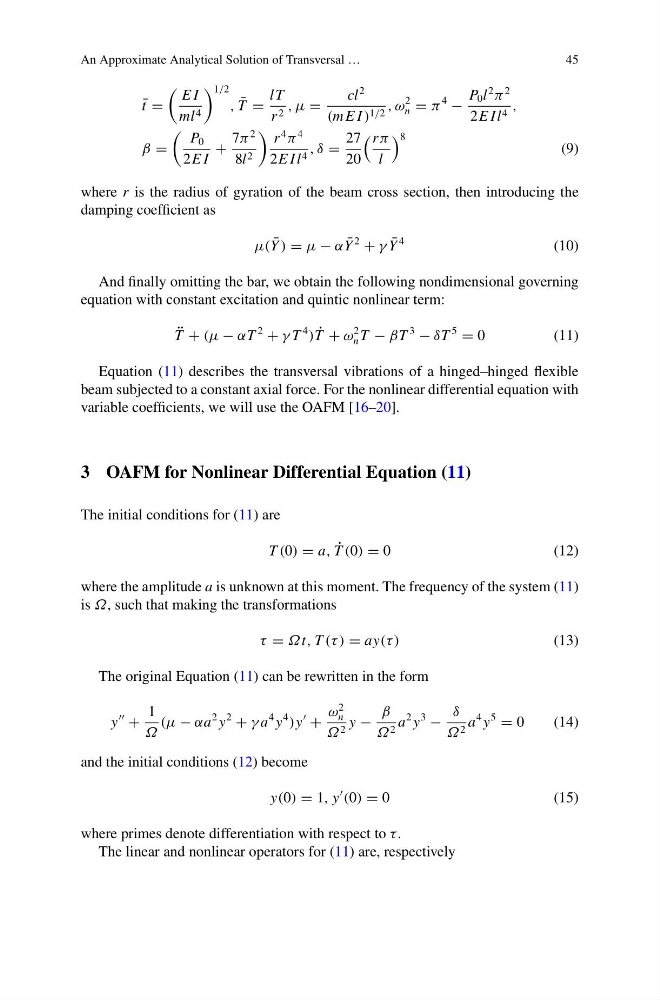
where r is the radius of gyration of the beam cross section, then introducing the
damping coefficient as
μ( ¯
Y ) = μ − α ¯
Y
2
+ γ ¯
Y
4
(10)
And finally omitting the bar, we obtain the following nondimensional governing
equation with constant excitation and quintic nonlinear term:
¨
T + (μ − αT
2
+ γ T
4
) ˙
T + ω
2
n T − βT
3
− δT
5
= 0
(11)
Equation (11) describes the transversal vibrations of a hinged–hinged flexible
beam subjected to a constant axial force. For the nonlinear differential equation with
variable coefficients, we will use the OAFM [16–20].
3 OAFM for Nonlinear Differential Equation (11)
The initial conditions for (11) are
T (0) = a, ˙
T (0) = 0
( 1 2 )
where the amplitude a is unknown at this moment. The frequency of the system (11)
is Ω, such that making the transformations
τ = Ωt, T (τ ) = ay(τ )
(13)
The original Equation (11) can be rewritten in the form
y
+
1
Ω
(μ − αa
2 y
2
+ γ a
4 y
4
)y
+
ω
2
n
Ω 2 y −
β
Ω 2 a
2 y
3
−
δ
Ω 2 a
4 y
5
= 0
(14)
and the initial conditions (12) become
y(0) = 1, y
(0) = 0
(15)
where primes denote differentiation with respect to τ.
The linear and nonlinear operators for (11) are, respectively
45
¯
t =
E I
ml 4
1/2
, ¯
T =
lT
r 2 , μ =
cl
2
(m E I ) 1/2 , ω
2
n = π
4
−
P 0 l
2
π
2
2E Il 4 ,
β =
P 0
2E I
+
7π
2
8l 2
r
4
π
4
2E Il 4 , δ =
27
20
r π
l
8
(9)
where r is the radius of gyration of the beam cross section, then introducing the
damping coefficient as
μ( ¯
Y ) = μ − α ¯
Y
2
+ γ ¯
Y
4
(10)
And finally omitting the bar, we obtain the following nondimensional governing
equation with constant excitation and quintic nonlinear term:
¨
T + (μ − αT
2
+ γ T
4
) ˙
T + ω
2
n T − βT
3
− δT
5
= 0
(11)
Equation (11) describes the transversal vibrations of a hinged–hinged flexible
beam subjected to a constant axial force. For the nonlinear differential equation with
variable coefficients, we will use the OAFM [16–20].
3 OAFM for Nonlinear Differential Equation (11)
The initial conditions for (11) are
T (0) = a, ˙
T (0) = 0
( 1 2 )
where the amplitude a is unknown at this moment. The frequency of the system (11)
is Ω, such that making the transformations
τ = Ωt, T (τ ) = ay(τ )
(13)
The original Equation (11) can be rewritten in the form
y
+
1
Ω
(μ − αa
2 y
2
+ γ a
4 y
4
)y
+
ω
2
n
Ω 2 y −
β
Ω 2 a
2 y
3
−
δ
Ω 2 a
4 y
5
= 0
(14)
and the initial conditions (12) become
y(0) = 1, y
(0) = 0
(15)
where primes denote differentiation with respect to τ.
The linear and nonlinear operators for (11) are, respectively