

34
L. Cveticanin and D. Cveticanin
¨
x + ω
2
(τ )x|x|
α−1
= −
ε
M(τ )
dM
dτ
˙
x
(47)
where
ω
2
(τ ) =
k
M(τ )
(48)
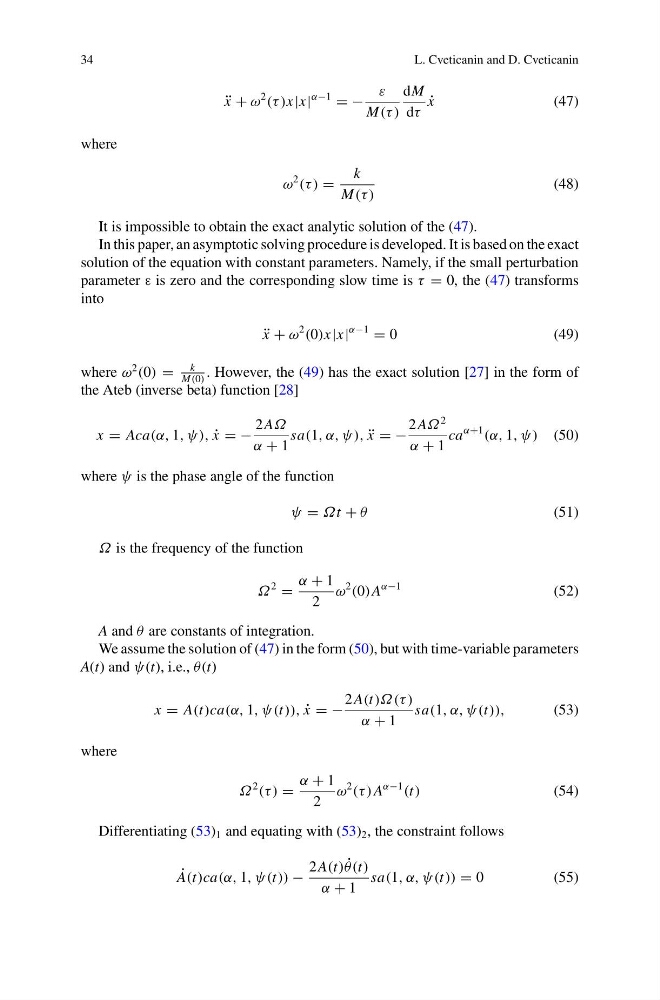
It is impossible to obtain the exact analytic solution of the (47).
In this paper, an asymptotic solving procedure is developed. It is based on the exact
solution of the equation with constant parameters. Namely, if the small perturbation
parameter ε is zero and the corresponding slow time is τ = 0, the (47) transforms
into
¨
x + ω
2
(0)x|x|
α−1
= 0
(49)
where ω
2
(0) =
k
M(0)
. However, the (49) has the exact solution [27] in the form of
the Ateb (inverse beta) function [28]
x = Aca(α, 1, ψ), ˙
x = −
2 AΩ
α + 1
sa(1, α, ψ), ¨
x = −
2 AΩ
2
α + 1
ca
α+1
(α, 1, ψ) (50)
where ψ is the phase angle of the function
ψ = Ωt + θ
(51)
Ω is the frequency of the function
Ω
2
=
α + 1
2
ω
2
(0)A
α−1
(52)
A and θ are constants of integration.
We assume the solution of (47) in the form (50), but with time-variable parameters
A(t) and ψ(t), i.e., θ (t)
x = A(t)ca(α, 1, ψ(t)), ˙
x = −
2 A(t)Ω(τ )
α + 1
sa(1, α, ψ(t)),
(53)
where
Ω
2
(τ ) =
α + 1
2
ω
2
(τ )A
α−1
(t)
(54)
Differentiating (53) 1 and equating with (53) 2 , the constraint follows
˙
A(t)ca(α, 1, ψ(t)) −
2 A(t) ˙
θ (t)
α + 1
sa(1, α, ψ(t)) = 0
(55)
L. Cveticanin and D. Cveticanin
¨
x + ω
2
(τ )x|x|
α−1
= −
ε
M(τ )
dM
dτ
˙
x
(47)
where
ω
2
(τ ) =
k
M(τ )
(48)
It is impossible to obtain the exact analytic solution of the (47).
In this paper, an asymptotic solving procedure is developed. It is based on the exact
solution of the equation with constant parameters. Namely, if the small perturbation
parameter ε is zero and the corresponding slow time is τ = 0, the (47) transforms
into
¨
x + ω
2
(0)x|x|
α−1
= 0
(49)
where ω
2
(0) =
k
M(0)
. However, the (49) has the exact solution [27] in the form of
the Ateb (inverse beta) function [28]
x = Aca(α, 1, ψ), ˙
x = −
2 AΩ
α + 1
sa(1, α, ψ), ¨
x = −
2 AΩ
2
α + 1
ca
α+1
(α, 1, ψ) (50)
where ψ is the phase angle of the function
ψ = Ωt + θ
(51)
Ω is the frequency of the function
Ω
2
=
α + 1
2
ω
2
(0)A
α−1
(52)
A and θ are constants of integration.
We assume the solution of (47) in the form (50), but with time-variable parameters
A(t) and ψ(t), i.e., θ (t)
x = A(t)ca(α, 1, ψ(t)), ˙
x = −
2 A(t)Ω(τ )
α + 1
sa(1, α, ψ(t)),
(53)
where
Ω
2
(τ ) =
α + 1
2
ω
2
(τ )A
α−1
(t)
(54)
Differentiating (53) 1 and equating with (53) 2 , the constraint follows
˙
A(t)ca(α, 1, ψ(t)) −
2 A(t) ˙
θ (t)
α + 1
sa(1, α, ψ(t)) = 0
(55)