

Parametric Analysis of Dynamic Insulation in the Action …
373
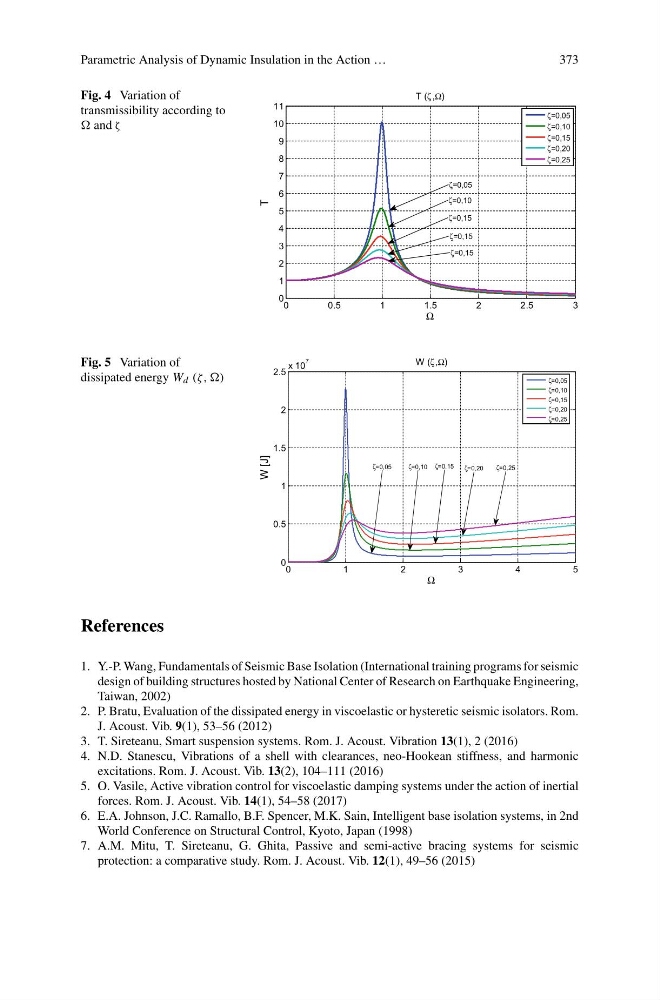
Fig. 4 Variation of
transmissibility according to
and ζ
0
0.5
1
1.5
2
2.5
3
0
1
2
3
4
5
6
7
8
9
10
11
Ω
T
T (ζ ,Ω)
ζ=0,05
ζ=0,10
ζ=0,15
ζ=0,20
ζ=0,25
ζ=0,05
ζ=0,10
ζ=0,15
ζ=0,15
ζ=0,15
Fig. 5 Variation of
dissipated energy W d (ζ, ,)
0
1
2
3
4
5
0
0.5
1
1.5
2
2.5
x 10
7
Ω
W [J]
W (ζ ,Ω)
ζ=0,05
ζ=0,10
ζ=0,15
ζ=0,20
ζ=0,25
ζ=0,10
ζ=0,20
ζ=0,25
ζ=0,15
ζ=0,05
References
1. Y.-P. Wang, Fundamentals of Seismic Base Isolation (International training programs for seismic
design of building structures hosted by National Center of Research on Earthquake Engineering,
Taiwan, 2002)
2. P. Bratu, Evaluation of the dissipated energy in viscoelastic or hysteretic seismic isolators. Rom.
J. Acoust. Vib. 9(1), 53–56 (2012)
3. T. Sireteanu, Smart suspension systems. Rom. J. Acoust. Vibration 13(1), 2 (2016)
4. N.D. Stanescu, Vibrations of a shell with clearances, neo-Hookean stiffness, and harmonic
excitations. Rom. J. Acoust. Vib. 13(2), 104–111 (2016)
5. O. Vasile, Active vibration control for viscoelastic damping systems under the action of inertial
forces. Rom. J. Acoust. Vib. 14(1), 54–58 (2017)
6. E.A. Johnson, J.C. Ramallo, B.F. Spencer, M.K. Sain, Intelligent base isolation systems, in 2nd
World Conference on Structural Control, Kyoto, Japan (1998)
7. A.M. Mitu, T. Sireteanu, G. Ghita, Passive and semi-active bracing systems for seismic
protection: a comparative study. Rom. J. Acoust. Vib. 12(1), 49–56 (2015)
373
Fig. 4 Variation of
transmissibility according to
and ζ
0
0.5
1
1.5
2
2.5
3
0
1
2
3
4
5
6
7
8
9
10
11
Ω
T
T (ζ ,Ω)
ζ=0,05
ζ=0,10
ζ=0,15
ζ=0,20
ζ=0,25
ζ=0,05
ζ=0,10
ζ=0,15
ζ=0,15
ζ=0,15
Fig. 5 Variation of
dissipated energy W d (ζ, ,)
0
1
2
3
4
5
0
0.5
1
1.5
2
2.5
x 10
7
Ω
W [J]
W (ζ ,Ω)
ζ=0,05
ζ=0,10
ζ=0,15
ζ=0,20
ζ=0,25
ζ=0,10
ζ=0,20
ζ=0,25
ζ=0,15
ζ=0,05
References
1. Y.-P. Wang, Fundamentals of Seismic Base Isolation (International training programs for seismic
design of building structures hosted by National Center of Research on Earthquake Engineering,
Taiwan, 2002)
2. P. Bratu, Evaluation of the dissipated energy in viscoelastic or hysteretic seismic isolators. Rom.
J. Acoust. Vib. 9(1), 53–56 (2012)
3. T. Sireteanu, Smart suspension systems. Rom. J. Acoust. Vibration 13(1), 2 (2016)
4. N.D. Stanescu, Vibrations of a shell with clearances, neo-Hookean stiffness, and harmonic
excitations. Rom. J. Acoust. Vib. 13(2), 104–111 (2016)
5. O. Vasile, Active vibration control for viscoelastic damping systems under the action of inertial
forces. Rom. J. Acoust. Vib. 14(1), 54–58 (2017)
6. E.A. Johnson, J.C. Ramallo, B.F. Spencer, M.K. Sain, Intelligent base isolation systems, in 2nd
World Conference on Structural Control, Kyoto, Japan (1998)
7. A.M. Mitu, T. Sireteanu, G. Ghita, Passive and semi-active bracing systems for seismic
protection: a comparative study. Rom. J. Acoust. Vib. 12(1), 49–56 (2015)