

372
P. Bratu et al.
6 Conclusions
Systems made up of HDRB (High Damping Rubber Bearing), LRB (Lead Rubber
Bearing), elastomeric antiseismic devices in connection with FVD (fluid viscous
damper) dissipative antiseismic devices can be plotted as a Zener equivalent model
based on the following methods of analysis and evaluation:
(a) identifying the size and distribution of mass elements, the geometric configuration and rigid behavior of the building to be isolated at the base;
(b) maximum acceleration level and spectral component (fundamental) for earthquakes from the seismic zoning of the building site;
(c) conceiving the system of supporting and lateral displacement of the building
placed on the insulation system at the base;
(d) the Zener connection specifying all elastic and viscous stiffnesses as an
equivalent model;
(e) analytical calculation of the dynamic response and evaluation of the dynamic
isolation parameters.
Computational relationships can be used for dynamic optimization of base isolation so that the transmissibility must be no more than 20–30%, as a critical and
significant condition for Zener model performance, [1, 2, 6–9].
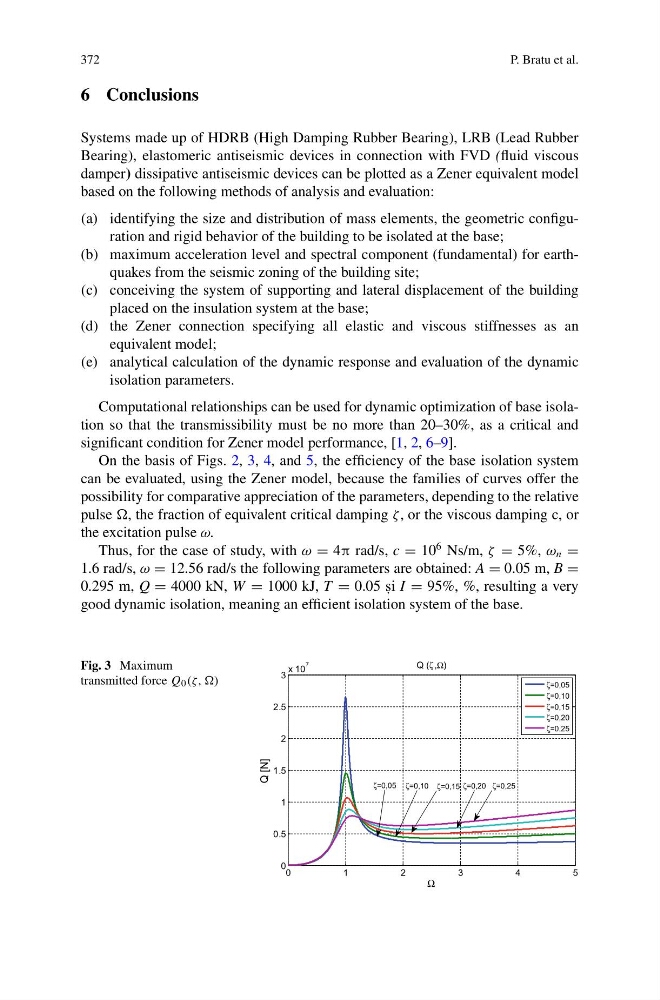
On the basis of Figs. 2, 3, 4, and 5, the efficiency of the base isolation system
can be evaluated, using the Zener model, because the families of curves offer the
possibility for comparative appreciation of the parameters, depending to the relative
pulse , the fraction of equivalent critical damping ζ, or the viscous damping c, or
the excitation pulse ω.
Thus, for the case of study, with ω = 4π rad/s, c = 10
6 Ns/m, ζ = 5%, ω n =
1.6 rad/s, ω = 12.56 rad/s the following parameters are obtained: A = 0.05 m, B =
0.295 m, Q = 4000 kN, W = 1000 kJ, T = 0.05 s , i I = 95%, %, resulting a very
good dynamic isolation, meaning an efficient isolation system of the base.
Fig. 3 Maximum
transmitted force Q 0 (ζ, ,)
0
1
2
3
4
5
0
0.5
1
1.5
2
2.5
3
x 10
7
Ω
Q [N]
Q (ζ ,Ω)
ζ=0,05
ζ=0,10
ζ=0,15
ζ=0,20
ζ=0,25
ζ=0,05 ζ=0,10 ζ=0,15 ζ=0,20 ζ=0,25
P. Bratu et al.
6 Conclusions
Systems made up of HDRB (High Damping Rubber Bearing), LRB (Lead Rubber
Bearing), elastomeric antiseismic devices in connection with FVD (fluid viscous
damper) dissipative antiseismic devices can be plotted as a Zener equivalent model
based on the following methods of analysis and evaluation:
(a) identifying the size and distribution of mass elements, the geometric configuration and rigid behavior of the building to be isolated at the base;
(b) maximum acceleration level and spectral component (fundamental) for earthquakes from the seismic zoning of the building site;
(c) conceiving the system of supporting and lateral displacement of the building
placed on the insulation system at the base;
(d) the Zener connection specifying all elastic and viscous stiffnesses as an
equivalent model;
(e) analytical calculation of the dynamic response and evaluation of the dynamic
isolation parameters.
Computational relationships can be used for dynamic optimization of base isolation so that the transmissibility must be no more than 20–30%, as a critical and
significant condition for Zener model performance, [1, 2, 6–9].
On the basis of Figs. 2, 3, 4, and 5, the efficiency of the base isolation system
can be evaluated, using the Zener model, because the families of curves offer the
possibility for comparative appreciation of the parameters, depending to the relative
pulse , the fraction of equivalent critical damping ζ, or the viscous damping c, or
the excitation pulse ω.
Thus, for the case of study, with ω = 4π rad/s, c = 10
6 Ns/m, ζ = 5%, ω n =
1.6 rad/s, ω = 12.56 rad/s the following parameters are obtained: A = 0.05 m, B =
0.295 m, Q = 4000 kN, W = 1000 kJ, T = 0.05 s , i I = 95%, %, resulting a very
good dynamic isolation, meaning an efficient isolation system of the base.
Fig. 3 Maximum
transmitted force Q 0 (ζ, ,)
0
1
2
3
4
5
0
0.5
1
1.5
2
2.5
3
x 10
7
Ω
Q [N]
Q (ζ ,Ω)
ζ=0,05
ζ=0,10
ζ=0,15
ζ=0,20
ζ=0,25
ζ=0,05 ζ=0,10 ζ=0,15 ζ=0,20 ζ=0,25