

370
P. Bratu et al.
0
2
4
6
8
10
0
0.2
0.4
0.6
0.8
1
1.2
1.4
1.6
ω[rad/s]
A [m]
A(c,ω)
c=10
6 Ns/m
c=2*10
6 Ns/m
c=3*10
6 Ns/m
c=4*10
6 Ns/m
c=5*10
6 Ns/m
c=10
6 Ns/m
c=2*10
6 Ns/m
c=3*10
6 Ns/m
c=4*10
6 Ns/m
c=5*10
6 Ns/m
0
2
4
6
8
10
0.27
0.28
0.29
0.3
0.31
0.32
0.33
0.34
0.35
0.36
ω [rad/s]
B [m]
B [c,ω]
c=10 6 Ns/m
c=2*10 6 Ns/m
c=3*10 6 Ns/m
c=4*10 6 Ns/m
c=5*10 6 Ns/m
c=2*10 6 Ns/m
c=4*10 6 Ns/m
c=5*10 6 Ns/m
c=3*10 6 Ns/m
c=10 6 Ns/m
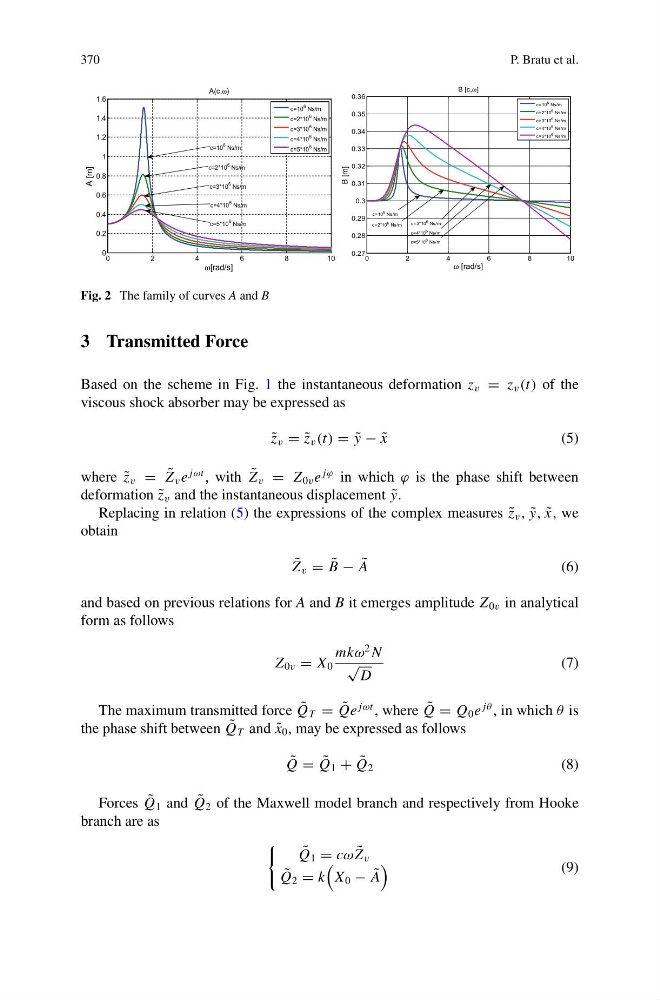
Fig. 2 The family of curves A and B
3 Transmitted Force
Based on the scheme in Fig. 1 the instantaneous deformation z v = z v (t) of the
viscous shock absorber may be expressed as
˜
z v = ˜
z v (t) = ˜
y − ˜
x
(5)
where ˜
z v = ˜
Z v e
jωt , with ˜
Z v = Z 0v e
jϕ in which ϕ is the phase shift between
deformation ˜
z v and the instantaneous displacement ˜
y.
Replacing in relation (5) the expressions of the complex measures ˜
z v , ˜
y, ˜
x, we
obtain
˜
Z v = ˜
B − ˜
A
(6)
and based on previous relations for A and B it emerges amplitude Z 0v in analytical
form as follows
Z 0v = X 0
mkω
2 N
√
D
(7)
The maximum transmitted force ˜
Q T = ˜
Qe
jωt , where ˜
Q = Q 0 e
jθ , in which θ is
the phase shift between ˜
Q T and ˜
x 0 , may be expressed as follows
˜
Q = ˜
Q 1 + ˜
Q 2
(8)
Forces ˜
Q 1 and ˜
Q 2 of the Maxwell model branch and respectively from Hooke
branch are as
˜
Q 1 = cω ˜
Z v
˜
Q 2 = k
X 0 − ˜
A
(9)
P. Bratu et al.
0
2
4
6
8
10
0
0.2
0.4
0.6
0.8
1
1.2
1.4
1.6
ω[rad/s]
A [m]
A(c,ω)
c=10
6 Ns/m
c=2*10
6 Ns/m
c=3*10
6 Ns/m
c=4*10
6 Ns/m
c=5*10
6 Ns/m
c=10
6 Ns/m
c=2*10
6 Ns/m
c=3*10
6 Ns/m
c=4*10
6 Ns/m
c=5*10
6 Ns/m
0
2
4
6
8
10
0.27
0.28
0.29
0.3
0.31
0.32
0.33
0.34
0.35
0.36
ω [rad/s]
B [m]
B [c,ω]
c=10 6 Ns/m
c=2*10 6 Ns/m
c=3*10 6 Ns/m
c=4*10 6 Ns/m
c=5*10 6 Ns/m
c=2*10 6 Ns/m
c=4*10 6 Ns/m
c=5*10 6 Ns/m
c=3*10 6 Ns/m
c=10 6 Ns/m
Fig. 2 The family of curves A and B
3 Transmitted Force
Based on the scheme in Fig. 1 the instantaneous deformation z v = z v (t) of the
viscous shock absorber may be expressed as
˜
z v = ˜
z v (t) = ˜
y − ˜
x
(5)
where ˜
z v = ˜
Z v e
jωt , with ˜
Z v = Z 0v e
jϕ in which ϕ is the phase shift between
deformation ˜
z v and the instantaneous displacement ˜
y.
Replacing in relation (5) the expressions of the complex measures ˜
z v , ˜
y, ˜
x, we
obtain
˜
Z v = ˜
B − ˜
A
(6)
and based on previous relations for A and B it emerges amplitude Z 0v in analytical
form as follows
Z 0v = X 0
mkω
2 N
√
D
(7)
The maximum transmitted force ˜
Q T = ˜
Qe
jωt , where ˜
Q = Q 0 e
jθ , in which θ is
the phase shift between ˜
Q T and ˜
x 0 , may be expressed as follows
˜
Q = ˜
Q 1 + ˜
Q 2
(8)
Forces ˜
Q 1 and ˜
Q 2 of the Maxwell model branch and respectively from Hooke
branch are as
˜
Q 1 = cω ˜
Z v
˜
Q 2 = k
X 0 − ˜
A
(9)