

Comparative Analysis of the Voigt–Kelvin and Maxwell Models …
365
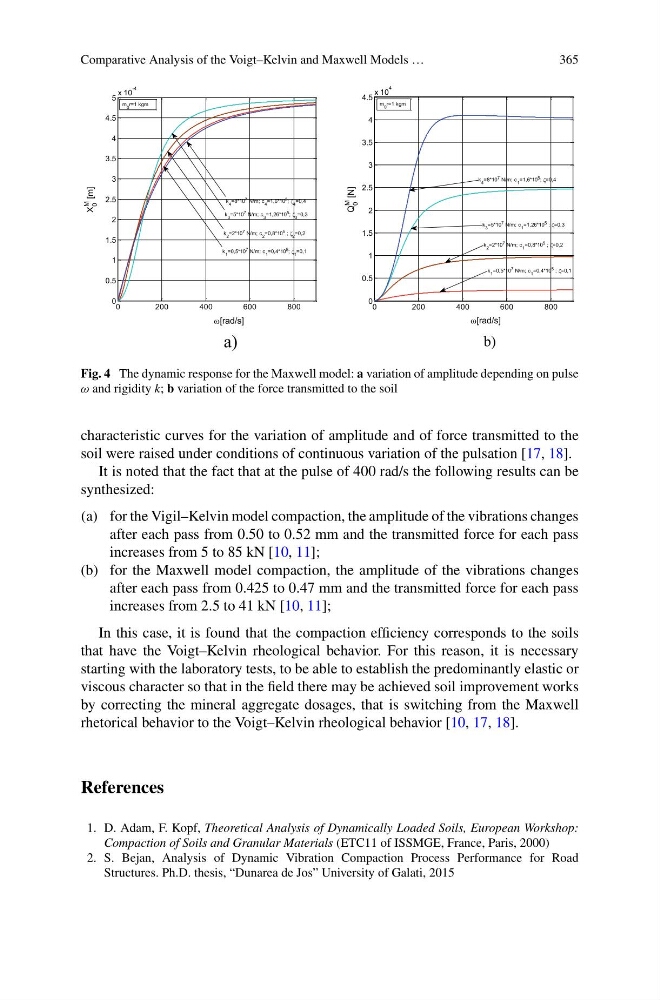
Fig. 4 The dynamic response for the Maxwell model: a variation of amplitude depending on pulse
ω and rigidity k; b variation of the force transmitted to the soil
characteristic curves for the variation of amplitude and of force transmitted to the
soil were raised under conditions of continuous variation of the pulsation [17, 18].
It is noted that the fact that at the pulse of 400 rad/s the following results can be
synthesized:
(a) for the Vigil–Kelvin model compaction, the amplitude of the vibrations changes
after each pass from 0.50 to 0.52 mm and the transmitted force for each pass
increases from 5 to 85 kN [10, 11];
(b) for the Maxwell model compaction, the amplitude of the vibrations changes
after each pass from 0.425 to 0.47 mm and the transmitted force for each pass
increases from 2.5 to 41 kN [10, 11];
In this case, it is found that the compaction efficiency corresponds to the soils
that have the Voigt–Kelvin rheological behavior. For this reason, it is necessary
starting with the laboratory tests, to be able to establish the predominantly elastic or
viscous character so that in the field there may be achieved soil improvement works
by correcting the mineral aggregate dosages, that is switching from the Maxwell
rhetorical behavior to the Voigt–Kelvin rheological behavior [10, 17, 18].
References
1. D. Adam, F. Kopf, Theoretical Analysis of Dynamically Loaded Soils, European Workshop:
Compaction of Soils and Granular Materials (ETC11 of ISSMGE, France, Paris, 2000)
2. S. Bejan, Analysis of Dynamic Vibration Compaction Process Performance for Road
Structures. Ph.D. thesis, “Dunarea de Jos” University of Galati, 2015
365
Fig. 4 The dynamic response for the Maxwell model: a variation of amplitude depending on pulse
ω and rigidity k; b variation of the force transmitted to the soil
characteristic curves for the variation of amplitude and of force transmitted to the
soil were raised under conditions of continuous variation of the pulsation [17, 18].
It is noted that the fact that at the pulse of 400 rad/s the following results can be
synthesized:
(a) for the Vigil–Kelvin model compaction, the amplitude of the vibrations changes
after each pass from 0.50 to 0.52 mm and the transmitted force for each pass
increases from 5 to 85 kN [10, 11];
(b) for the Maxwell model compaction, the amplitude of the vibrations changes
after each pass from 0.425 to 0.47 mm and the transmitted force for each pass
increases from 2.5 to 41 kN [10, 11];
In this case, it is found that the compaction efficiency corresponds to the soils
that have the Voigt–Kelvin rheological behavior. For this reason, it is necessary
starting with the laboratory tests, to be able to establish the predominantly elastic or
viscous character so that in the field there may be achieved soil improvement works
by correcting the mineral aggregate dosages, that is switching from the Maxwell
rhetorical behavior to the Voigt–Kelvin rheological behavior [10, 17, 18].
References
1. D. Adam, F. Kopf, Theoretical Analysis of Dynamically Loaded Soils, European Workshop:
Compaction of Soils and Granular Materials (ETC11 of ISSMGE, France, Paris, 2000)
2. S. Bejan, Analysis of Dynamic Vibration Compaction Process Performance for Road
Structures. Ph.D. thesis, “Dunarea de Jos” University of Galati, 2015