

364
C.-F. Dobrescu
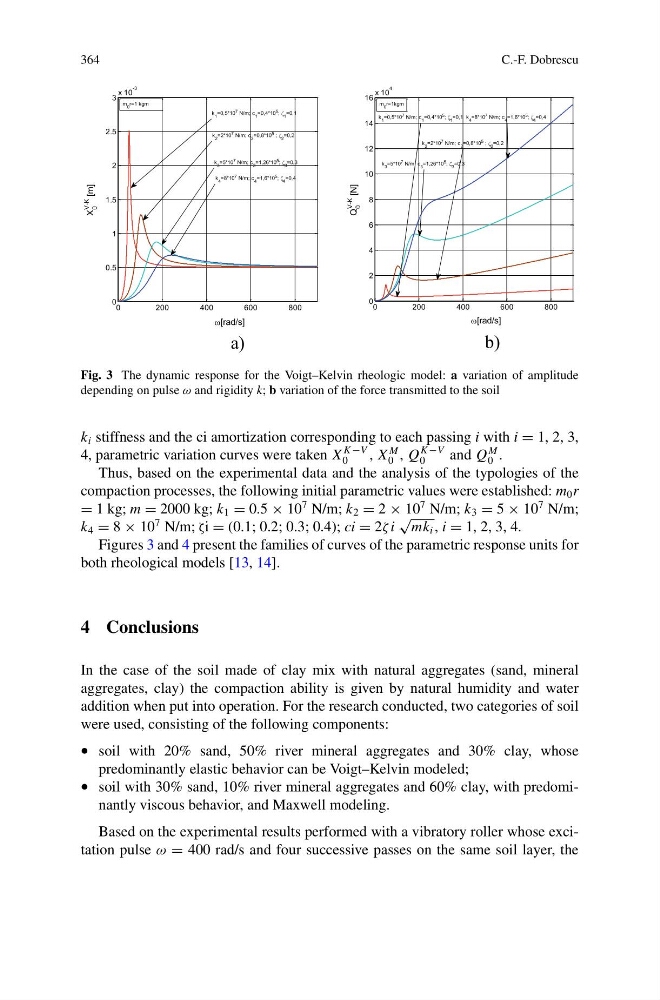
Fig. 3 The dynamic response for the Voigt–Kelvin rheologic model: a variation of amplitude
depending on pulse ω and rigidity k; b variation of the force transmitted to the soil
k i stiffness and the ci amortization corresponding to each passing i with i = 1, 2, 3,
4, parametric variation curves were taken X
K −V
0
, X
M
0 , Q
K −V
0
and Q
M
0 .
Thus, based on the experimental data and the analysis of the typologies of the
compaction processes, the following initial parametric values were established: m 0 r
= 1 kg; m = 2000 kg; k 1 = 0.5 × 10
7 N/m; k 2 = 2 × 10
7 N/m; k 3 = 5 × 10
7 N/m;
k 4 = 8 × 10
7 N/m; ζi = (0.1; 0.2; 0.3; 0.4); ci = 2ζ i
√
mk i , i = 1, 2, 3, 4.
Figures 3 and 4 present the families of curves of the parametric response units for
both rheological models [13, 14].
4 Conclusions
In the case of the soil made of clay mix with natural aggregates (sand, mineral
aggregates, clay) the compaction ability is given by natural humidity and water
addition when put into operation. For the research conducted, two categories of soil
were used, consisting of the following components:
• soil with 20% sand, 50% river mineral aggregates and 30% clay, whose
predominantly elastic behavior can be Voigt–Kelvin modeled;
• soil with 30% sand, 10% river mineral aggregates and 60% clay, with predominantly viscous behavior, and Maxwell modeling.
Based on the experimental results performed with a vibratory roller whose excitation pulse ω = 400 rad/s and four successive passes on the same soil layer, the
C.-F. Dobrescu
Fig. 3 The dynamic response for the Voigt–Kelvin rheologic model: a variation of amplitude
depending on pulse ω and rigidity k; b variation of the force transmitted to the soil
k i stiffness and the ci amortization corresponding to each passing i with i = 1, 2, 3,
4, parametric variation curves were taken X
K −V
0
, X
M
0 , Q
K −V
0
and Q
M
0 .
Thus, based on the experimental data and the analysis of the typologies of the
compaction processes, the following initial parametric values were established: m 0 r
= 1 kg; m = 2000 kg; k 1 = 0.5 × 10
7 N/m; k 2 = 2 × 10
7 N/m; k 3 = 5 × 10
7 N/m;
k 4 = 8 × 10
7 N/m; ζi = (0.1; 0.2; 0.3; 0.4); ci = 2ζ i
√
mk i , i = 1, 2, 3, 4.
Figures 3 and 4 present the families of curves of the parametric response units for
both rheological models [13, 14].
4 Conclusions
In the case of the soil made of clay mix with natural aggregates (sand, mineral
aggregates, clay) the compaction ability is given by natural humidity and water
addition when put into operation. For the research conducted, two categories of soil
were used, consisting of the following components:
• soil with 20% sand, 50% river mineral aggregates and 30% clay, whose
predominantly elastic behavior can be Voigt–Kelvin modeled;
• soil with 30% sand, 10% river mineral aggregates and 60% clay, with predominantly viscous behavior, and Maxwell modeling.
Based on the experimental results performed with a vibratory roller whose excitation pulse ω = 400 rad/s and four successive passes on the same soil layer, the