

Modeling and Simulation of Mechanical Behavior …
321
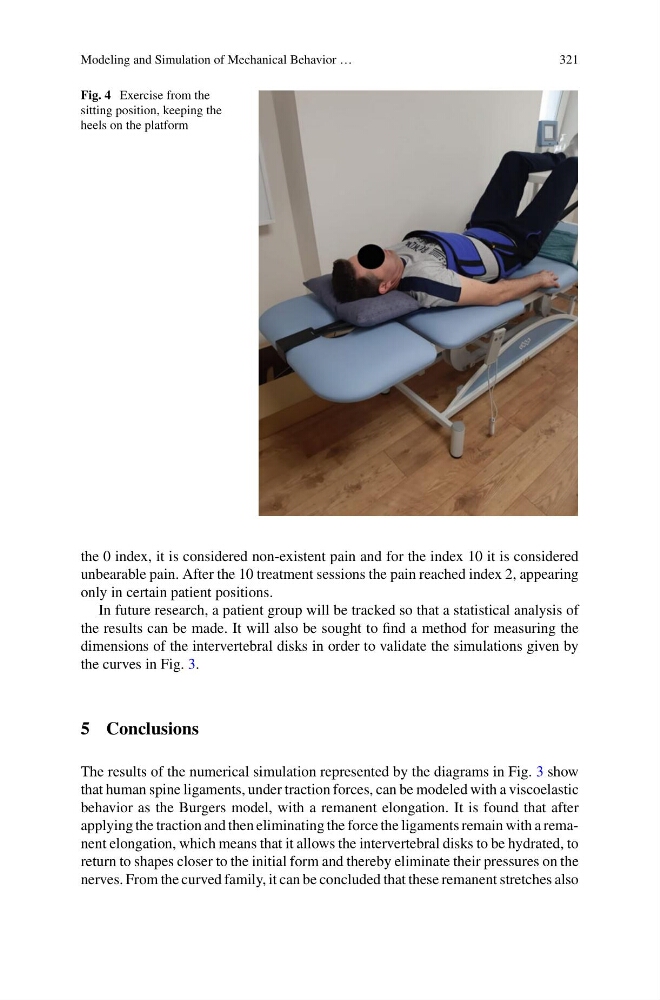
Fig. 4 Exercise from the
sitting position, keeping the
heels on the platform
the 0 index, it is considered non-existent pain and for the index 10 it is considered
unbearable pain. After the 10 treatment sessions the pain reached index 2, appearing
only in certain patient positions.
In future research, a patient group will be tracked so that a statistical analysis of
the results can be made. It will also be sought to find a method for measuring the
dimensions of the intervertebral disks in order to validate the simulations given by
the curves in Fig. 3.
5 Conclusions
The results of the numerical simulation represented by the diagrams in Fig. 3 show
that human spine ligaments, under traction forces, can be modeled with a viscoelastic
behavior as the Burgers model, with a remanent elongation. It is found that after
applying the traction and then eliminating the force the ligaments remain with a remanent elongation, which means that it allows the intervertebral disks to be hydrated, to
return to shapes closer to the initial form and thereby eliminate their pressures on the
nerves. From the curved family, it can be concluded that these remanent stretches also
321
Fig. 4 Exercise from the
sitting position, keeping the
heels on the platform
the 0 index, it is considered non-existent pain and for the index 10 it is considered
unbearable pain. After the 10 treatment sessions the pain reached index 2, appearing
only in certain patient positions.
In future research, a patient group will be tracked so that a statistical analysis of
the results can be made. It will also be sought to find a method for measuring the
dimensions of the intervertebral disks in order to validate the simulations given by
the curves in Fig. 3.
5 Conclusions
The results of the numerical simulation represented by the diagrams in Fig. 3 show
that human spine ligaments, under traction forces, can be modeled with a viscoelastic
behavior as the Burgers model, with a remanent elongation. It is found that after
applying the traction and then eliminating the force the ligaments remain with a remanent elongation, which means that it allows the intervertebral disks to be hydrated, to
return to shapes closer to the initial form and thereby eliminate their pressures on the
nerves. From the curved family, it can be concluded that these remanent stretches also