

Modeling and Simulation of Mechanical Behavior …
319
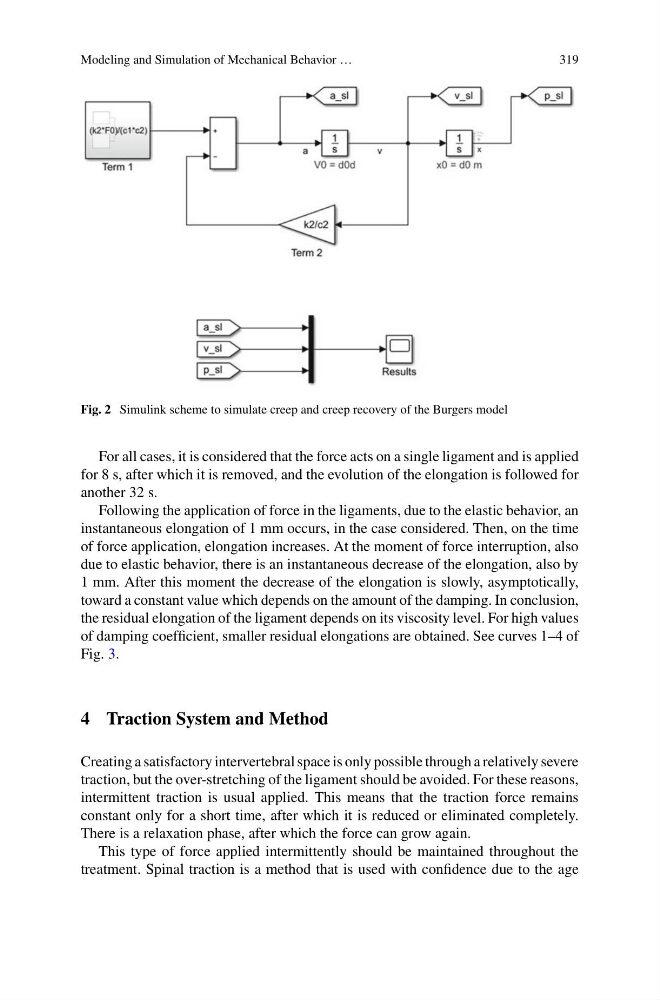
Fig. 2 Simulink scheme to simulate creep and creep recovery of the Burgers model
For all cases, it is considered that the force acts on a single ligament and is applied
for 8 s, after which it is removed, and the evolution of the elongation is followed for
another 32 s.
Following the application of force in the ligaments, due to the elastic behavior, an
instantaneous elongation of 1 mm occurs, in the case considered. Then, on the time
of force application, elongation increases. At the moment of force interruption, also
due to elastic behavior, there is an instantaneous decrease of the elongation, also by
1 mm. After this moment the decrease of the elongation is slowly, asymptotically,
toward a constant value which depends on the amount of the damping. In conclusion,
the residual elongation of the ligament depends on its viscosity level. For high values
of damping coefficient, smaller residual elongations are obtained. See curves 1–4 of
Fig. 3.
4 Traction System and Method
Creating a satisfactory intervertebral space is only possible through a relatively severe
traction, but the over-stretching of the ligament should be avoided. For these reasons,
intermittent traction is usual applied. This means that the traction force remains
constant only for a short time, after which it is reduced or eliminated completely.
There is a relaxation phase, after which the force can grow again.
This type of force applied intermittently should be maintained throughout the
treatment. Spinal traction is a method that is used with confidence due to the age
319
Fig. 2 Simulink scheme to simulate creep and creep recovery of the Burgers model
For all cases, it is considered that the force acts on a single ligament and is applied
for 8 s, after which it is removed, and the evolution of the elongation is followed for
another 32 s.
Following the application of force in the ligaments, due to the elastic behavior, an
instantaneous elongation of 1 mm occurs, in the case considered. Then, on the time
of force application, elongation increases. At the moment of force interruption, also
due to elastic behavior, there is an instantaneous decrease of the elongation, also by
1 mm. After this moment the decrease of the elongation is slowly, asymptotically,
toward a constant value which depends on the amount of the damping. In conclusion,
the residual elongation of the ligament depends on its viscosity level. For high values
of damping coefficient, smaller residual elongations are obtained. See curves 1–4 of
Fig. 3.
4 Traction System and Method
Creating a satisfactory intervertebral space is only possible through a relatively severe
traction, but the over-stretching of the ligament should be avoided. For these reasons,
intermittent traction is usual applied. This means that the traction force remains
constant only for a short time, after which it is reduced or eliminated completely.
There is a relaxation phase, after which the force can grow again.
This type of force applied intermittently should be maintained throughout the
treatment. Spinal traction is a method that is used with confidence due to the age