

Modeling and Simulation of Mechanical Behavior …
317
It is well known that other simple models such as Kelvin and Maxwell have a
viscoelastic behavior but do not show the relaxation phenomenon. This is the reason
why the Burgers model was chosen to simulate the biomechanical behavior of the
spinal ligaments in traction. In the Maxwell model the two constituent elements
connected in series are characterized by the elasticity given by the stiffness coefficient
k 1 and by an amortization given by the damping coefficient, c 1 . The Kelvin model,
consists of two parallel elements, is characterized by the elasticity given by the
stiffness coefficient k 2 and by an amortization given by the damping coefficient, c 2 .
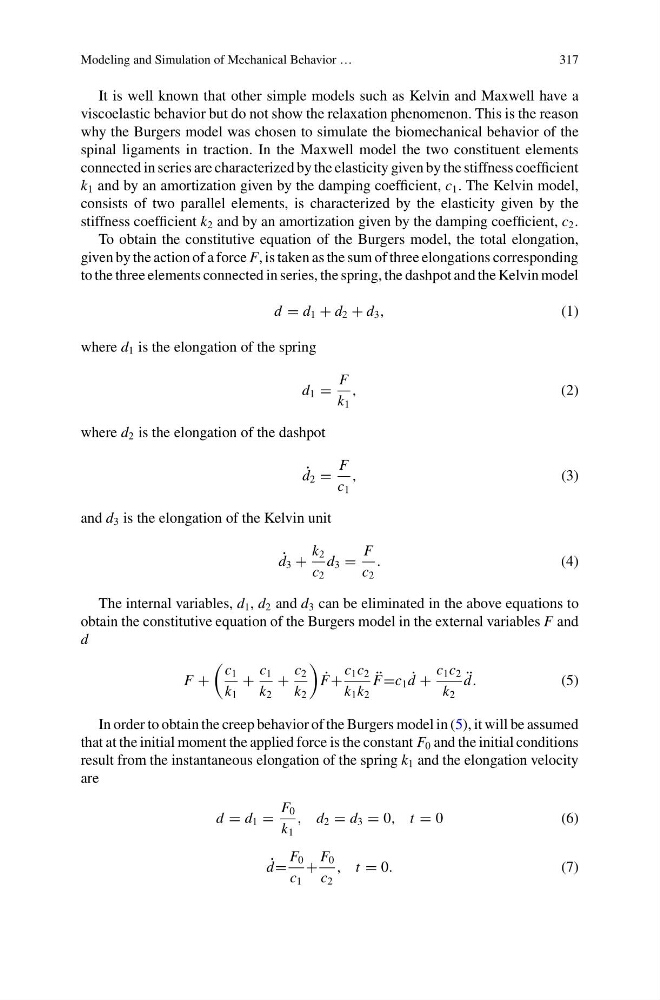
To obtain the constitutive equation of the Burgers model, the total elongation,
given by the action of a force F, is taken as the sum of three elongations corresponding
to the three elements connected in series, the spring, the dashpot and the Kelvin model
d = d 1 + d 2 + d 3 ,
(1)
where d 1 is the elongation of the spring
d 1 =
F
k 1
,
(2)
where d 2 is the elongation of the dashpot
˙
d 2 =
F
c 1
,
(3)
and d 3 is the elongation of the Kelvin unit
˙
d 3 +
k 2
c 2
d 3 =
F
c 2
.
(4)
The internal variables, d 1 , d 2 and d 3 can be eliminated in the above equations to
obtain the constitutive equation of the Burgers model in the external variables F and
d
F +
c 1
k 1
+
c 1
k 2
+
c 2
k 2
˙
F+
c 1 c 2
k 1 k 2
¨
F=c 1 ˙
d +
c 1 c 2
k 2
¨
d.
(5)
In order to obtain the creep behavior of the Burgers model in (5), it will be assumed
that at the initial moment the applied force is the constant F 0 and the initial conditions
result from the instantaneous elongation of the spring k 1 and the elongation velocity
are
d = d 1 =
F 0
k 1
, d 2 = d 3 = 0, t = 0
( 6 )
˙
d=
F 0
c 1
+
F 0
c 2
, t = 0.
(7)
317
It is well known that other simple models such as Kelvin and Maxwell have a
viscoelastic behavior but do not show the relaxation phenomenon. This is the reason
why the Burgers model was chosen to simulate the biomechanical behavior of the
spinal ligaments in traction. In the Maxwell model the two constituent elements
connected in series are characterized by the elasticity given by the stiffness coefficient
k 1 and by an amortization given by the damping coefficient, c 1 . The Kelvin model,
consists of two parallel elements, is characterized by the elasticity given by the
stiffness coefficient k 2 and by an amortization given by the damping coefficient, c 2 .
To obtain the constitutive equation of the Burgers model, the total elongation,
given by the action of a force F, is taken as the sum of three elongations corresponding
to the three elements connected in series, the spring, the dashpot and the Kelvin model
d = d 1 + d 2 + d 3 ,
(1)
where d 1 is the elongation of the spring
d 1 =
F
k 1
,
(2)
where d 2 is the elongation of the dashpot
˙
d 2 =
F
c 1
,
(3)
and d 3 is the elongation of the Kelvin unit
˙
d 3 +
k 2
c 2
d 3 =
F
c 2
.
(4)
The internal variables, d 1 , d 2 and d 3 can be eliminated in the above equations to
obtain the constitutive equation of the Burgers model in the external variables F and
d
F +
c 1
k 1
+
c 1
k 2
+
c 2
k 2
˙
F+
c 1 c 2
k 1 k 2
¨
F=c 1 ˙
d +
c 1 c 2
k 2
¨
d.
(5)
In order to obtain the creep behavior of the Burgers model in (5), it will be assumed
that at the initial moment the applied force is the constant F 0 and the initial conditions
result from the instantaneous elongation of the spring k 1 and the elongation velocity
are
d = d 1 =
F 0
k 1
, d 2 = d 3 = 0, t = 0
( 6 )
˙
d=
F 0
c 1
+
F 0
c 2
, t = 0.
(7)