

316
A. Neam¸ tu Popescu et al.
Elongation or stretching is a process that applies to the various regions of the
spine that create a decrease in intervertebral pressure. A first mechanism by which
stretching works is the elongation of the ligaments of the vertebral column leading
to the dislocation of the disco-vertebral segments and the creation of space for the
volume increase of the intervertebral disk. Another mechanism of the stretching
process is to create a vacuum or negative pressure effect within the intervertebral
disks, an effect that will help the disks to hydrate, providing a good environment for
healing. At the same time, the decompression of the spine and the hydration of the
disk lead to the height of the intervertebral space.
Cervical traction is used for various types of vertebral lesions such as cervical
herniated nucleus pulposus, strains and myofascial pain [1]. The effect of traction
can provide beneficial effects on posture and lumbar movement [2]. Improving the
amplitude of the hip and pelvis movement helps reduce back pain and is achieved by
stretching the broad facial tensor [3]. Static and dynamic stretching has an effect on
increasing spine movement in patients with low back pain [4]. The acute effects of
the tract of stretching in the thorax and lumbar curves and the pelvic inclination were
determined in the paper [5]. The effect of stretching exercises leads to the correction
of the posture and walking of patients who have had fractures [6, 7], but also to the
performance of soccer players [8].
The purpose of this paper is to model the viscoelastic behavior of the spine ligaments, to simulate this behavior in Simulink by highlighting the two phases of the
stretching process: creep and stress relaxation. The effects of the stretching process
in which the traction force can be given by the body’s own weight by sliding on an
inclined plane, by means of counterweights or by means of straps, in which case a
controlled computerized force command is provided.
2 Viscoelastic Modeling of Spinal Ligaments
The mechanical behavior of the ligaments can be considered as a superposition of
the elastic property, as a spring, over the viscous flow property as a dashpot. The
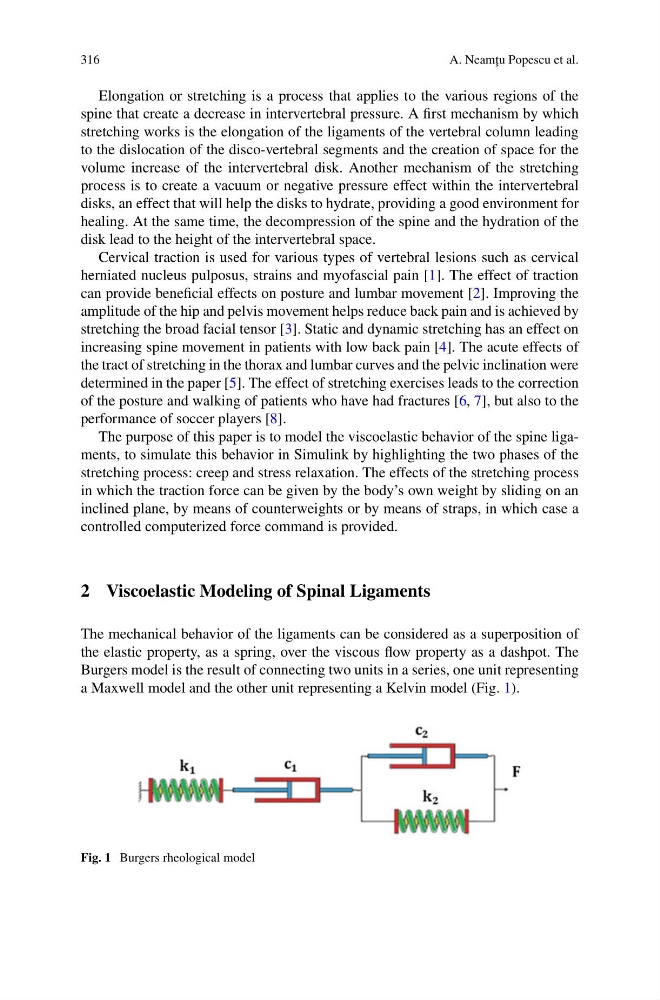
Burgers model is the result of connecting two units in a series, one unit representing
a Maxwell model and the other unit representing a Kelvin model (Fig. 1).
Fig. 1 Burgers rheological model
A. Neam¸ tu Popescu et al.
Elongation or stretching is a process that applies to the various regions of the
spine that create a decrease in intervertebral pressure. A first mechanism by which
stretching works is the elongation of the ligaments of the vertebral column leading
to the dislocation of the disco-vertebral segments and the creation of space for the
volume increase of the intervertebral disk. Another mechanism of the stretching
process is to create a vacuum or negative pressure effect within the intervertebral
disks, an effect that will help the disks to hydrate, providing a good environment for
healing. At the same time, the decompression of the spine and the hydration of the
disk lead to the height of the intervertebral space.
Cervical traction is used for various types of vertebral lesions such as cervical
herniated nucleus pulposus, strains and myofascial pain [1]. The effect of traction
can provide beneficial effects on posture and lumbar movement [2]. Improving the
amplitude of the hip and pelvis movement helps reduce back pain and is achieved by
stretching the broad facial tensor [3]. Static and dynamic stretching has an effect on
increasing spine movement in patients with low back pain [4]. The acute effects of
the tract of stretching in the thorax and lumbar curves and the pelvic inclination were
determined in the paper [5]. The effect of stretching exercises leads to the correction
of the posture and walking of patients who have had fractures [6, 7], but also to the
performance of soccer players [8].
The purpose of this paper is to model the viscoelastic behavior of the spine ligaments, to simulate this behavior in Simulink by highlighting the two phases of the
stretching process: creep and stress relaxation. The effects of the stretching process
in which the traction force can be given by the body’s own weight by sliding on an
inclined plane, by means of counterweights or by means of straps, in which case a
controlled computerized force command is provided.
2 Viscoelastic Modeling of Spinal Ligaments
The mechanical behavior of the ligaments can be considered as a superposition of
the elastic property, as a spring, over the viscous flow property as a dashpot. The
Burgers model is the result of connecting two units in a series, one unit representing
a Maxwell model and the other unit representing a Kelvin model (Fig. 1).
Fig. 1 Burgers rheological model