

The Effect of Vibration Exposure on Posterior Lower Limbs …
307
The aim of this paper is to analyze the dynamic behavior of a viscoelastic model,
for the lower leg muscles when exposed to vibrations. The energy dissipation mode,
based on the model used, as well as the temperature increase of the skin, is followed.
2 Dynamic Behavior of Viscoelastic Model
The simplest mechanical model, which besides the accumulation of potential deformation energy also describes energy dissipation, is the Kelvin–Voigt model. Although
this rheology model has a number of disadvantages, which it will not insist on here, its
simplicity, but above all its linear behavior, makes the Kelvin–Voigt model, especially
used to explain the phenomenon of energy dissipation by vibration. The mechanical behavior of the limbs muscle can be considered as a superposition of the elastic
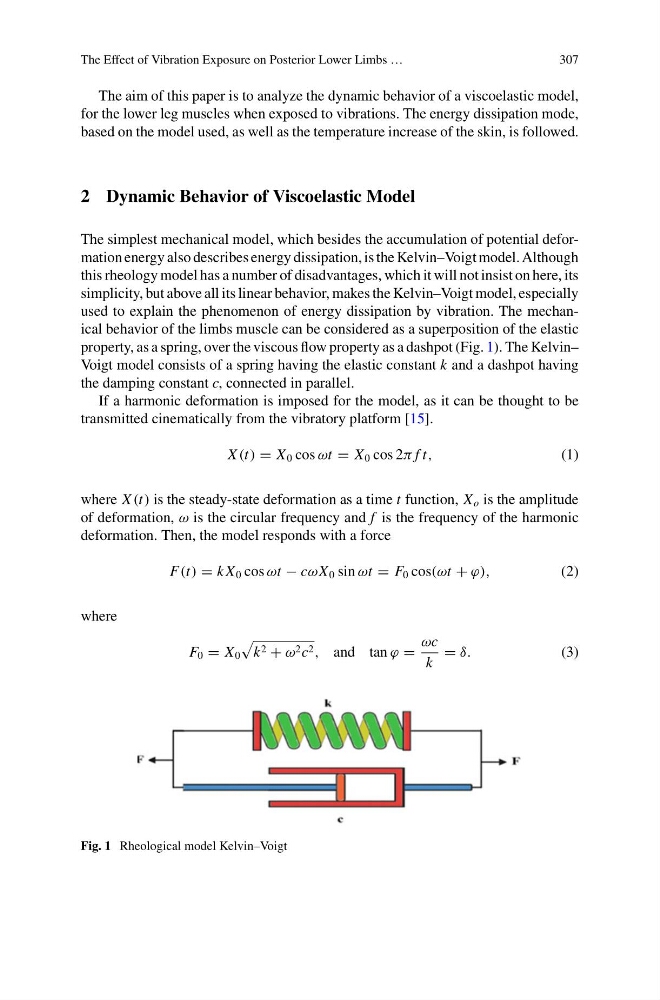
property, as a spring, over the viscous flow property as a dashpot (Fig. 1). The Kelvin–
Voigt model consists of a spring having the elastic constant k and a dashpot having
the damping constant c, connected in parallel.
If a harmonic deformation is imposed for the model, as it can be thought to be
transmitted cinematically from the vibratory platform [15].
X (t) = X 0 cos ωt = X 0 cos 2π f t,
(1)
where X (t) is the steady-state deformation as a time t function, X o is the amplitude
of deformation, ω is the circular frequency and f is the frequency of the harmonic
deformation. Then, the model responds with a force
F(t) = k X 0 cos ωt − cωX 0 sin ωt = F 0 cos(ωt + ϕ),
(2)
where
F 0 = X 0
k 2 + ω 2 c 2 , and tan ϕ =
ωc
k
= δ.
(3)
Fig. 1 Rheological model Kelvin–Voigt
307
The aim of this paper is to analyze the dynamic behavior of a viscoelastic model,
for the lower leg muscles when exposed to vibrations. The energy dissipation mode,
based on the model used, as well as the temperature increase of the skin, is followed.
2 Dynamic Behavior of Viscoelastic Model
The simplest mechanical model, which besides the accumulation of potential deformation energy also describes energy dissipation, is the Kelvin–Voigt model. Although
this rheology model has a number of disadvantages, which it will not insist on here, its
simplicity, but above all its linear behavior, makes the Kelvin–Voigt model, especially
used to explain the phenomenon of energy dissipation by vibration. The mechanical behavior of the limbs muscle can be considered as a superposition of the elastic
property, as a spring, over the viscous flow property as a dashpot (Fig. 1). The Kelvin–
Voigt model consists of a spring having the elastic constant k and a dashpot having
the damping constant c, connected in parallel.
If a harmonic deformation is imposed for the model, as it can be thought to be
transmitted cinematically from the vibratory platform [15].
X (t) = X 0 cos ωt = X 0 cos 2π f t,
(1)
where X (t) is the steady-state deformation as a time t function, X o is the amplitude
of deformation, ω is the circular frequency and f is the frequency of the harmonic
deformation. Then, the model responds with a force
F(t) = k X 0 cos ωt − cωX 0 sin ωt = F 0 cos(ωt + ϕ),
(2)
where
F 0 = X 0
k 2 + ω 2 c 2 , and tan ϕ =
ωc
k
= δ.
(3)
Fig. 1 Rheological model Kelvin–Voigt