

280
C. Drug˘ a et al.
reader module, two push buttons, a three-way button, a potentiometer 1kOhm, a
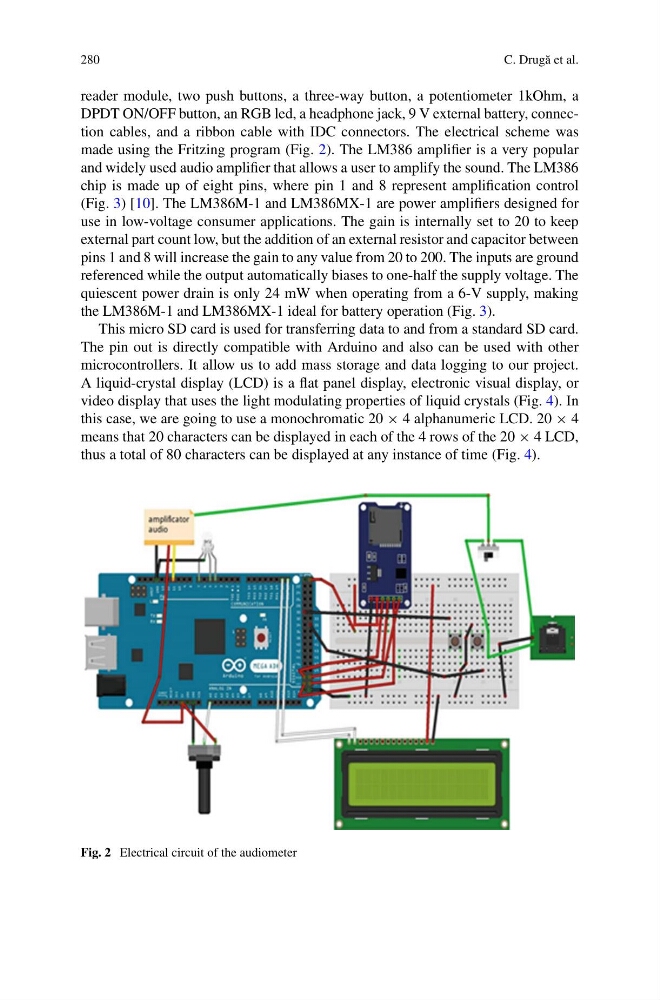
DPDT ON/OFF button, an RGB led, a headphone jack, 9 V external battery, connection cables, and a ribbon cable with IDC connectors. The electrical scheme was
made using the Fritzing program (Fig. 2). The LM386 amplifier is a very popular
and widely used audio amplifier that allows a user to amplify the sound. The LM386
chip is made up of eight pins, where pin 1 and 8 represent amplification control
(Fig. 3) [10]. The LM386M-1 and LM386MX-1 are power amplifiers designed for
use in low-voltage consumer applications. The gain is internally set to 20 to keep
external part count low, but the addition of an external resistor and capacitor between
pins 1 and 8 will increase the gain to any value from 20 to 200. The inputs are ground
referenced while the output automatically biases to one-half the supply voltage. The
quiescent power drain is only 24 mW when operating from a 6-V supply, making
the LM386M-1 and LM386MX-1 ideal for battery operation (Fig. 3).
This micro SD card is used for transferring data to and from a standard SD card.
The pin out is directly compatible with Arduino and also can be used with other
microcontrollers. It allow us to add mass storage and data logging to our project.
A liquid-crystal display (LCD) is a flat panel display, electronic visual display, or
video display that uses the light modulating properties of liquid crystals (Fig. 4). In
this case, we are going to use a monochromatic 20 × 4 alphanumeric LCD. 20 × 4
means that 20 characters can be displayed in each of the 4 rows of the 20 × 4 LCD,
thus a total of 80 characters can be displayed at any instance of time (Fig. 4).
Fig. 2 Electrical circuit of the audiometer
C. Drug˘ a et al.
reader module, two push buttons, a three-way button, a potentiometer 1kOhm, a
DPDT ON/OFF button, an RGB led, a headphone jack, 9 V external battery, connection cables, and a ribbon cable with IDC connectors. The electrical scheme was
made using the Fritzing program (Fig. 2). The LM386 amplifier is a very popular
and widely used audio amplifier that allows a user to amplify the sound. The LM386
chip is made up of eight pins, where pin 1 and 8 represent amplification control
(Fig. 3) [10]. The LM386M-1 and LM386MX-1 are power amplifiers designed for
use in low-voltage consumer applications. The gain is internally set to 20 to keep
external part count low, but the addition of an external resistor and capacitor between
pins 1 and 8 will increase the gain to any value from 20 to 200. The inputs are ground
referenced while the output automatically biases to one-half the supply voltage. The
quiescent power drain is only 24 mW when operating from a 6-V supply, making
the LM386M-1 and LM386MX-1 ideal for battery operation (Fig. 3).
This micro SD card is used for transferring data to and from a standard SD card.
The pin out is directly compatible with Arduino and also can be used with other
microcontrollers. It allow us to add mass storage and data logging to our project.
A liquid-crystal display (LCD) is a flat panel display, electronic visual display, or
video display that uses the light modulating properties of liquid crystals (Fig. 4). In
this case, we are going to use a monochromatic 20 × 4 alphanumeric LCD. 20 × 4
means that 20 characters can be displayed in each of the 4 rows of the 20 × 4 LCD,
thus a total of 80 characters can be displayed at any instance of time (Fig. 4).
Fig. 2 Electrical circuit of the audiometer