

New Medical Rehabilitation System
275
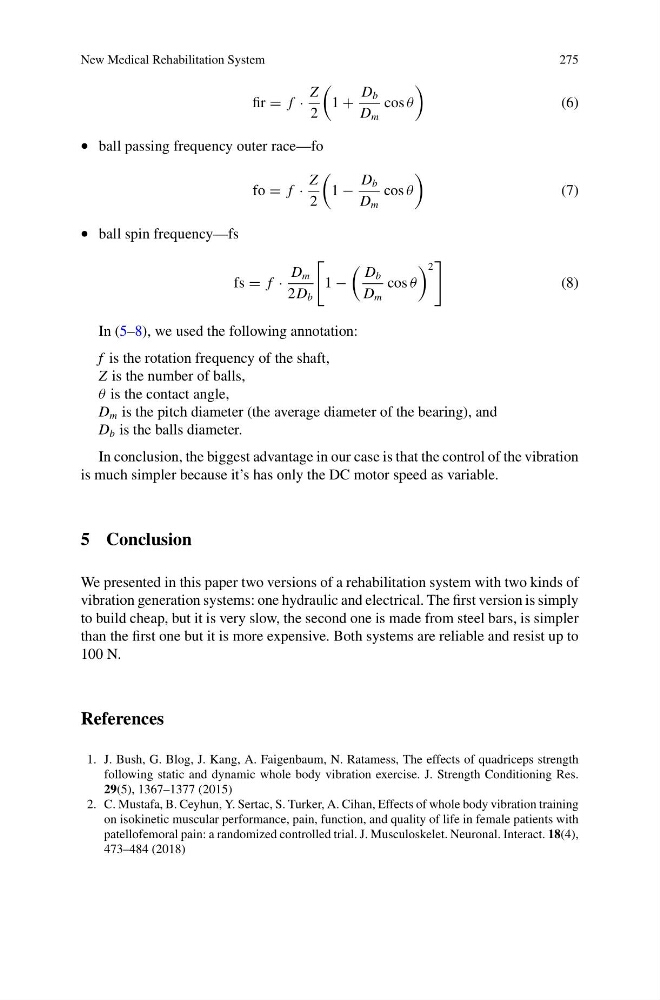
fir = f ·
Z
2
1 +
D b
D m
cos θ
(6)
• ball passing frequency outer race—fo
fo = f ·
Z
2
1 −
D b
D m
cos θ
(7)
• ball spin frequency—fs
fs = f ·
D m
2D b
1 −
D b
D m
cos θ
2
(8)
In (5–8), we used the following annotation:
f is the rotation frequency of the shaft,
Z is the number of balls,
θ is the contact angle,
D m is the pitch diameter (the average diameter of the bearing), and
D b is the balls diameter.
In conclusion, the biggest advantage in our case is that the control of the vibration
is much simpler because it’s has only the DC motor speed as variable.
5 Conclusion
We presented in this paper two versions of a rehabilitation system with two kinds of
vibration generation systems: one hydraulic and electrical. The first version is simply
to build cheap, but it is very slow, the second one is made from steel bars, is simpler
than the first one but it is more expensive. Both systems are reliable and resist up to
100 N.
References
1. J. Bush, G. Blog, J. Kang, A. Faigenbaum, N. Ratamess, The effects of quadriceps strength
following static and dynamic whole body vibration exercise. J. Strength Conditioning Res.
29(5), 1367–1377 (2015)
2. C. Mustafa, B. Ceyhun, Y. Sertac, S. Turker, A. Cihan, Effects of whole body vibration training
on isokinetic muscular performance, pain, function, and quality of life in female patients with
patellofemoral pain: a randomized controlled trial. J. Musculoskelet. Neuronal. Interact. 18(4),
473–484 (2018)
275
fir = f ·
Z
2
1 +
D b
D m
cos θ
(6)
• ball passing frequency outer race—fo
fo = f ·
Z
2
1 −
D b
D m
cos θ
(7)
• ball spin frequency—fs
fs = f ·
D m
2D b
1 −
D b
D m
cos θ
2
(8)
In (5–8), we used the following annotation:
f is the rotation frequency of the shaft,
Z is the number of balls,
θ is the contact angle,
D m is the pitch diameter (the average diameter of the bearing), and
D b is the balls diameter.
In conclusion, the biggest advantage in our case is that the control of the vibration
is much simpler because it’s has only the DC motor speed as variable.
5 Conclusion
We presented in this paper two versions of a rehabilitation system with two kinds of
vibration generation systems: one hydraulic and electrical. The first version is simply
to build cheap, but it is very slow, the second one is made from steel bars, is simpler
than the first one but it is more expensive. Both systems are reliable and resist up to
100 N.
References
1. J. Bush, G. Blog, J. Kang, A. Faigenbaum, N. Ratamess, The effects of quadriceps strength
following static and dynamic whole body vibration exercise. J. Strength Conditioning Res.
29(5), 1367–1377 (2015)
2. C. Mustafa, B. Ceyhun, Y. Sertac, S. Turker, A. Cihan, Effects of whole body vibration training
on isokinetic muscular performance, pain, function, and quality of life in female patients with
patellofemoral pain: a randomized controlled trial. J. Musculoskelet. Neuronal. Interact. 18(4),
473–484 (2018)