

274
C.-G. Alionte et al.
All the parameters, which are necessary for the simulation, have been obtained
from the 3D model using an automated mixed meshing with 23,974 nodes and 11,984
elements each types of elements are tetrahedral.
4 Excitation Systems
We imagine two kinds of systems; one is hydraulic and the second is electrical. The
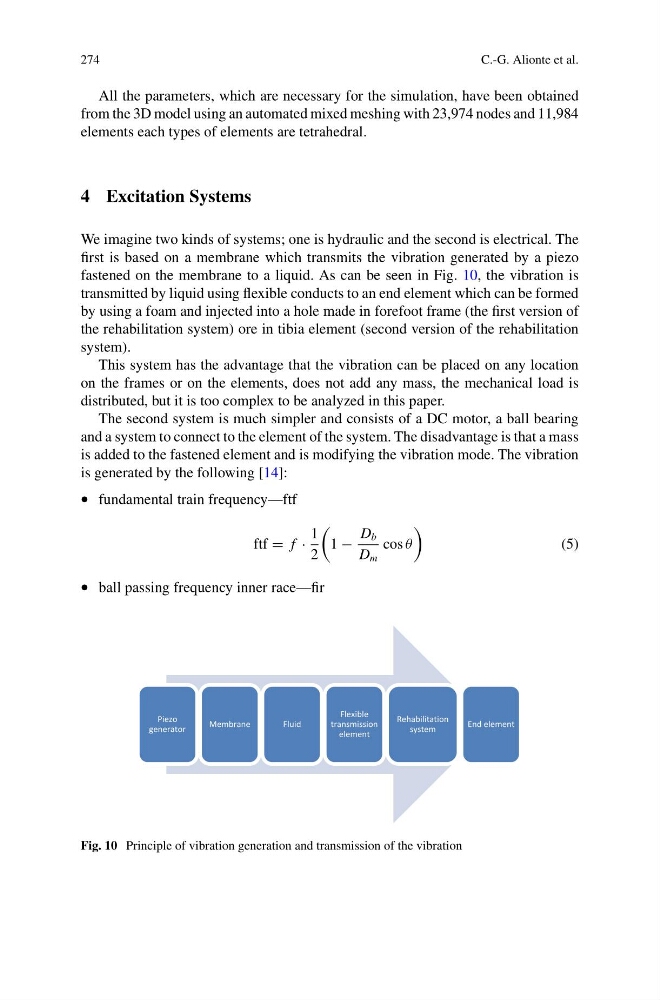
first is based on a membrane which transmits the vibration generated by a piezo
fastened on the membrane to a liquid. As can be seen in Fig. 10, the vibration is
transmitted by liquid using flexible conducts to an end element which can be formed
by using a foam and injected into a hole made in forefoot frame (the first version of
the rehabilitation system) ore in tibia element (second version of the rehabilitation
system).
This system has the advantage that the vibration can be placed on any location
on the frames or on the elements, does not add any mass, the mechanical load is
distributed, but it is too complex to be analyzed in this paper.
The second system is much simpler and consists of a DC motor, a ball bearing
and a system to connect to the element of the system. The disadvantage is that a mass
is added to the fastened element and is modifying the vibration mode. The vibration
is generated by the following [14]:
• fundamental train frequency—ftf
ftf = f ·
1
2
1 −
D b
D m
cos θ
(5)
• ball passing frequency inner race—fir
Piezo
generator
Membrane
Fluid
Flexible
transmission
element
Rehabilitation
system
End element
Fig. 10 Principle of vibration generation and transmission of the vibration
C.-G. Alionte et al.
All the parameters, which are necessary for the simulation, have been obtained
from the 3D model using an automated mixed meshing with 23,974 nodes and 11,984
elements each types of elements are tetrahedral.
4 Excitation Systems
We imagine two kinds of systems; one is hydraulic and the second is electrical. The
first is based on a membrane which transmits the vibration generated by a piezo
fastened on the membrane to a liquid. As can be seen in Fig. 10, the vibration is
transmitted by liquid using flexible conducts to an end element which can be formed
by using a foam and injected into a hole made in forefoot frame (the first version of
the rehabilitation system) ore in tibia element (second version of the rehabilitation
system).
This system has the advantage that the vibration can be placed on any location
on the frames or on the elements, does not add any mass, the mechanical load is
distributed, but it is too complex to be analyzed in this paper.
The second system is much simpler and consists of a DC motor, a ball bearing
and a system to connect to the element of the system. The disadvantage is that a mass
is added to the fastened element and is modifying the vibration mode. The vibration
is generated by the following [14]:
• fundamental train frequency—ftf
ftf = f ·
1
2
1 −
D b
D m
cos θ
(5)
• ball passing frequency inner race—fir
Piezo
generator
Membrane
Fluid
Flexible
transmission
element
Rehabilitation
system
End element
Fig. 10 Principle of vibration generation and transmission of the vibration