

264
M. Lupsa et al.
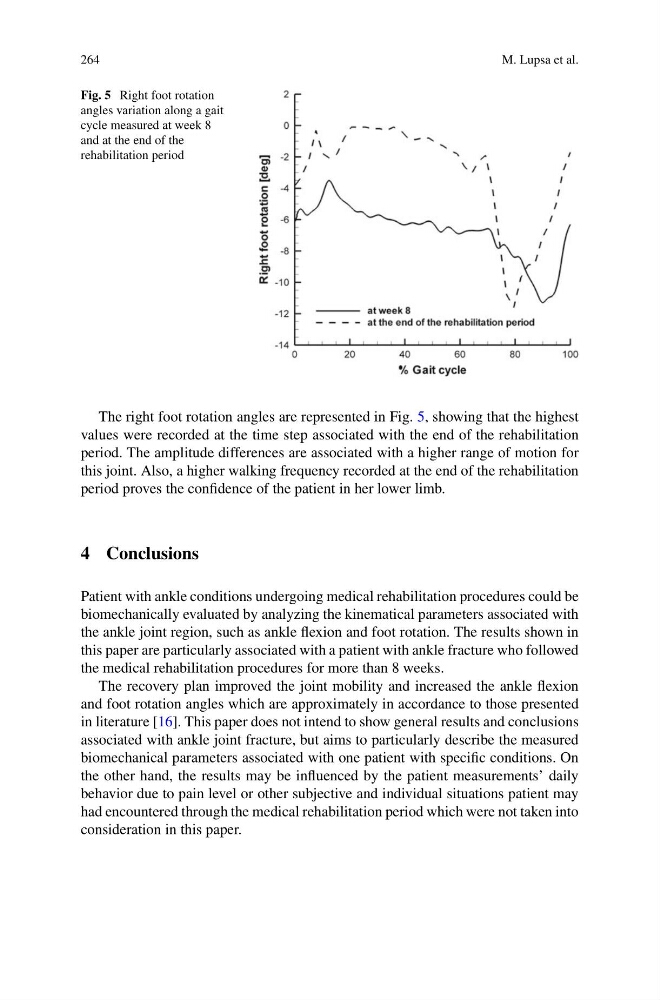
Fig. 5 Right foot rotation
angles variation along a gait
cycle measured at week 8
and at the end of the
rehabilitation period
The right foot rotation angles are represented in Fig. 5, showing that the highest
values were recorded at the time step associated with the end of the rehabilitation
period. The amplitude differences are associated with a higher range of motion for
this joint. Also, a higher walking frequency recorded at the end of the rehabilitation
period proves the confidence of the patient in her lower limb.
4 Conclusions
Patient with ankle conditions undergoing medical rehabilitation procedures could be
biomechanically evaluated by analyzing the kinematical parameters associated with
the ankle joint region, such as ankle flexion and foot rotation. The results shown in
this paper are particularly associated with a patient with ankle fracture who followed
the medical rehabilitation procedures for more than 8 weeks.
The recovery plan improved the joint mobility and increased the ankle flexion
and foot rotation angles which are approximately in accordance to those presented
in literature [16]. This paper does not intend to show general results and conclusions
associated with ankle joint fracture, but aims to particularly describe the measured
biomechanical parameters associated with one patient with specific conditions. On
the other hand, the results may be influenced by the patient measurements’ daily
behavior due to pain level or other subjective and individual situations patient may
had encountered through the medical rehabilitation period which were not taken into
consideration in this paper.
M. Lupsa et al.
Fig. 5 Right foot rotation
angles variation along a gait
cycle measured at week 8
and at the end of the
rehabilitation period
The right foot rotation angles are represented in Fig. 5, showing that the highest
values were recorded at the time step associated with the end of the rehabilitation
period. The amplitude differences are associated with a higher range of motion for
this joint. Also, a higher walking frequency recorded at the end of the rehabilitation
period proves the confidence of the patient in her lower limb.
4 Conclusions
Patient with ankle conditions undergoing medical rehabilitation procedures could be
biomechanically evaluated by analyzing the kinematical parameters associated with
the ankle joint region, such as ankle flexion and foot rotation. The results shown in
this paper are particularly associated with a patient with ankle fracture who followed
the medical rehabilitation procedures for more than 8 weeks.
The recovery plan improved the joint mobility and increased the ankle flexion
and foot rotation angles which are approximately in accordance to those presented
in literature [16]. This paper does not intend to show general results and conclusions
associated with ankle joint fracture, but aims to particularly describe the measured
biomechanical parameters associated with one patient with specific conditions. On
the other hand, the results may be influenced by the patient measurements’ daily
behavior due to pain level or other subjective and individual situations patient may
had encountered through the medical rehabilitation period which were not taken into
consideration in this paper.