

Coefficient of Sound Absorption of Polyamide PA12 Samples …
161
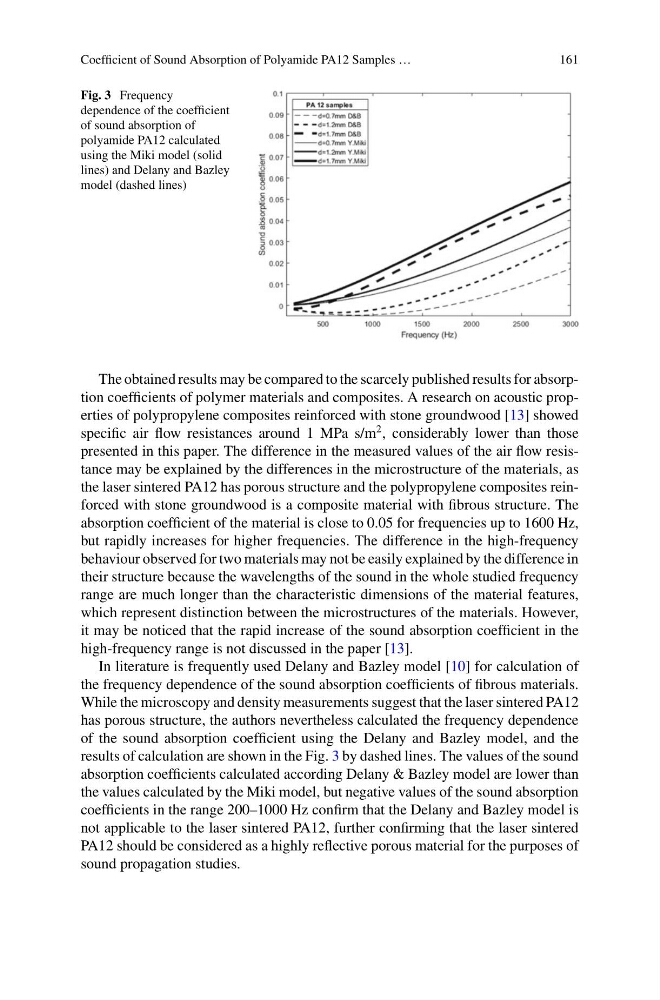
Fig. 3 Frequency
dependence of the coefficient
of sound absorption of
polyamide PA12 calculated
using the Miki model (solid
lines) and Delany and Bazley
model (dashed lines)
The obtained results may be compared to the scarcely published results for absorption coefficients of polymer materials and composites. A research on acoustic properties of polypropylene composites reinforced with stone groundwood [13] showed
specific air flow resistances around 1 MPa s/m
2 , considerably lower than those
presented in this paper. The difference in the measured values of the air flow resistance may be explained by the differences in the microstructure of the materials, as
the laser sintered PA12 has porous structure and the polypropylene composites reinforced with stone groundwood is a composite material with fibrous structure. The
absorption coefficient of the material is close to 0.05 for frequencies up to 1600 Hz,
but rapidly increases for higher frequencies. The difference in the high-frequency
behaviour observed for two materials may not be easily explained by the difference in
their structure because the wavelengths of the sound in the whole studied frequency
range are much longer than the characteristic dimensions of the material features,
which represent distinction between the microstructures of the materials. However,
it may be noticed that the rapid increase of the sound absorption coefficient in the
high-frequency range is not discussed in the paper [13].
In literature is frequently used Delany and Bazley model [10] for calculation of
the frequency dependence of the sound absorption coefficients of fibrous materials.
While the microscopy and density measurements suggest that the laser sintered PA12
has porous structure, the authors nevertheless calculated the frequency dependence
of the sound absorption coefficient using the Delany and Bazley model, and the
results of calculation are shown in the Fig. 3 by dashed lines. The values of the sound
absorption coefficients calculated according Delany & Bazley model are lower than
the values calculated by the Miki model, but negative values of the sound absorption
coefficients in the range 200–1000 Hz confirm that the Delany and Bazley model is
not applicable to the laser sintered PA12, further confirming that the laser sintered
PA12 should be considered as a highly reflective porous material for the purposes of
sound propagation studies.
161
Fig. 3 Frequency
dependence of the coefficient
of sound absorption of
polyamide PA12 calculated
using the Miki model (solid
lines) and Delany and Bazley
model (dashed lines)
The obtained results may be compared to the scarcely published results for absorption coefficients of polymer materials and composites. A research on acoustic properties of polypropylene composites reinforced with stone groundwood [13] showed
specific air flow resistances around 1 MPa s/m
2 , considerably lower than those
presented in this paper. The difference in the measured values of the air flow resistance may be explained by the differences in the microstructure of the materials, as
the laser sintered PA12 has porous structure and the polypropylene composites reinforced with stone groundwood is a composite material with fibrous structure. The
absorption coefficient of the material is close to 0.05 for frequencies up to 1600 Hz,
but rapidly increases for higher frequencies. The difference in the high-frequency
behaviour observed for two materials may not be easily explained by the difference in
their structure because the wavelengths of the sound in the whole studied frequency
range are much longer than the characteristic dimensions of the material features,
which represent distinction between the microstructures of the materials. However,
it may be noticed that the rapid increase of the sound absorption coefficient in the
high-frequency range is not discussed in the paper [13].
In literature is frequently used Delany and Bazley model [10] for calculation of
the frequency dependence of the sound absorption coefficients of fibrous materials.
While the microscopy and density measurements suggest that the laser sintered PA12
has porous structure, the authors nevertheless calculated the frequency dependence
of the sound absorption coefficient using the Delany and Bazley model, and the
results of calculation are shown in the Fig. 3 by dashed lines. The values of the sound
absorption coefficients calculated according Delany & Bazley model are lower than
the values calculated by the Miki model, but negative values of the sound absorption
coefficients in the range 200–1000 Hz confirm that the Delany and Bazley model is
not applicable to the laser sintered PA12, further confirming that the laser sintered
PA12 should be considered as a highly reflective porous material for the purposes of
sound propagation studies.