

Gears Dynamic Response to Vibrations
95
5 Dynamic Simulation in ADAMS of Gearing
To model the dynamic behavior of gear, ADAMS software is used. This allows the
dynamic model of a gear by defining contact between tooth flanks. Contact forces
are described by a mechanical contact model that is defined by parameters such
as stiffness, contact force exponent, friction and damping coefficients, and penetration depth. MSC.ADAMS has the ability to perform rigid-elastic model calculations
that are suitable for different contact models (gears). The rigid-elastic model is a
compromise between rigid or elastic body modeling, in which the bodies in contact
are considered rigid, but the contact surfaces are considered as deformable. The most
appropriate method for defining contact parameters available in ADAMS is that of
the impact method. The contact force calculated by this method is composed of
two components: the elastic force produced by the deforming components and the
damping force caused by the relative deformation velocity. The coefficient of friction
between the flanks of the gears reaches values of 0.05, …, 0.1.
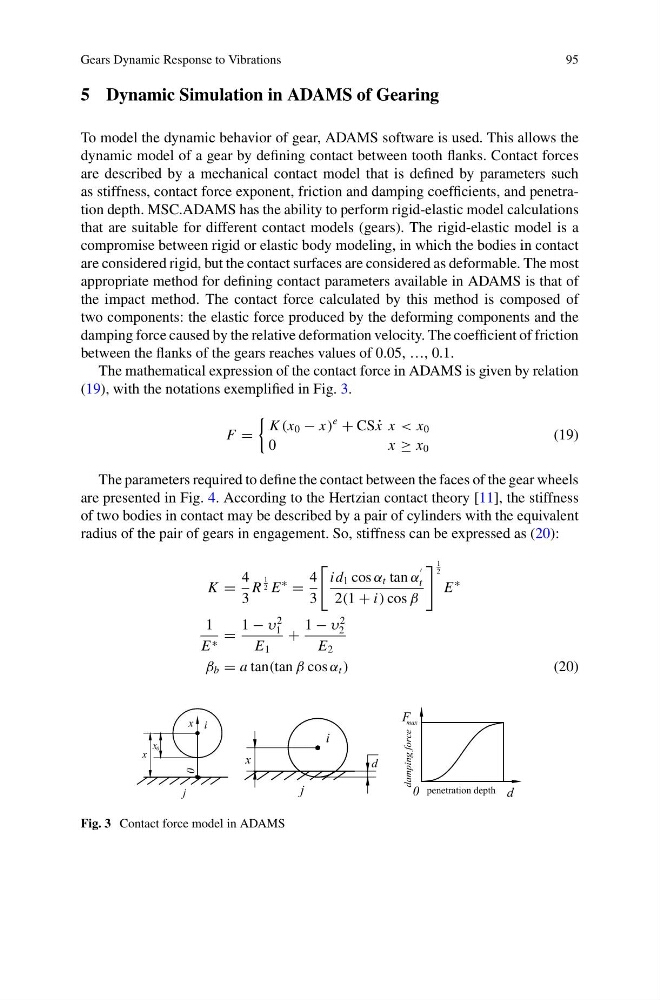
The mathematical expression of the contact force in ADAMS is given by relation
(19), with the notations exemplified in Fig. 3.
F =
K (x 0 − x)
e
+ CS ˙
x x < x 0
0
x ≥ x 0
(19)
The parameters required to define the contact between the faces of the gear wheels
are presented in Fig. 4. According to the Hertzian contact theory [11], the stiffness
of two bodies in contact may be described by a pair of cylinders with the equivalent
radius of the pair of gears in engagement. So, stiffness can be expressed as (20):
K =
4
3
R
1
2 E
∗
=
4
3
id 1 cos α t tan α
t
2(1 + i) cos β
1
2
E
∗
1
E ∗ =
1 − υ
2
1
E 1
+
1 − υ
2
2
E 2
β b = a tan(tan β cos α t )
(20)
i
j
0
x
x 0
x
i
j
x
d
d
0
F
damping force
max
penetration depth
Fig. 3 Contact force model in ADAMS
95
5 Dynamic Simulation in ADAMS of Gearing
To model the dynamic behavior of gear, ADAMS software is used. This allows the
dynamic model of a gear by defining contact between tooth flanks. Contact forces
are described by a mechanical contact model that is defined by parameters such
as stiffness, contact force exponent, friction and damping coefficients, and penetration depth. MSC.ADAMS has the ability to perform rigid-elastic model calculations
that are suitable for different contact models (gears). The rigid-elastic model is a
compromise between rigid or elastic body modeling, in which the bodies in contact
are considered rigid, but the contact surfaces are considered as deformable. The most
appropriate method for defining contact parameters available in ADAMS is that of
the impact method. The contact force calculated by this method is composed of
two components: the elastic force produced by the deforming components and the
damping force caused by the relative deformation velocity. The coefficient of friction
between the flanks of the gears reaches values of 0.05, …, 0.1.
The mathematical expression of the contact force in ADAMS is given by relation
(19), with the notations exemplified in Fig. 3.
F =
K (x 0 − x)
e
+ CS ˙
x x < x 0
0
x ≥ x 0
(19)
The parameters required to define the contact between the faces of the gear wheels
are presented in Fig. 4. According to the Hertzian contact theory [11], the stiffness
of two bodies in contact may be described by a pair of cylinders with the equivalent
radius of the pair of gears in engagement. So, stiffness can be expressed as (20):
K =
4
3
R
1
2 E
∗
=
4
3
id 1 cos α t tan α
t
2(1 + i) cos β
1
2
E
∗
1
E ∗ =
1 − υ
2
1
E 1
+
1 − υ
2
2
E 2
β b = a tan(tan β cos α t )
(20)
i
j
0
x
x 0
x
i
j
x
d
d
0
F
damping force
max
penetration depth
Fig. 3 Contact force model in ADAMS