

Improving the Accuracy of Estimates of the Frequencies …
89
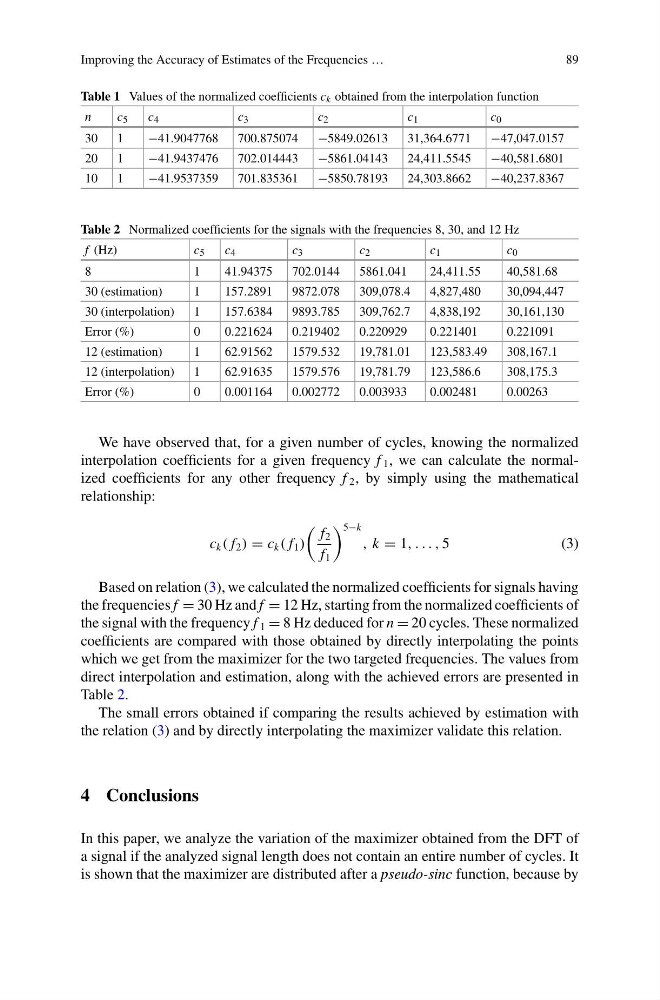
Table 1 Values of the normalized coefficients c k obtained from the interpolation function
n
c 5
c 4
c 3
c 2
c 1
c 0
30
1
−41.9047768
700.875074
−5849.02613
31,364.6771
−47,047.0157
20
1
−41.9437476
702.014443
−5861.04143
24,411.5545
−40,581.6801
10
1
−41.9537359
701.835361
−5850.78193
24,303.8662
−40,237.8367
Table 2 Normalized coefficients for the signals with the frequencies 8, 30, and 12 Hz
f (Hz)
c 5
c 4
c 3
c 2
c 1
c 0
8
1
41.94375
702.0144
5861.041
24,411.55
40,581.68
30 (estimation)
1
157.2891
9872.078
309,078.4
4,827,480
30,094,447
30 (interpolation)
1
157.6384
9893.785
309,762.7
4,838,192
30,161,130
Error (%)
0
0.221624
0.219402
0.220929
0.221401
0.221091
12 (estimation)
1
62.91562
1579.532
19,781.01
123,583.49
308,167.1
12 (interpolation)
1
62.91635
1579.576
19,781.79
123,586.6
308,175.3
Error (%)
0
0.001164
0.002772
0.003933
0.002481
0.00263
We have observed that, for a given number of cycles, knowing the normalized
interpolation coefficients for a given frequency f 1 , we can calculate the normalized coefficients for any other frequency f 2 , by simply using the mathematical
relationship:
c k ( f 2 ) = c k ( f 1 )
f 2
f 1
5−k
, k = 1, . . . , 5
( 3 )
Based on relation (3), we calculated the normalized coefficients for signals having
the frequencies f = 30 Hz and f = 12 Hz, starting from the normalized coefficients of
the signal with the frequency f 1 = 8 Hz deduced for n = 20 cycles. These normalized
coefficients are compared with those obtained by directly interpolating the points
which we get from the maximizer for the two targeted frequencies. The values from
direct interpolation and estimation, along with the achieved errors are presented in
Table 2.
The small errors obtained if comparing the results achieved by estimation with
the relation (3) and by directly interpolating the maximizer validate this relation.
4 Conclusions
In this paper, we analyze the variation of the maximizer obtained from the DFT of
a signal if the analyzed signal length does not contain an entire number of cycles. It
is shown that the maximizer are distributed after a pseudo-sinc function, because by
89
Table 1 Values of the normalized coefficients c k obtained from the interpolation function
n
c 5
c 4
c 3
c 2
c 1
c 0
30
1
−41.9047768
700.875074
−5849.02613
31,364.6771
−47,047.0157
20
1
−41.9437476
702.014443
−5861.04143
24,411.5545
−40,581.6801
10
1
−41.9537359
701.835361
−5850.78193
24,303.8662
−40,237.8367
Table 2 Normalized coefficients for the signals with the frequencies 8, 30, and 12 Hz
f (Hz)
c 5
c 4
c 3
c 2
c 1
c 0
8
1
41.94375
702.0144
5861.041
24,411.55
40,581.68
30 (estimation)
1
157.2891
9872.078
309,078.4
4,827,480
30,094,447
30 (interpolation)
1
157.6384
9893.785
309,762.7
4,838,192
30,161,130
Error (%)
0
0.221624
0.219402
0.220929
0.221401
0.221091
12 (estimation)
1
62.91562
1579.532
19,781.01
123,583.49
308,167.1
12 (interpolation)
1
62.91635
1579.576
19,781.79
123,586.6
308,175.3
Error (%)
0
0.001164
0.002772
0.003933
0.002481
0.00263
We have observed that, for a given number of cycles, knowing the normalized
interpolation coefficients for a given frequency f 1 , we can calculate the normalized coefficients for any other frequency f 2 , by simply using the mathematical
relationship:
c k ( f 2 ) = c k ( f 1 )
f 2
f 1
5−k
, k = 1, . . . , 5
( 3 )
Based on relation (3), we calculated the normalized coefficients for signals having
the frequencies f = 30 Hz and f = 12 Hz, starting from the normalized coefficients of
the signal with the frequency f 1 = 8 Hz deduced for n = 20 cycles. These normalized
coefficients are compared with those obtained by directly interpolating the points
which we get from the maximizer for the two targeted frequencies. The values from
direct interpolation and estimation, along with the achieved errors are presented in
Table 2.
The small errors obtained if comparing the results achieved by estimation with
the relation (3) and by directly interpolating the maximizer validate this relation.
4 Conclusions
In this paper, we analyze the variation of the maximizer obtained from the DFT of
a signal if the analyzed signal length does not contain an entire number of cycles. It
is shown that the maximizer are distributed after a pseudo-sinc function, because by