

93
Select residues that are appropriate for cysteine mutagenesis
(or mutagenesis to an appropriate residue). Note that this prediction does not account for any disruption of binding core function
associated with chemical labeling. Therefore, a residue that yields
the largest predicted dynamic range may not necessarily yield the
best sensor, as the residue may have some structural or functional
importance, which may be disrupted with mutagenesis. Residues
with side chains oriented toward the solvent, or that are not a part
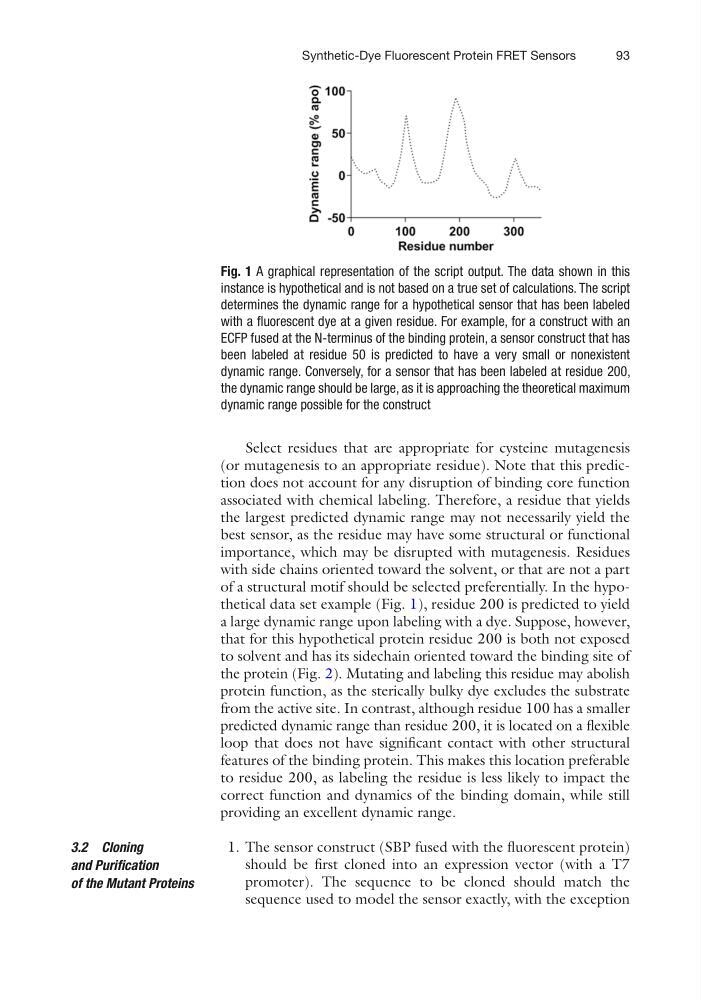
of a structural motif should be selected preferentially. In the hypothetical data set example (Fig. 1), residue 200 is predicted to yield
a large dynamic range upon labeling with a dye. Suppose, however,
that for this hypothetical protein residue 200 is both not exposed
to solvent and has its sidechain oriented toward the binding site of
the protein (Fig. 2). Mutating and labeling this residue may abolish
protein function, as the sterically bulky dye excludes the substrate
from the active site. In contrast, although residue 100 has a smaller
predicted dynamic range than residue 200, it is located on a flexible
loop that does not have significant contact with other structural
features of the binding protein. This makes this location preferable
to residue 200, as labeling the residue is less likely to impact the
correct function and dynamics of the binding domain, while still
providing an excellent dynamic range.
1. The sensor construct (SBP fused with the fluorescent protein)
should be first cloned into an expression vector (with a T7
promoter). The sequence to be cloned should match the
sequence used to model the sensor exactly, with the exception
3.2 Cloning
and Purification
of the Mutant Proteins
Fig. 1 A graphical representation of the script output. The data shown in this
instance is hypothetical and is not based on a true set of calculations. The script
determines the dynamic range for a hypothetical sensor that has been labeled
with a fluorescent dye at a given residue. For example, for a construct with an
ECFP fused at the N-terminus of the binding protein, a sensor construct that has
been labeled at residue 50 is predicted to have a very small or nonexistent
dynamic range. Conversely, for a sensor that has been labeled at residue 200,
the dynamic range should be large, as it is approaching the theoretical maximum
dynamic range possible for the construct
Synthetic-Dye Fluorescent Protein FRET Sensors
Select residues that are appropriate for cysteine mutagenesis
(or mutagenesis to an appropriate residue). Note that this prediction does not account for any disruption of binding core function
associated with chemical labeling. Therefore, a residue that yields
the largest predicted dynamic range may not necessarily yield the
best sensor, as the residue may have some structural or functional
importance, which may be disrupted with mutagenesis. Residues
with side chains oriented toward the solvent, or that are not a part
of a structural motif should be selected preferentially. In the hypothetical data set example (Fig. 1), residue 200 is predicted to yield
a large dynamic range upon labeling with a dye. Suppose, however,
that for this hypothetical protein residue 200 is both not exposed
to solvent and has its sidechain oriented toward the binding site of
the protein (Fig. 2). Mutating and labeling this residue may abolish
protein function, as the sterically bulky dye excludes the substrate
from the active site. In contrast, although residue 100 has a smaller
predicted dynamic range than residue 200, it is located on a flexible
loop that does not have significant contact with other structural
features of the binding protein. This makes this location preferable
to residue 200, as labeling the residue is less likely to impact the
correct function and dynamics of the binding domain, while still
providing an excellent dynamic range.
1. The sensor construct (SBP fused with the fluorescent protein)
should be first cloned into an expression vector (with a T7
promoter). The sequence to be cloned should match the
sequence used to model the sensor exactly, with the exception
3.2 Cloning
and Purification
of the Mutant Proteins
Fig. 1 A graphical representation of the script output. The data shown in this
instance is hypothetical and is not based on a true set of calculations. The script
determines the dynamic range for a hypothetical sensor that has been labeled
with a fluorescent dye at a given residue. For example, for a construct with an
ECFP fused at the N-terminus of the binding protein, a sensor construct that has
been labeled at residue 50 is predicted to have a very small or nonexistent
dynamic range. Conversely, for a sensor that has been labeled at residue 200,
the dynamic range should be large, as it is approaching the theoretical maximum
dynamic range possible for the construct
Synthetic-Dye Fluorescent Protein FRET Sensors