

45
is performed such that the original N- and C-termini of the protein
is linked by peptide linker of appropriate length and “opened up”
at a different point in the gene to yield new N- and C-termini at
which the insert gene can be inserted into the acceptor gene.
Previous studies suggest that the sequence space accessed by combining circular permutation with random domain insertion is rich
in active switches with very large differences in activity between
their “on” and “off” states [7, 14]. Circular permutation libraries
can be created by PCR on a plasmid containing a tandem repeat of
the gene joined by DNA encoding the linker between the N- and
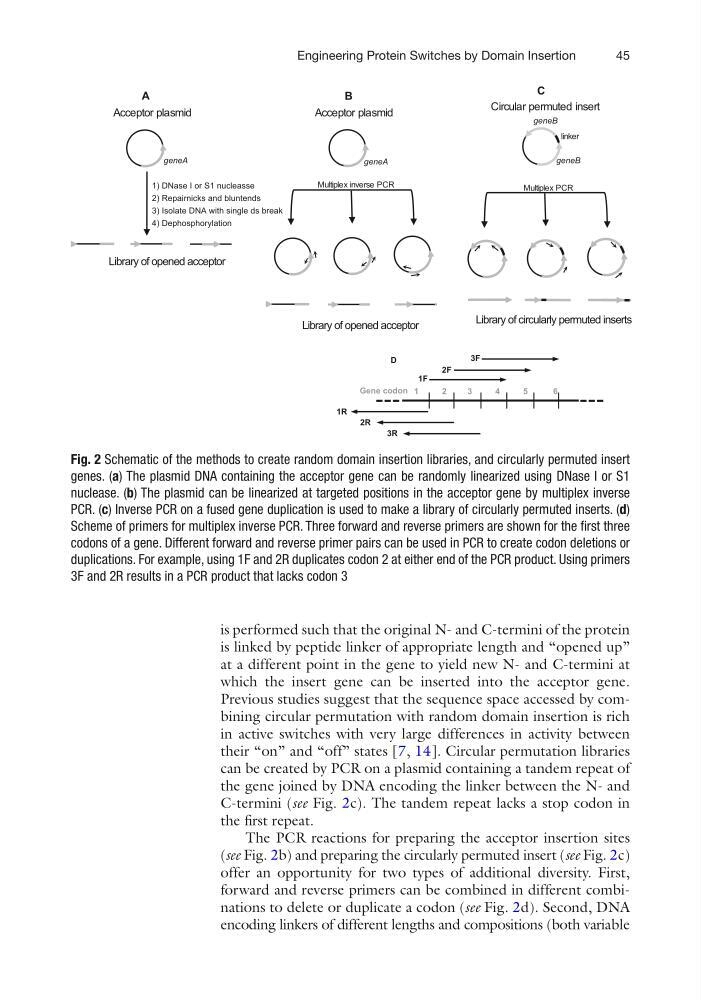
C-termini (see Fig. 2c). The tandem repeat lacks a stop codon in
the first repeat.
The PCR reactions for preparing the acceptor insertion sites
(see Fig. 2b) and preparing the circularly permuted insert (see Fig. 2c)
offer an opportunity for two types of additional diversity. First,
forward and reverse primers can be combined in different combinations to delete or duplicate a codon (see Fig. 2d). Second, DNA
encoding linkers of different lengths and compositions (both variable
1) DNase I or S1 nucleasse
2) Repairnicks and bluntends
3) Isolate DNA with single ds break
4) Dephosphorylation
Acceptor plasmid
geneA
Library of opened acceptor
Library of opened acceptor
Library of circularly permuted inserts
A
Multiplex inverse PCR
Acceptor plasmid
geneA
B
Multiplex PCR
Circular permuted insert
linker
geneB
geneB
C
1
2
3
4
5
6
Gene codon
1F
2F
3F
1R
2R
3R
D
Fig. 2 Schematic of the methods to create random domain insertion libraries, and circularly permuted insert
genes. (a) The plasmid DNA containing the acceptor gene can be randomly linearized using DNase I or S1
nuclease. (b) The plasmid can be linearized at targeted positions in the acceptor gene by multiplex inverse
PCR. (c) Inverse PCR on a fused gene duplication is used to make a library of circularly permuted inserts. (d)
Scheme of primers for multiplex inverse PCR. Three forward and reverse primers are shown for the first three
codons of a gene. Different forward and reverse primer pairs can be used in PCR to create codon deletions or
duplications. For example, using 1F and 2R duplicates codon 2 at either end of the PCR product. Using primers
3F and 2R results in a PCR product that lacks codon 3
Engineering Protein Switches by Domain Insertion
is performed such that the original N- and C-termini of the protein
is linked by peptide linker of appropriate length and “opened up”
at a different point in the gene to yield new N- and C-termini at
which the insert gene can be inserted into the acceptor gene.
Previous studies suggest that the sequence space accessed by combining circular permutation with random domain insertion is rich
in active switches with very large differences in activity between
their “on” and “off” states [7, 14]. Circular permutation libraries
can be created by PCR on a plasmid containing a tandem repeat of
the gene joined by DNA encoding the linker between the N- and
C-termini (see Fig. 2c). The tandem repeat lacks a stop codon in
the first repeat.
The PCR reactions for preparing the acceptor insertion sites
(see Fig. 2b) and preparing the circularly permuted insert (see Fig. 2c)
offer an opportunity for two types of additional diversity. First,
forward and reverse primers can be combined in different combinations to delete or duplicate a codon (see Fig. 2d). Second, DNA
encoding linkers of different lengths and compositions (both variable
1) DNase I or S1 nucleasse
2) Repairnicks and bluntends
3) Isolate DNA with single ds break
4) Dephosphorylation
Acceptor plasmid
geneA
Library of opened acceptor
Library of opened acceptor
Library of circularly permuted inserts
A
Multiplex inverse PCR
Acceptor plasmid
geneA
B
Multiplex PCR
Circular permuted insert
linker
geneB
geneB
C
1
2
3
4
5
6
Gene codon
1F
2F
3F
1R
2R
3R
D
Fig. 2 Schematic of the methods to create random domain insertion libraries, and circularly permuted insert
genes. (a) The plasmid DNA containing the acceptor gene can be randomly linearized using DNase I or S1
nuclease. (b) The plasmid can be linearized at targeted positions in the acceptor gene by multiplex inverse
PCR. (c) Inverse PCR on a fused gene duplication is used to make a library of circularly permuted inserts. (d)
Scheme of primers for multiplex inverse PCR. Three forward and reverse primers are shown for the first three
codons of a gene. Different forward and reverse primer pairs can be used in PCR to create codon deletions or
duplications. For example, using 1F and 2R duplicates codon 2 at either end of the PCR product. Using primers
3F and 2R results in a PCR product that lacks codon 3
Engineering Protein Switches by Domain Insertion