

44
can encode for the input or output domain. These fusion proteins
are then subjected to selections and/or screens to find a chimeric
protein that possesses signal-dependent behavior. Using this strategy our lab has produced several examples of ligand-activated protein switches [1, 5, 7–18]. In one example, we created a
ligand-activated enzyme with a 600-fold change in enzyme activity in response ligand binding [7].
One of the major steps in constructing protein switches by
directed evolution is creating diversity in the ways you fuse the two
domains. Random insertion libraries can be created using DNase I
or S1 nuclease to generate a single double-stranded break throughout
the plasmid that encodes the acceptor gene [7, 10, 12] (see Fig. 2a).
However, some drawbacks of using these nuclease-digestion methods include the generation of insertions outside the gene- coding
sequence and out-of-frame or inverted insertions, resulting in a
significant fraction of the library encoding undesired and nonfunctional library members. Therefore, this strategy is best combined
with a robust screening/selection system. In comparison to these
nuclease methods, multiplex inverse PCR affords much greater
control over the library composition. In inverse PCR, abutting
primers are designed to “open up” a plasmid to facilitate domain
insertion (see Fig. 2b). A separate inverse PCR reaction is performed for each desired insertion site, each of which requires a
unique set of primers (see Fig. 2d). One feature of this method is
the ability to use it for both random domain insertion (i.e., inverse
PCR at each codon) or for insertions at sites chosen by rational
design (i.e., achieved by inverse PCR only at designed positions).
Another layer of diversity can be created by circular permutation
of the insert gene, thus increasing the overall diversity of the
protein switch library. Conceptually, circular permutation is changing the intramolecular order of amino acids. Circular permutation
Acceptor gene
Insert gene
Gene fusion
Input domain
Output domain
Switch protein
+
A
B
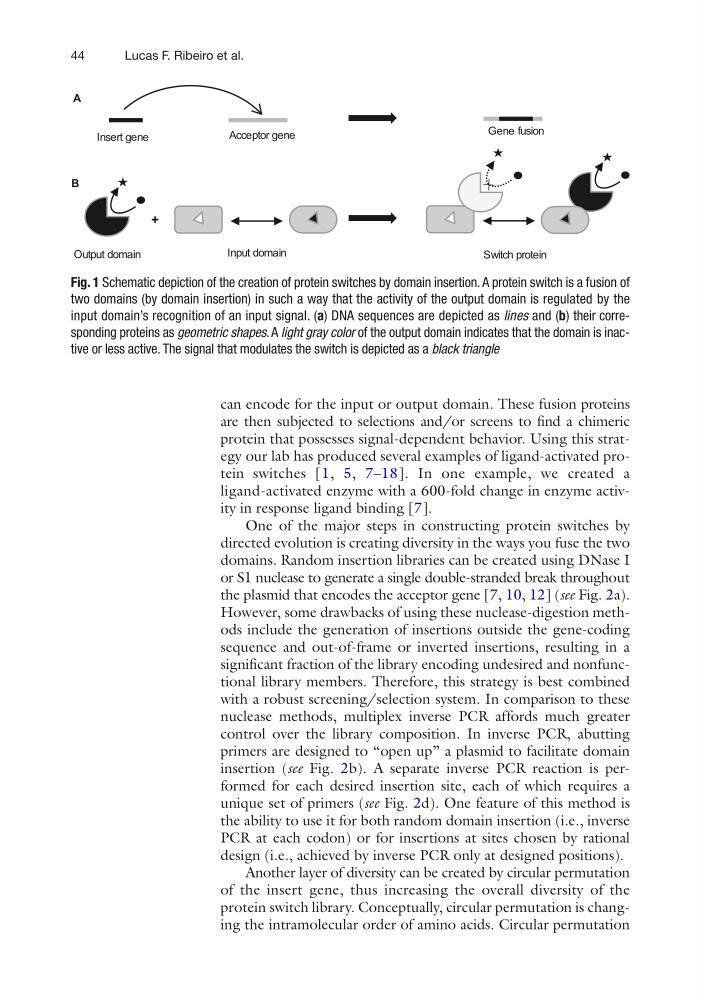
Fig. 1 Schematic depiction of the creation of protein switches by domain insertion. A protein switch is a fusion of
two domains (by domain insertion) in such a way that the activity of the output domain is regulated by the
input domain’s recognition of an input signal. (a) DNA sequences are depicted as lines and (b) their corresponding proteins as geometric shapes. A light gray color of the output domain indicates that the domain is inactive or less active. The signal that modulates the switch is depicted as a black triangle
Lucas F. Ribeiro et al.
can encode for the input or output domain. These fusion proteins
are then subjected to selections and/or screens to find a chimeric
protein that possesses signal-dependent behavior. Using this strategy our lab has produced several examples of ligand-activated protein switches [1, 5, 7–18]. In one example, we created a
ligand-activated enzyme with a 600-fold change in enzyme activity in response ligand binding [7].
One of the major steps in constructing protein switches by
directed evolution is creating diversity in the ways you fuse the two
domains. Random insertion libraries can be created using DNase I
or S1 nuclease to generate a single double-stranded break throughout
the plasmid that encodes the acceptor gene [7, 10, 12] (see Fig. 2a).
However, some drawbacks of using these nuclease-digestion methods include the generation of insertions outside the gene- coding
sequence and out-of-frame or inverted insertions, resulting in a
significant fraction of the library encoding undesired and nonfunctional library members. Therefore, this strategy is best combined
with a robust screening/selection system. In comparison to these
nuclease methods, multiplex inverse PCR affords much greater
control over the library composition. In inverse PCR, abutting
primers are designed to “open up” a plasmid to facilitate domain
insertion (see Fig. 2b). A separate inverse PCR reaction is performed for each desired insertion site, each of which requires a
unique set of primers (see Fig. 2d). One feature of this method is
the ability to use it for both random domain insertion (i.e., inverse
PCR at each codon) or for insertions at sites chosen by rational
design (i.e., achieved by inverse PCR only at designed positions).
Another layer of diversity can be created by circular permutation
of the insert gene, thus increasing the overall diversity of the
protein switch library. Conceptually, circular permutation is changing the intramolecular order of amino acids. Circular permutation
Acceptor gene
Insert gene
Gene fusion
Input domain
Output domain
Switch protein
+
A
B
Fig. 1 Schematic depiction of the creation of protein switches by domain insertion. A protein switch is a fusion of
two domains (by domain insertion) in such a way that the activity of the output domain is regulated by the
input domain’s recognition of an input signal. (a) DNA sequences are depicted as lines and (b) their corresponding proteins as geometric shapes. A light gray color of the output domain indicates that the domain is inactive or less active. The signal that modulates the switch is depicted as a black triangle
Lucas F. Ribeiro et al.