

330
2. Design PCR primers to amplify protein domains with appropriate “overhang” sequences and AarI recognition sequences that
will result in the multi-part assembly of a domain-shuffled gene.
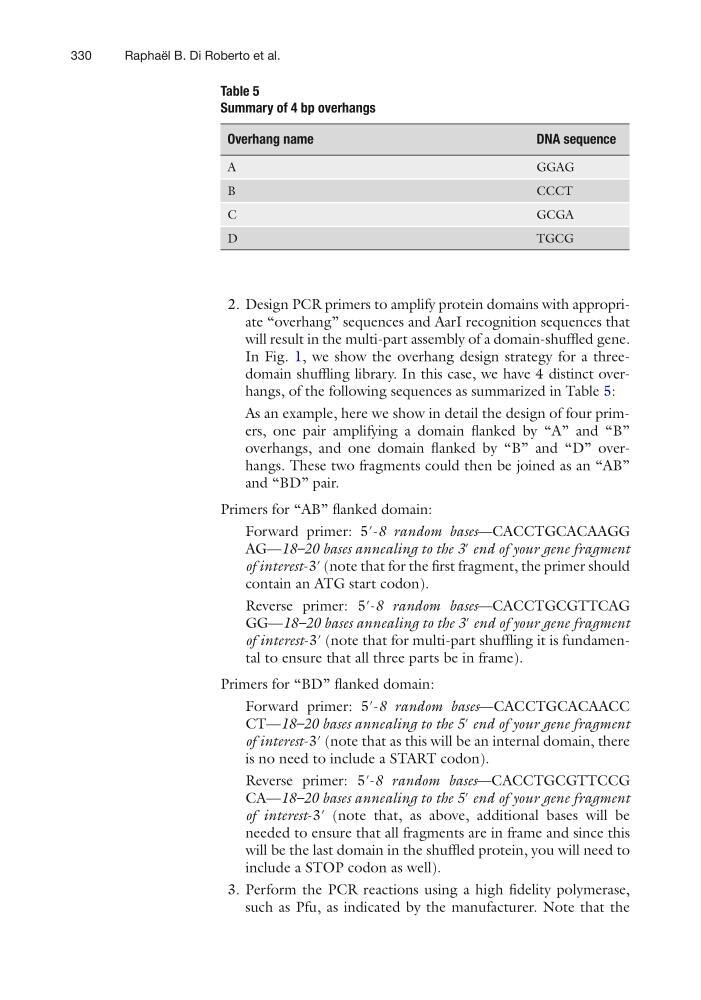
In Fig. 1, we show the overhang design strategy for a threedomain shuffling library. In this case, we have 4 distinct overhangs, of the following sequences as summarized in Table 5:
As an example, here we show in detail the design of four primers, one pair amplifying a domain flanked by “A” and “B”
overhangs, and one domain flanked by “B” and “D” overhangs. These two fragments could then be joined as an “AB”
and “BD” pair.
Primers for “AB” flanked domain:
Forward primer: 5′-8 random bases—CACCTGCACAAGG
AG—18–20 bases annealing to the 3′ end of your gene fragment
of interest-3′ (note that for the first fragment, the primer should
contain an ATG start codon).
Reverse primer: 5′-8 random bases—CACCTGCGTTCAG
GG—18–20 bases annealing to the 3′ end of your gene fragment
of interest-3′ (note that for multi-part shuffling it is fundamental to ensure that all three parts be in frame).
Primers for “BD” flanked domain:
Forward primer: 5′-8 random bases—CACCTGCACAACC
CT—18–20 bases annealing to the 5′ end of your gene fragment
of interest-3′ (note that as this will be an internal domain, there
is no need to include a START codon).
Reverse primer: 5′-8 random bases—CACCTGCGTTCCG
CA—18–20 bases annealing to the 5′ end of your gene fragment
of interest-3′ (note that, as above, additional bases will be
needed to ensure that all fragments are in frame and since this
will be the last domain in the shuffled protein, you will need to
include a STOP codon as well).
3. Perform the PCR reactions using a high fidelity polymerase,
such as Pfu, as indicated by the manufacturer. Note that the
Table 5
Summary of 4 bp overhangs
Overhang name
DNA sequence
A
GGAG
B
CCCT
C
GCGA
D
TGCG
Raphaël B. Di Roberto et al.
2. Design PCR primers to amplify protein domains with appropriate “overhang” sequences and AarI recognition sequences that
will result in the multi-part assembly of a domain-shuffled gene.
In Fig. 1, we show the overhang design strategy for a threedomain shuffling library. In this case, we have 4 distinct overhangs, of the following sequences as summarized in Table 5:
As an example, here we show in detail the design of four primers, one pair amplifying a domain flanked by “A” and “B”
overhangs, and one domain flanked by “B” and “D” overhangs. These two fragments could then be joined as an “AB”
and “BD” pair.
Primers for “AB” flanked domain:
Forward primer: 5′-8 random bases—CACCTGCACAAGG
AG—18–20 bases annealing to the 3′ end of your gene fragment
of interest-3′ (note that for the first fragment, the primer should
contain an ATG start codon).
Reverse primer: 5′-8 random bases—CACCTGCGTTCAG
GG—18–20 bases annealing to the 3′ end of your gene fragment
of interest-3′ (note that for multi-part shuffling it is fundamental to ensure that all three parts be in frame).
Primers for “BD” flanked domain:
Forward primer: 5′-8 random bases—CACCTGCACAACC
CT—18–20 bases annealing to the 5′ end of your gene fragment
of interest-3′ (note that as this will be an internal domain, there
is no need to include a START codon).
Reverse primer: 5′-8 random bases—CACCTGCGTTCCG
CA—18–20 bases annealing to the 5′ end of your gene fragment
of interest-3′ (note that, as above, additional bases will be
needed to ensure that all fragments are in frame and since this
will be the last domain in the shuffled protein, you will need to
include a STOP codon as well).
3. Perform the PCR reactions using a high fidelity polymerase,
such as Pfu, as indicated by the manufacturer. Note that the
Table 5
Summary of 4 bp overhangs
Overhang name
DNA sequence
A
GGAG
B
CCCT
C
GCGA
D
TGCG
Raphaël B. Di Roberto et al.